
We are a professional manufacturer of organic fertilizer equipment and a customized service provider for fertilizer production lines
-
NO.313, Wanshan Road, Xingyang City, Zhengzhou City, Henan Province, China
Company Address
-
Call Us: +86-18703630069
(Sat - Thursday)
-
inquiry@hqhifertilizermachine.com
Our Email
Horizontal Mixer


Equipment Introduction
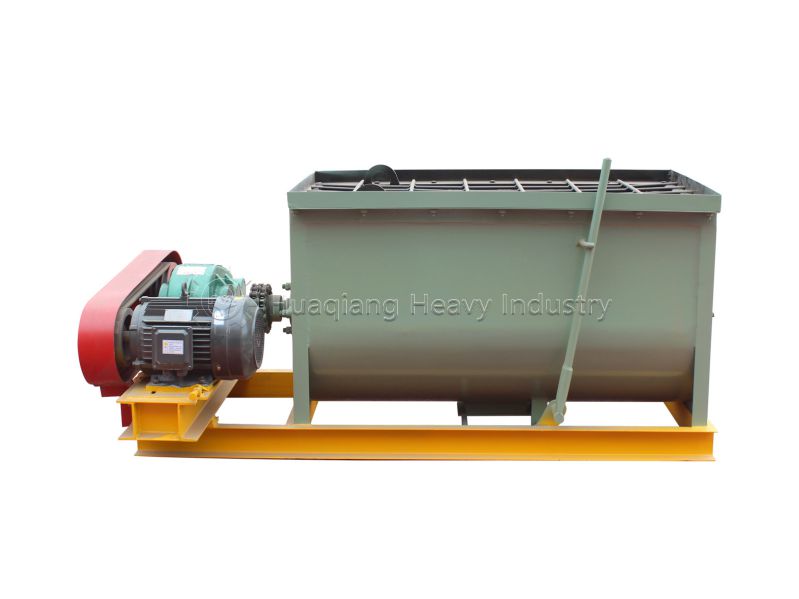
The horizontal ribbon mixer, also known as a horizontal agitator, is a mainstream intermittent homogenizing mixing equipment in the powder engineering field. Standardized and mass-produced by equipment manufacturers such as Zhengzhou Huaqiang Heavy Industry, its core technology relies on a double-layer counter-rotating spiral ribbon to achieve material convection and circulation mixing. It boasts five core advantages: high mixing uniformity, low material residue, wide material compatibility, gentle low-speed mixing that does not damage particles, and simple maintenance.
Key Performance Features:
- High Mixing Uniformity: Batch mixing coefficient of variation (CV) ≤ 5%, uniformity up to 97%~99%, capable of handling multi-component materials with density differences ≤ 10 times;
- Low Residue Optimization: The gap between the screw ribbon and the cylinder wall can be adjusted to near zero, with a large bottom unloading door, resulting in a residue of < 0.5%;
- Gentle Agitation: Main shaft speed is generally below 45 r/min, resulting in low shear force and a breakage rate of < 5% for fragile particles;
- Strong Functional Expandability: Can be equipped with jackets (heating/cooling), top spray system, vacuum feeding, pneumatic dust removal, and frequency conversion speed regulation;
- Low Installation Threshold: Minimal operating vibration, no need for heavy concrete foundation, carbon steel/304/316L stainless steel materials can be customized as needed.
Structural Components of the Equipment
The horizontal ribbon mixer mainly consists of the following five systems:
- Mixing Container (Cylinder)
Typically a U-shaped elongated structure with a smooth inner wall to reduce material movement resistance. Some models have a jacket on the outer wall of the cylinder for introducing heating or cooling media to achieve temperature control. The cylinder cover can be designed as arched (pressure-bearing) or fully open (easy to clean). Considering the characteristics of organic fertilizer raw materials, the inner wall of the cylinder is often lined with 304 stainless steel or high-molecular-weight polyethylene plate for corrosion resistance and to prevent sticking.
- Mixing Components (Core Working Parts)
Constitutes double or triple-layer spiral blades (ribbons) mounted on a horizontal main shaft. The spiral directions of the inner and outer layers of the ribbon are opposite:
Outer spiral ribbon: gathers material from both sides of the cylinder towards the center.
Inner spiral ribbon: conveys material from the center to both sides.
The edges of the ribbon blades are usually overlaid with wear-resistant alloy to resist sand and gravel erosion.
- Transmission System
Composed of a motor, reducer, pulleys, V-belts, and couplings. The system employs a belt-driven cycloidal reducer, whose elastic connection offers the advantage of protecting transmission components under overload conditions. The motor and mixing shaft are directly connected via a cycloidal pinwheel reducer, resulting in a simple structure, high operational reliability, and convenient maintenance.
- Discharge Device: A pneumatic or manual large-opening arc-shaped discharge port with a discharge angle greater than 70 degrees is installed at the bottom. Powder materials utilize a pneumatic large-opening structure, offering advantages such as fast discharge and no residue; high-fineness materials or semi-fluid materials use a manual or pneumatic butterfly valve.
- Auxiliary Systems: Includes a shaft end packing seal device, a liquid injection device (for injecting liquid during solid-liquid mixing), and a flying knife device (for special materials).
Applications of the Equipment
| Application Scenario | Equipment Characteristics | Recommended Models |
|---|---|---|
| Fertilizer Production Line | Large capacity, high continuous operation stability, suitable for compound fertilizer, organic fertilizer and mixed fertilizer crushing | LP1000 / LP1500 |
| Small‑Medium Fertilizer Plant | Compact structure, easy installation and maintenance, suitable for medium and small batch production | LP600 / LP800 |
| Straw & Biomass Crushing | Strong adaptability to fibrous materials, adjustable discharge size, suitable for straw, wood chips and garden waste | LP800 / LP1000 |
| Chemical & Building Material | Wear‑resistant design, stable particle size, suitable for chemical raw materials, building materials and medium‑hard ores | LP1000 / LP1500 |
| Laboratory & Test Production | Small footprint, easy to clean, suitable for material testing and small batch trial production | LP600 |
Equipment Working Principle
After the equipment is started, the rotor drives the inner and outer double-layer helical ribbons to rotate.
- The inner helical ribbon pushes the material from the center to both sides.
- The outer helical ribbon gathers the material from both sides towards the center.
Under the action of the double-layer helical ribbons, the material forms bidirectional convection and is continuously sheared, penetrated, and diffused during rotation, thus achieving a highly uniform mixing effect in a very short time (usually 3-10 minutes).
Raw Materials for the Equipment
This equipment can process the following types of raw materials:
| Raw Material Type | Specific Materials |
|---|---|
| Powder Materials | Fertilizer powder, dry‑mix mortar, ceramic powder, pigments, dyes, pharmaceutical raw and auxiliary materials |
| Granular Materials | Compound fertilizer granules, plastic pellets, feed pellets, refractory granules |
| Paste / Viscous Materials | Fermented organic fertilizer, putty paste, real‑stone paint, adhesives, food sauces |
| Solid‑liquid Mixtures | Powder + binder, powder + microbial agent, powder + oily additives |
Raw Material Requirements:
- Material Moisture Content: It can adapt to higher moisture content, but materials with excessive viscosity are difficult to clean;
- Avoid mixing in large stones, iron blocks, and other hard objects to prevent damage to the mixing blades;
- For materials with high fiber content and significant density differences, applicability needs to be assessed.
Equipment Operation and Maintenance Methods
- Installation and Commissioning
1) Construct the foundation according to the foundation drawing, reserving foundation holes (no particularly strong concrete foundation is required);
2) After installation, check whether the bolts in all parts are loose and whether the main unit’s door is secure;
3) Install the power supply and control switch according to the equipment’s power configuration;
4) After inspection, conduct a no-load test run. Production can only begin after normal operation.
- Operating Procedures
1) Start-up: Must be started under no-load conditions. Starting with material is strictly prohibited to avoid overloading and damaging the motor;
2) Inspection: Before starting, check all bolts, bearing seats, reducer oil level, and rotation direction;
3) Feeding: Large stones, iron blocks, and other hard objects must not be mixed into the material;
4) Shutdown: Before stopping, stop feeding first, and stop the machine only after the material in the mixing chamber has been emptied. Stopping the machine with material is strictly prohibited.
- Daily Maintenance
1) Check the tightness of bolts and the wear of vulnerable parts every shift;
2) Regularly clean residual material in the mixing chamber to prevent clumping;
3) Check the tension of the V-belt and adjust or replace it in time;
4) Stop the machine immediately for inspection if the bearing oil temperature rises.
Equipment Application in Production Lines
In organic fertilizer or dry powder production lines, the horizontal ribbon mixer is typically located after the automatic batching scale and before the granulator or packaging machine. It plays a crucial role in connecting these processes, ensuring that the raw material components entering subsequent stages are completely consistent, which is a key factor in guaranteeing product quality stability.
Equipment Application in Production Lines
- Core Position in Organic Fertilizer and Compound Fertilizer Production Lines
The horizontal ribbon mixer is the key link between the crushing and granulation processes in organic fertilizer and compound fertilizer production lines. In the entire fertilizer production line, the horizontal mixer is usually located after crushing and screening and before the granulator.
Core Function: It precisely homogenizes the crushed organic powder, nitrogen, phosphorus, and potassium fertilizer powder, trace elements, and microbial agents, providing stable and nutrient-uniform raw materials for the granulation process, directly determining the pelleting rate and granule strength.
- Automated Production Line Configuration
The equipment boasts a high degree of automation and can be integrated with batching machines, conveyors, and granulators to form a fully automated production line. This achieves continuous feeding, intelligent mixing, and quantitative discharge, supporting 24/7 uninterrupted production and fully adapting to the needs of large-scale fertilizer processing.
- Key Process Indicators
Mixing Uniformity: The coefficient of variation (CV) can be stably controlled within 5%, far exceeding the 10%–15% of vertical models.
Residual Rate: Utilizing the reverse thrust of the screw conveyor, materials can be completely discharged within 3–5 seconds, with a residual rate of less than 0.5%, effectively preventing cross-contamination between different batches of formulations.
Single Batch Mixing Time: 3–8 minutes
- Multi-Process Integration Capability
The equipment can simultaneously complete multiple processes such as material dispersal, microbial inoculation, and moisture adjustment. It is capable of handling both dry powder proportioning and semi-wet material mixing.
Common Equipment Problems and Solutions
| Common Faults | Cause Description | Solutions |
|---|---|---|
| Ribbon Fall‑off or Wear | Severe wear after long‑time operation; mismatched material hardness & viscosity; unreasonable assembly clearance | Inspect ribbon wear condition; replace with high‑wear‑resistant ribbon when over‑worn; calibrate clearance between ribbon & shell; fasten fixing bolts periodically to prevent falling‑off |
| Motor Failure | Circuit aging, short‑circuit, poor contact; long‑term overload operation; damaged winding & bearing | Inspect circuits, switches and terminals thoroughly; repair circuit faults; test motor operating parameters; replace motor for severe damage; avoid long‑time overload operation |
| Transmission Device Fault | Worn & loose transmission connectors; aged parts; blocked power transmission, leading to slow or stalled ribbon rotation | Check all transmission components; replace worn key joints & connectors; fasten transmission parts regularly to guarantee stable power transfer |
| Bearing Overheating | Insufficient or deteriorated lubricant; worn bearing; bent main shaft; unbalanced rotor; over‑tensioned drive belt | Refill or replace high‑temperature grease; replace damaged bearing; calibrate main shaft straightness & rotor balance; adjust belt tension to rated range |
| Equipment Vibration & Abnormal Noise | Hard foreign objects inside; loose chain; cracked/deformed rotor; uneven installation; loose anchor bolts; reducer malfunction | Stop machine immediately and clean foreign objects; adjust chain tension; replace aged chain; repair rotor damage; re‑level equipment and tighten anchor bolts; repair or replace faulty reducer |
| Poor Sealing, Material Leakage | Aged & damaged sealing gaskets; loose compression bolts; excessive sealing gap | Install brand‑new sealing gaskets & rings; tighten cover bolts for tight sealing; inspect seals regularly, replace aged parts to stop dust & liquid leakage |
| Sudden Shutdown, Discharge Mechanism Inactive | Over‑heavy load and overload operation; slipping drive belt; foreign jamming inside discharge & lifting mechanism | Reduce single‑batch feeding weight to avoid overload; adjust or replace worn belt; clear jamming foreign materials; replace damaged bearings and sealing parts |
| Reducer Overheating | Insufficient or degraded lubricating oil; long‑time heavy‑load running; worn & jammed internal gears and bearings | Check oil level, refill or replace dedicated reducer oil; control feeding load to avoid long‑time overload; inspect internal components, replace worn parts timely for smooth transmission |
Target Customers for the Horizontal Ribbon Mixer:
- Organic fertilizer/compound fertilizer manufacturers: Used for uniform mixing and batching of fermentation materials, fertilizer raw materials, and recycled materials;
- Feed processing companies: Used for uniform mixing of multiple components in compound feed and premixes;
- Chemical/coating companies: Used for mixing dry mortar, putty powder, stone paint, and dyes/pigments;
- Food/pharmaceutical companies: Used for GMP-grade mixing of food additives and pharmaceutical raw materials;
- Building materials companies: Used for mixing thermal insulation mortar, refractory materials, and ceramic powders;
- New energy/new materials companies: Used for precision mixing of lithium battery materials and electronic ceramic powders;
- Environmental treatment companies: Used for sludge conditioning and mixed treatment of organic waste.
The core advantages of the equipment
| Advantages | Description |
|---|---|
| High Mixing Uniformity | Double‑layer reverse ribbons create 3D convection. CV value ≤7%, micro‑proportion ratio up to 1:10000 |
| Low Residual Volume | Adjustable clearance between rotor and shell nearly zero. Large bottom door, residual rate ≤0.5% |
| Fast Mixing Speed | Single batch mixing takes only 2‑15 minutes, efficiency 6‑10 times higher than traditional equipment |
| High Loading Coefficient | Effective filling ratio reaches 60%‑80%, large single‑batch processing capacity |
| Low Crushing & Low Energy Consumption | Low‑speed main shaft operation causes minimal damage to granular materials with low unit energy consumption |
| Built‑in Crushing Function | Special rotor design breaks large agglomerates, reduces investment for pre‑crushing equipment |
| Easy Maintenance | Transmission adopts nylon shaft pins and sprockets for easy disassembly; externally‑arranged lubrication points for convenient servicing |