
In the grand scheme of modern fertilizer production, if precision mixers and roaring granulators are the beating heart, then the belt conveyor is undoubtedly the resilient “backbone” running through the entire system. Rarely the star in the spotlight, it silently carries every transfer from raw material to finished product with unparalleled reliability and universality. Today, let’s turn our attention to this indispensable “supporting actor” on the industrial stage and explore how its most fundamental form upholds the grand architecture of fertilizer manufacturing.
Core Advantages: Reliability, Efficiency, and Economy
As the most classic and widely adopted solution in material handling, the charm of the belt conveyor is rooted in its inherent strengths.
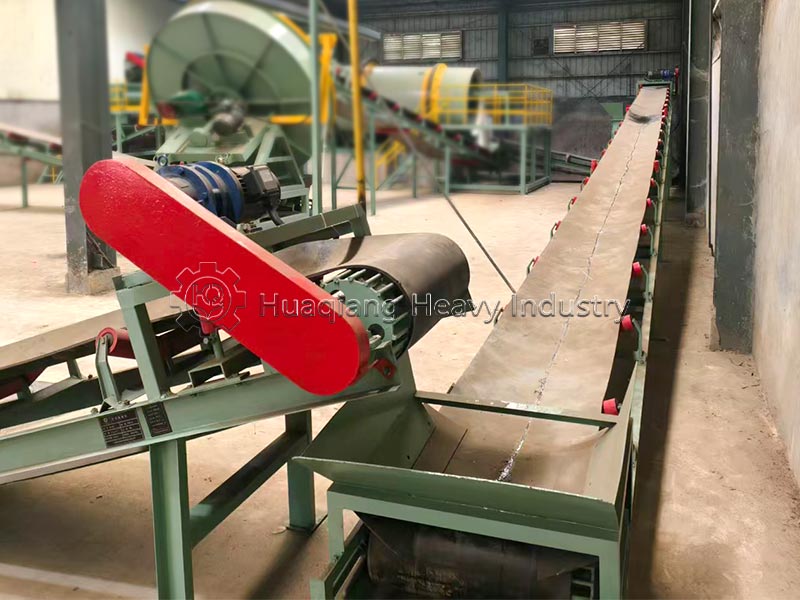
First is supreme reliability. Simple structure and mature design translate to low failure rates and stable operation. A well-designed belt conveyor system can operate 24/7 uninterrupted for years, forming the fundamental guarantee of production line continuity.
Second is exceptional conveying efficiency and capacity. The broad belt surface can handle materials ranging from fine powders to lumpy aggregates. With single-unit lengths reaching hundreds of meters, it achieves long-distance, high-volume smooth conveyance—a feat many specialized conveying devices struggle to match.
Lastly is remarkable economy. Its acquisition cost, energy consumption, and ongoing maintenance expenses are often the most competitive among similar equipment. This “high cost-effectiveness” makes it the universal choice for operations ranging from large-scale compound fertilizer plants to small organic fertilizer workshops.
Case Study: The Art of Smooth Operation
A major NPK compound fertilizer production base provides a perfect example. Its 500-meter-long mainline belt conveyor functions like an “overland river,” continuously transporting raw materials like phosphate and potash from storage to a six-story production tower. This “artery” handles nearly 70% of the plant’s solid material conveyance. Engineers specifically highlighted its enclosed design, which effectively prevents dust emission, and its variable frequency drive system, which perfectly synchronizes with upstream crushers and downstream automatic weighing feeders for precise dosing. Since commissioning, this conveyor line has ensured the efficient synergy of downstream processes like granulation, drying, and cooling through its remarkable stability.
System Synergy: The Critical Link in the Production Network
The value of the belt conveyor is fully realized in its synergistic operation with other fertilizer equipment. It is the critical link connecting individual processes:
• Coordinating with Mixers: It uniformly and continuously feeds precisely formulated raw materials into the horizontal mixer—the first step in ensuring fertilizer composition homogeneity.
• Serving Granulators: It steadily delivers blended powder to the granulator, where the stability of its feed directly impacts particle formation rate and uniformity.
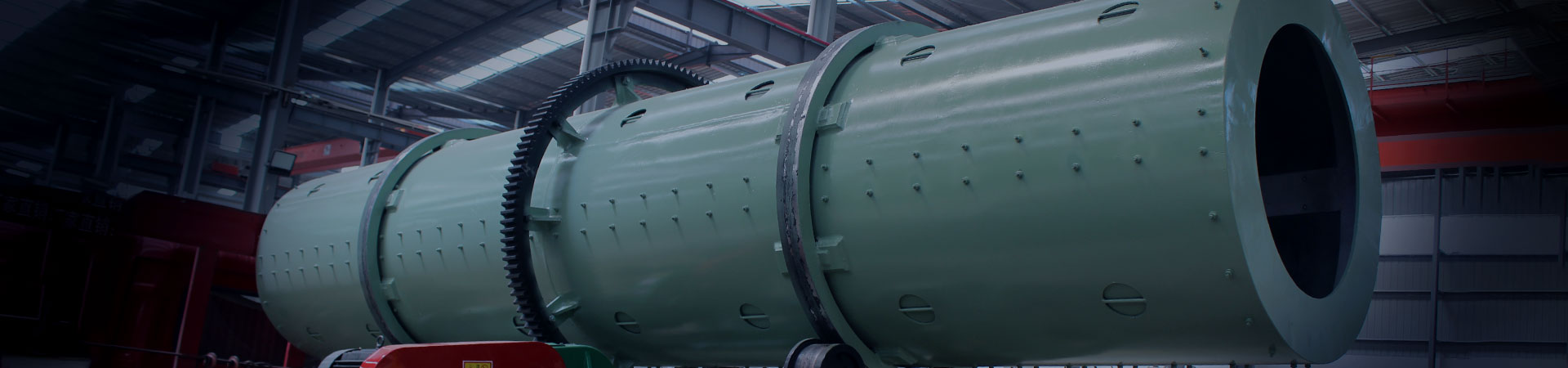
• Connecting Drying & Cooling Systems: It orderly moves moist granules into the drum fertilizer dryer and then transports the dried product to the cooler, maintaining a gentle and steady flow to prevent particle breakage.
• Feeding Packaging Lines: Finally, it delivers finished fertilizer at a constant flow rate to automatic packaging machines, completing the “last meter” of production.
In essence, this seemingly simple belt integrates “islanded” equipment like crushers, blenders, granulators, dryers, and packers into one smooth, automated production system.