

In trough-style aerobic fermentation systems for organic fertilizer production, uniform turning and efficient aeration are critical to shortening the maturation cycle and ensuring product quality. The double screws compost turner is a high-performance machine engineered to meet these demands. With its unique twin-screw mechanism, it delivers deep turning, homogeneous mixing, and effective oxygen diffusion throughout the fermentation material, serving as the central unit for rapid and consistent compost production.
Key Advantages: Deep Blending, High Efficiency & Low Energy Consumption
The double screws compost turner stands out due to its robust mechanical design and process-oriented operation, offering three major benefits:
Superior Mixing Uniformity
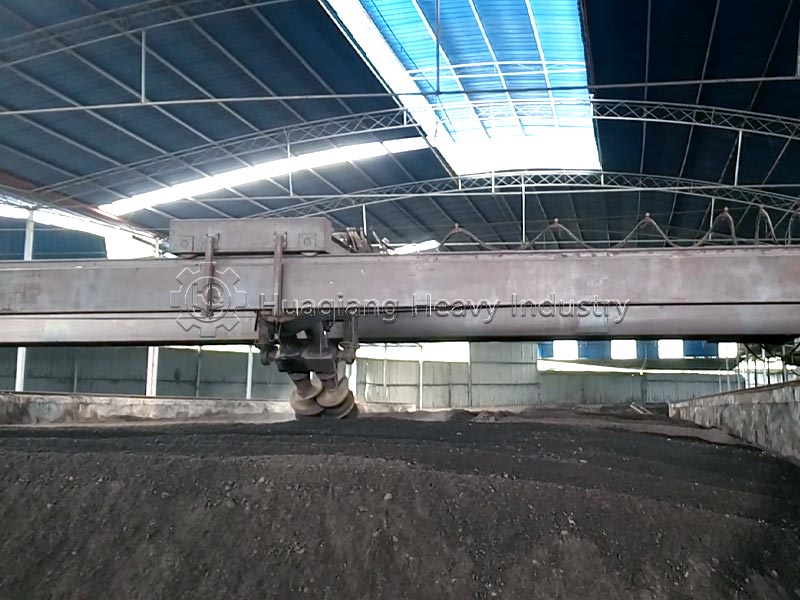
Two parallel screw shafts rotate in opposite directions, working like synchronized mechanical arms to lift, disperse, and redeposit material from the bottom and sides of the trench. This creates a continuous cross-flow movement, ensuring full-depth, homogeneous blending of the compost pile. Temperature, moisture, and microbial activity are evenly distributed, eliminating cold spots and accelerating the fermentation process.
Deep-Layer Processing Capability
The long, heavy-duty screw flights penetrate up to 2 meters deep, effectively turning and aerating the entire profile of the compost bed. This prevents anaerobic conditions at the bottom—a common issue in static or shallow-turned piles—and promotes consistent aerobic decomposition throughout the material mass.
Energy-Efficient Operation
The turning action itself provides mechanical aeration, reducing or eliminating the need for auxiliary forced-air systems. The design minimizes drag and power demand, resulting in lower energy consumption per ton of material processed compared to conventional turners or blower-dependent systems.
Integrated Role in Automated Fertilizer Production Lines
In modern composting plants, the double screws compost turner functions as an automated, intelligent component within a larger system.
Seamless Material Handling Integration
It can be synchronized with automated feeding conveyors and discharge systems, enabling continuous, unmanned operation from filling to emptying of fermentation trenches.
Real-Time Process Monitoring
The machine can be equipped with wireless temperature and oxygen sensors that provide live data to the control room, allowing for dynamic adjustment of turning frequency and travel speed based on actual compost conditions.
Environmental Compatibility
Its enclosed design and track-mounted configuration allow easy integration with building enclosures and air treatment systems, supporting odor-controlled and dust-free operation in compliance with environmental regulations.
Comparison with Other Turner Types: Selecting the Right Machine
| Feature | Double Screws (Trough) Turner | Large Wheel Compost Turner | Crawler Compost Turner |
| Primary Application | Enclosed or open fermentation troughs in factory settings. | Large-scale open windrows (long piles) on open ground. | Flexible; can work on windrows or be adapted to wide troughs. |
| Mixing Principle | Two counter-rotating screws provide intimate, homogeneous blending. | A single large rotating drum with flails lifts and throws material. | A rotating drum or flail shaft turns and crushes material. |
| Process Control | High. Enables precise control over retention time, aeration, and is easily automated. | Moderate. Dependent on windrow shape and manual scheduling. | Moderate to High. Good maneuverability for consistent turning. |
| Space & Investment | Requires investment in trough infrastructure. Higher initial cost but superior for controlled, continuous process. | Low infrastructure cost, only requires paved or compacted ground. Ideal for massive volumes. | Moderate infrastructure need. Higher machine cost due to complex crawler system. |
| Environmental Control | Excellent. Easily covered and connected to biofilters for full odor and emission control. | Poor. Open-air operation leads to significant emissions and odor dispersal. | Can be partially covered. Better control than open windrows but less than enclosed troughs. |
| Best For | Medium to large-scale plants prioritizing product consistency, automation, and environmental compliance. | Very large-scale operations (e.g., municipal waste) with ample land and lower odor constraints. | Operations with multiple or non-standard pile configurations or softer ground conditions. |
Conclusion
In summary, the double screws compost turner—with its deep-blending performance, high processing capacity, and energy-saving operation—has established itself as a essential machine in modern trough-type composting facilities. It ensures rapid, uniform fermentation and provides a reliable foundation for producing high-quality, stable organic fertilizer from diverse organic wastes.