

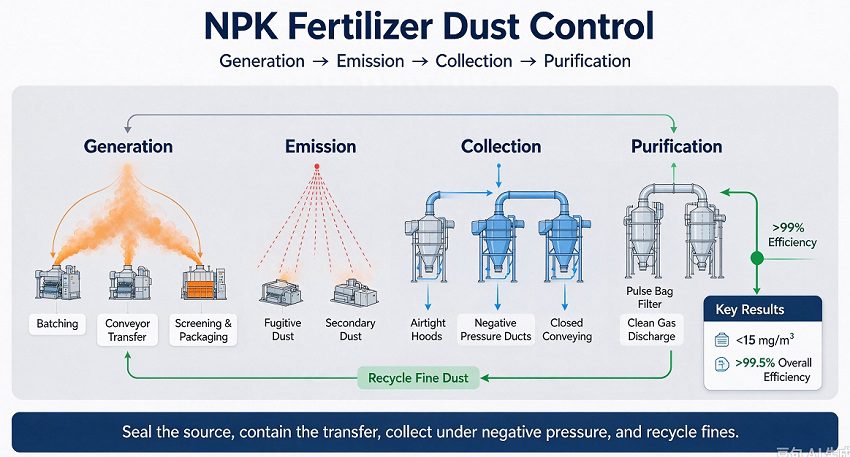
The effectiveness of NPK dust control does not depend on the size of the end-of-line dust collector, but on whether the entire path of “generation—emission—collection—purification” is sealed off from beginning to end. Dust in NPK production lines mainly comes from feeding and batching, mixing, belt conveyor transfer points, and screening and packaging. The feeding port and transfer drop points are the locations where instantaneous dust is most concentrated. Prioritizing closed feeding, negative pressure dust collection, and closed conveying can achieve a comprehensive dust removal efficiency of over 99.5%, and the organized particulate matter concentration can be stably controlled below 15 mg/m³, better than the current limit of 10–15 mg/m³ in most areas.
I. Dust Source List and Treatment Priorities
The source of NPK dust is not a single point, but a “line” distributed along the material flow direction. The first priority is the feeding and batching section: raw materials such as urea, DAP, and MOP generate a large amount of instantaneous dust during unpacking, pouring, and metering. The collection efficiency of the dust collection hoods is typically designed for 90%, and any uncollected portion directly enters the workshop as fugitive emissions.
The second priority is the mixing and transfer points: the inlet and outlet of the mixer, the receiving point of the conveyor belt, and the bottom of the elevator are high-risk locations for secondary dust generation. Open conveying systems repeatedly agitate settled dust. The third priority is the screening and packaging section: the vibration of the screening machine and the discharge port of the packaging machine continuously generate fine powder. This fine dust has a small particle size and high suspension capacity, and is a major source of reduced visibility and occupational health risks in the workshop.
The treatment sequence should follow the principle of “sealing the source first, then blocking the transfer, and finally collecting at the end,” configuring airtight and negative pressure systems before dust dissipates, rather than waiting until the dust disperses and then relying on large air volumes to “chase” it.
II. The Configuration Logic of Pulse Dust Collectors and Airtight Hoods
The primary function of a sealing hood is to confine dust to the vicinity of its generation point. A partial sealing hood used in conjunction with a pulse jet dust collector for compound fertilizer can partially or completely seal the dust generation point, thereby maintaining a certain negative pressure internally. This requires minimal exhaust volume, achieves optimal control, and is unaffected by indoor airflow. It is suitable for locations where the dust generation point is fixed and the airflow velocity is low, such as conveyor belt receiving points and mixer inlets/outlets. The sealing hood is not simply a metal cover; the gaps between the hood and the equipment, the sealing of the access doors, and the sealing of pipe joints directly determine whether negative pressure can be established.
The pulse bag filter performs the purification stage. Dust-laden gas is sent into the dust collector through a sealed pipeline. Dust is trapped by the filter bags, and clean gas is discharged. The bag filter itself can achieve a filtration efficiency of over 99% for micron and submicron dust. When connected in series with a front-end cyclone dust collector, the overall dust removal efficiency generally reaches 99.5%. The key configuration point is negative pressure operation: the induced draft fan is placed at the rear end of the dust collector, ensuring that the ducts and hood are always under negative pressure, preventing dust from leaking out through gaps. If the system is under positive pressure, dust-laden gas will escape from weak points in the seal, and even the highest dust collector efficiency cannot compensate for this. The pulse cleaning system needs to be automatically triggered based on the pressure difference. An excessively thick dust layer on the filter bag surface increases system resistance and reduces the collected airflow; insufficient or excessive cleaning will affect stable operation.
III. Secondary Impacts of Dust on Agglomeration and Equipment Wear
The significance of dust control goes beyond simply meeting emission standards. Dust is the “fuel” for agglomeration: fine powder has a large specific surface area and strong hygroscopicity, absorbing moisture first during packaging, storage, and transportation, and becoming the starting point for interparticle crystal bridges. Dust deposited on workshop floors and equipment surfaces repeatedly deliquesces and recrystallizes under humidity fluctuations, further exacerbating the tendency for finished products to agglomerate.
Dust also accelerates equipment wear: in open conveyor systems, compound fertilizer granules and powders continuously scour belts, chutes, and elevator components. Dust escape not only results in material loss but also shortens the service life of the conveying system. Containing dust at its source and recycling it into the production process reduces the combined costs of raw material loss, equipment maintenance, and cleaning labor — not just an environmental expenditure.

IV. FAQ: How to Meet Standards for Fugitive Emissions?
Q: We’ve installed baghouse dust collectors for organized emissions, but fugitive particulate matter in the factory area still exceeds standards. What’s the problem?
Excessive fugitive emissions are usually not due to insufficient dust collector efficiency, but rather gaps in the collection process. First, check the collection efficiency of the fugitive hoods: are intermittent dust sources such as feeding ports and packaging ports equipped with sufficiently airtight hoods of the correct type? Is the hood opening deviated from the dust-generating point due to material accumulation or operational collisions?
Secondly, check the overall airtightness of the workshop: open doors and windows, wall gaps, and roof vents will disrupt the negative pressure environment, allowing uncollected dust to diffuse outwards. GB 16297-1996 requires a monitoring concentration limit of 1.0 mg/m³ for fugitive particulate matter emissions. This limit depends far more on the airtightness of the workshop and the efficiency of gas collection than on the dust collector itself.
Thirdly, check the negative pressure status of the pipelines and dust collectors: leaky pipelines will reduce the terminal collection airflow. If the dust collector operates under positive pressure, dust-laden gas may escape from flanges and maintenance doors. The core logic for achieving fugitive emission standards is “collect all that should be collected and seal all that should be sealed.” Improving the gas collection efficiency from 90% to a higher level is more effective than simply increasing the power of the terminal fans.