We are a professional manufacturer of organic fertilizer equipment and a customized service provider for fertilizer production lines
NO.313, Wanshan Road, Xingyang City, Zhengzhou City, Henan Province, China
Company Address
Call Us: +86-18703630069
(Sat - Thursday)
inquiry@hqhifertilizermachine.com
Our Email
Disc Granulator
Equipment introduction
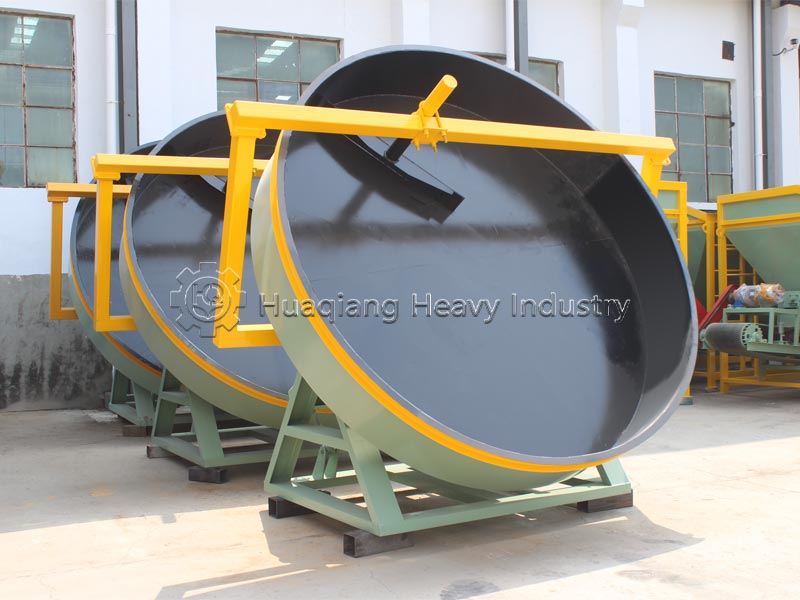
Disk granulator, also known as pan granulator and disc pelletizing machine, is a wet granulation equipment that uses the centrifugal force, friction, gravity and adhesion between materials generated by the rotating disc to continuously roll, agglomerate and grow the powdery materials in the disc, and finally form particles. It is widely used in the fields of compound fertilizer, organic fertilizer, mineral powder, metallurgical powder, building material powder, solid waste resource treatment and other fields. It is a very common type of equipment in the powder pelletizing and particle shaping process. The disc granulator is characterized by a relatively simple structure, intuitive operation, strong parameter adjustability, and good visualization of the granulation process. It is suitable for small and medium-scale continuous production, and is also suitable for working conditions that require flexible adjustment of particle size and balling state. Compared with some forced extrusion granulation equipment, the disc granulator is more suitable for materials that have a certain degree of cohesiveness and can be wet-formed into balls. Compared with the drum granulator, its operation is more intuitive and the control is more flexible. It is suitable for scenes that require higher particle appearance and particle size uniformity.
Equipment Structure and Components
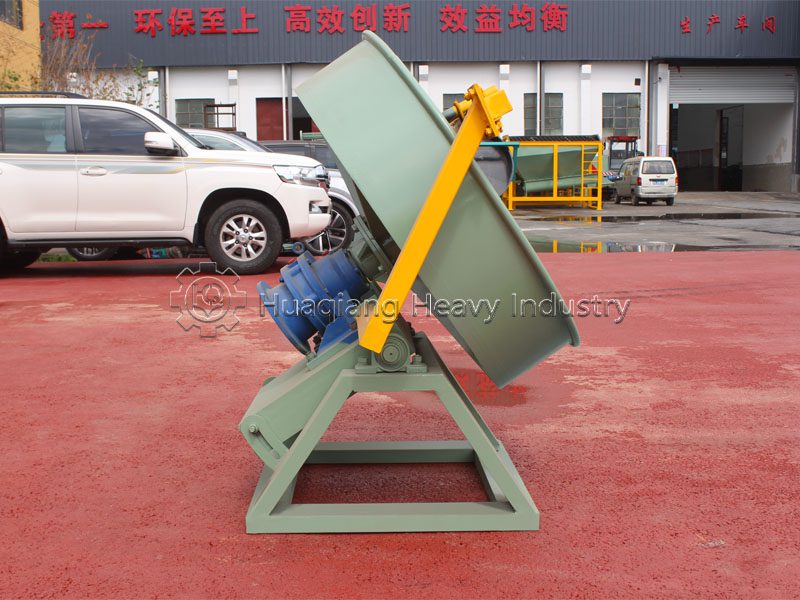
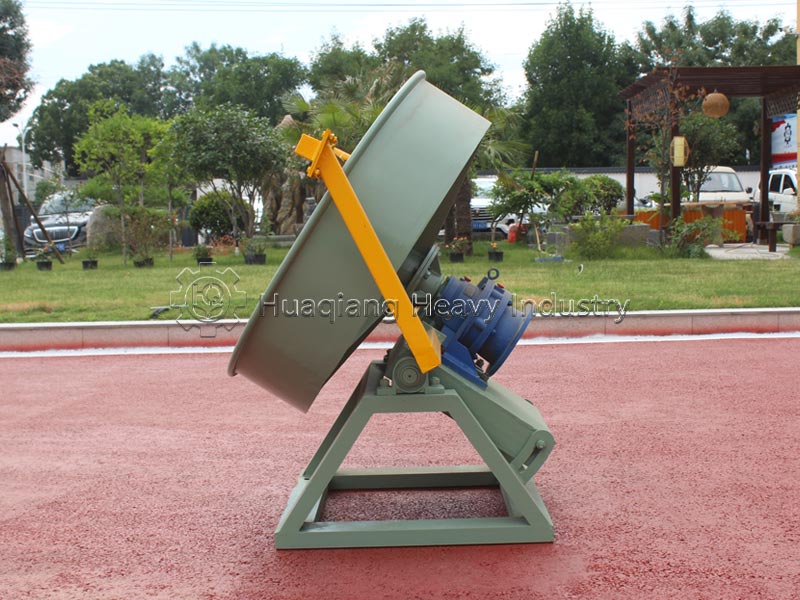
A disc granulator typically consists of the following core components:
Frame:Supports the entire equipment, bearing the loads from the disc, transmission system, and during operation.
Structural stability directly affects the smoothness of operation and granulation accuracy.
Disc Body:The core working component of the granulation process, usually a circular concave disc structure.
The disc’s tilt angle and rotation speed are adjustable, determining the material’s trajectory and particle growth process within the disc.
Transmission System:Primarily includes a motor, reducer, gears, and couplings.
It drives the disc’s stable rotation and is the power source for the equipment.
Scraper Device:Cleans material adhering to the disc surface and adjusts the material’s rolling path.
It is crucial for preventing sticking and improving pelletizing rate.
Spray System:Evenly sprays water, binder, or other liquids into the disc.
Moisture control is a key factor in granulation quality.
Angle Adjustment Mechanism:Adjusts the disc’s tilt angle.
Changes in tilt angle affect material residence time, rolling intensity, and particle size.
Support and roller components: Ensure balanced force distribution during disc rotation, reducing wear.
Affects equipment stability and service life.
Working Principle and Granulation Process of the Equipment
The working principle of the disc granulator is based on the agglomeration granulation mechanism:
1. Material Movement Trajectory The material is subjected to three forces within the rotating disc: Centrifugal force: pushes the material towards the edge of the disc. Gravity: causes the material to slide downwards along the disc surface. Friction: the interaction between the material and the disc surface, and between materials themselves.
2. Granulation Process (Layered Granulation Theory) The four-stage forming principle of disc granulation:
Nucleation Stage: Fine powder material comes into full contact with sprayed water and binder, and the fine powder initially agglomerates, forming tiny particle cores, which is the basis for granulation.
Layering Stage: The continuous rotation of the disc causes the particle cores to tumble continuously, and the particle surface continuously adsorbs surrounding dry powder material, gradually thickening and coating the surface, resulting in a gradually increasing particle size.
Compaction Stage: The material continues to roll and collide with each other within the disc, continuously reducing the internal voids of the particles, resulting in a compact overall structure and increased particle strength. Spheronization Stage: Through continuous tumbling and friction, the uneven surface of the particles is smoothed, significantly improving sphericity and ultimately forming finished particles that meet standards.
3. Key Process Parameters Disc Rotation Speed: 60%-75% of the critical speed (critical speed n = 42.3/√D, where D is the disc diameter in meters) Disc Inclination Angle: 35°-55°; the larger the angle, the shorter the particle residence time and the smaller the particles. Material Moisture Content: Typically controlled at 25%-35% (adjusted according to material characteristics) Binder Addition Amount: Determined based on the sphericity of the material, generally 3%-8% of the material weight.
Raw Materials for the Equipment
The disc granulator is suitable for various non-sticky materials in powder, granular, or small lump form, mainly including: Fertilizers: organic fertilizer powder, humic acid, peat moss, fermented livestock and poultry manure, straw powder, etc. Minerals: coal powder, cement, clinker, limestone, shale, clay, etc. Industrial raw materials: bentonite, kaolin, dry slag, ash, etc. Others: sludge, fermentation products, etc. Key raw material indicators: Moisture content is a key parameter for organic fertilizer granulation, usually needing to be controlled between 25% and 35%; the moisture content of organic fertilizer raw materials is generally best controlled between 20% and 30%.
Equipment Parameters
Model
Capacity (t/h)
Diameter (mm)
Side Height (mm)
Rotation Speed (r/min)
Motor Power (kW)
ZL-500
0.05-0.15
500
150
25
1.5
ZL-800
0.1-0.3
800
200
25
1.5
ZL-1000
0.1-0.35
1000
250
25
2.2
ZL-1200
0.1-0.35
1200
250
25
3
ZL-1500
0.3-1
1500
300
18
3
ZL-1800
0.5-1.2
1800
350
18
4
ZL-2000
0.5-1.5
2000
400
18
5.5
ZL-2500
1-2.5
2500
400
13.6
7.5
ZL-2800
2-3
2800
500
13.6
11
ZL-3000
2-3
3000
500
11
11
ZL-3200
3-5
3200
500
10
11
ZL-3600
3.5-6
3600
500
10
18.5
If you still have any questions about fertilizer production equipment and processes, or would like to learn more about customized solutions, please feel free to contact us. Whether it’s equipment selection and pricing, installation, commissioning and operation training, or after-sales maintenance and process upgrades, we can provide you with professional and timely answers and support to help your project be implemented efficiently.