
We are a professional manufacturer of organic fertilizer equipment and a customized service provider for fertilizer production lines
-
NO.313, Wanshan Road, Xingyang City, Zhengzhou City, Henan Province, China
Company Address
-
Call Us: +86-18703630069
(Sat - Thursday)
-
inquiry@hqhifertilizermachine.com
Our Email
Double Screws Compost Turning Machine
Equipment Introduction
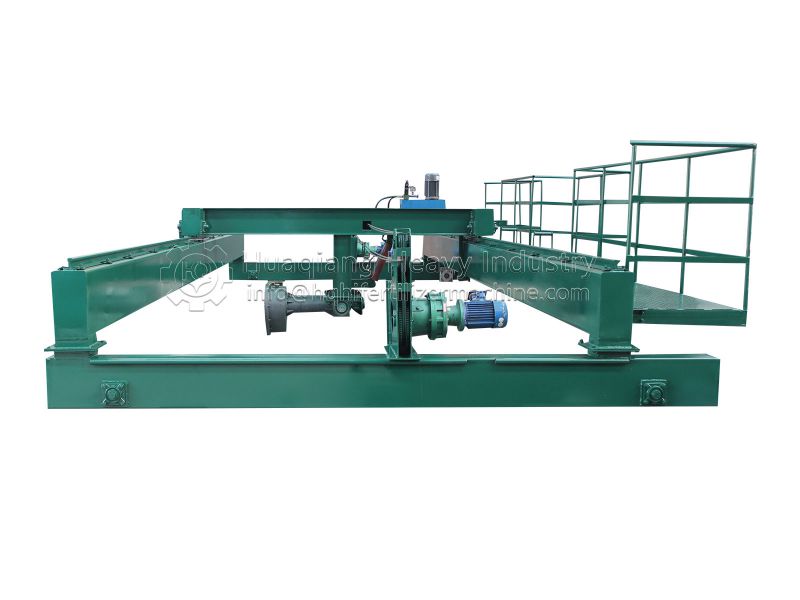
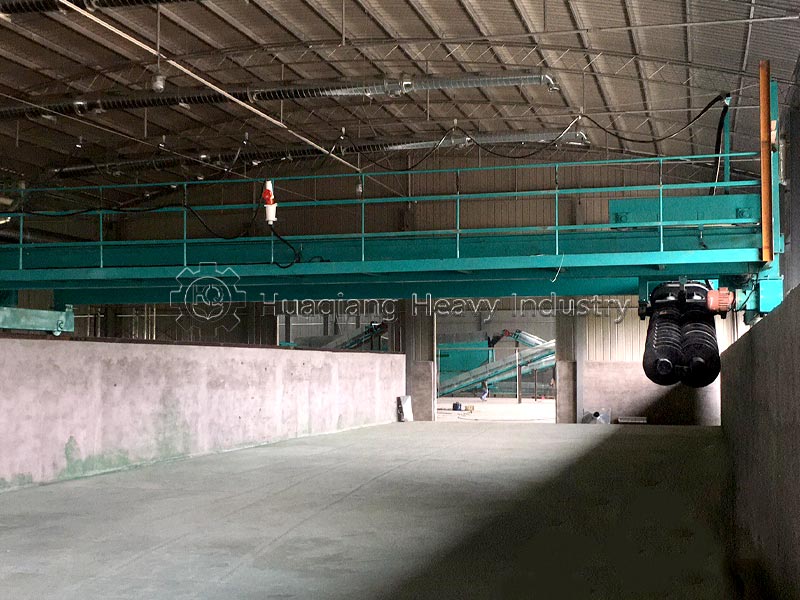
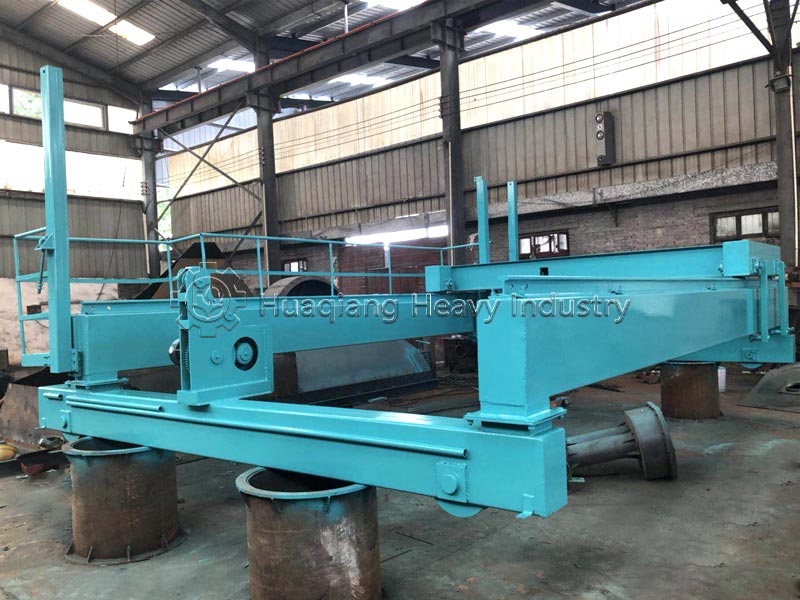
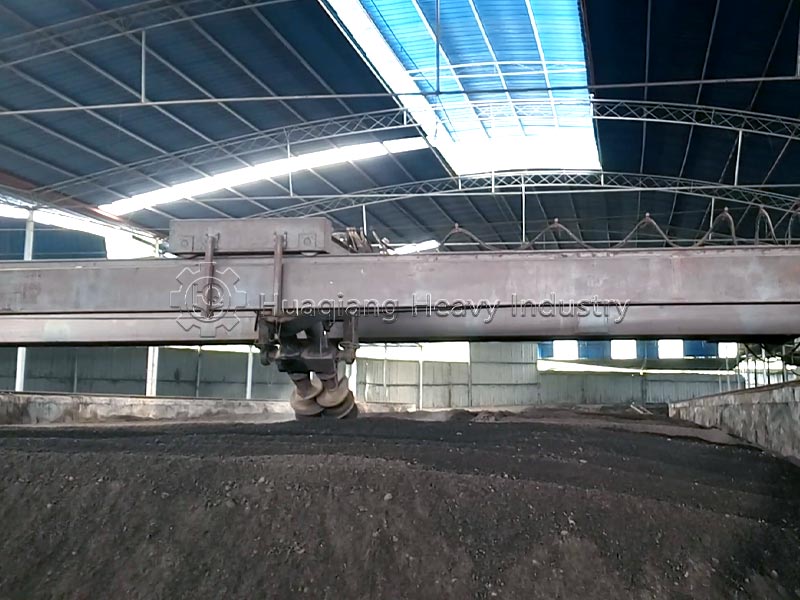
The double-screws compost turner is a high-end, deep-layer turning and composting equipment specifically designed for trough-type aerobic fermentation processes. Its core structure consists of two parallel, counter-rotating spiral shafts that reciprocate along the fermentation trough track, achieving integrated operations of deep lifting, crushing, mixing, oxygenation, and relocation of organic materials. It is the core fermentation unit for large and medium-sized organic fertilizer plants and manure harmless treatment bases.
I. Core Technological Advantages (Compared to Ordinary Drum and Single-Spiral Compost Turners)
1. Deep, Large-Span Turning and Composting with Extremely High Space Utilization: The effective turning depth can reach 1.0~1.8m, and the maximum suitable span for fermentation troughs is 6~11m. Under the same plant area, the material loading capacity per trough is increased by 40%, significantly reducing the construction cost of civil engineering fermentation troughs.
2. Dual-axis counter-current convection ensures thorough turning and uniform composting. Two spirals rotate synchronously in opposite directions, creating bidirectional convection. Anaerobic material at the bottom is completely turned to the surface, eliminating any missed turning spots at the tank edges. Material composting uniformity reaches over 95%, completely solving the industry pain points of single-axis equipment, such as one-sided accumulation and uneven stratified fermentation.
3. Strong oxygen supply and heat dissipation capacity significantly shortens the fermentation cycle. The spiral blades powerfully break up the material crust, continuously opening oxygen supply channels within the pile, rapidly releasing the high fermentation temperature and maintaining a harmless high-temperature range of 55-70℃. The conventional fermentation cycle is shortened from 30-60 days to 15-25 days, and for sludge and low-organic-matter materials, it can be shortened to 7-14 days.
4. Suitable for high-moisture, viscous materials, preventing tangling and jamming. The double-helix variable-pitch wear-resistant blade design compacts materials at the feed end and loosens and spreads them at the discharge end. It features a built-in anti-stick scraper, allowing stable operation with high-moisture livestock manure and municipal sludge (50%~70% moisture content), preventing tangling with straw and clumping materials.
5. Low energy consumption, stable operation, and long service life. The dual-shaft balanced structure reduces overall machine vibration by 40%, with noise ≤75dB. Power consumption is 15%~20% lower than drum compost turners for the same processing capacity. The thickened carbon steel frame and high-manganese steel wear-resistant blades extend the machine’s service life to 8~10 years, far exceeding the 5~6 years of ordinary models. 6. High degree of automation, suitable for large-scale continuous production. The PLC centralized control cabinet supports both manual and automatic modes, variable frequency speed regulation, fixed-point turning and automatic stop at both ends of the track. It can be integrated with solar fermentation chambers, bottom aeration systems, and transfer vehicles to achieve unattended continuous fermentation production.
II. Compatible Scenarios. It can be fully integrated with solar fermentation greenhouses, bottom forced aeration pipes, continuous discharge machines at the tank ends, and cross-tank transfer vehicles. The fermentation tank supports both continuous and batch discharge production modes, suitable for large-scale organic fertilizer production lines with an annual output of 30,000 to 200,000 tons, centralized livestock manure treatment centers, and municipal sludge treatment stations.
Equipment Structure
The entire machine consists of six core functional modules + an intelligent electrical control system + an optional transfer cart. The differentiating core component is the double-screws turning and turning assembly:
1. Overall Load-Bearing Frame: Thickened Q235 carbon steel welded integral gantry frame, surface sandblasted and anti-corrosion painted; the frame has walking support bases on both sides, and the double-helix turning and turning assembly is suspended in the middle. The structural strength can withstand the heavy impact of materials from a depth of 1.8m.
2. Track Walking Device: Composed of a walking variable frequency motor, transmission reduction gearbox, double-row walking sprockets, track load-bearing walking wheels, and track limit switches; the walking speed is steplessly adjustable from 0.5 to 2m/min. The track must be grounded to prevent leakage safety hazards.
3. Hydraulic Lifting Assembly (Standard Configuration for SFP-Y Hydraulic Model)
Independent 46# wear-resistant hydraulic oil tank, dedicated hydraulic pump motor, electromagnetic reversing valve assembly, high-pressure oil-resistant oil pipe, dual-side lifting cylinders, lifting support arm; the cylinder extension and retraction are controlled by an electronically controlled valve, precisely adjusting the depth of the double spiral turning and tumbling mechanism. During maintenance, the entire spiral can be raised for easy cleaning and upkeep.
4. Core Double Spiral Turning and Tumbling Assembly (Equipment Differentiation Core)
1) Dual Main Shaft Drive Unit: Two independent main motors + cycloidal pinwheel reducers, driving the left and right spiral shafts to rotate synchronously in opposite directions;
2) Spiral Main Shaft and Blades: Two parallel high-manganese steel spiral shafts, with variable-pitch wear-resistant spiral blades welded to the surface. The blades are thickened for wear resistance and can be disassembled and replaced individually;
3) Anti-stick Auxiliary Scraper: An elastic scraper is installed close to the spiral shaft to automatically scrape off high-moisture materials adhering to the shaft, preventing material entanglement and jamming.
5. Transfer Vehicle (Optional Equipment): Independent walking motor, transmission gears, load-bearing wheels, and lateral support frame; allows for lateral movement of the entire machine to other fermentation tanks, enabling multi-tank production and reducing total equipment purchase investment by over 40%.
Applications of the Equipment
The double-screws compost turner is suitable for aerobic fermentation in earthen troughs and is a core piece of equipment for the industrial-scale harmless treatment of livestock farming, municipal waste, and urban sewage sludge. Specific applications include:
| Application Field | Typical Scenarios |
|---|---|
| Large-scale Organic Fertilizer Factory | Fermentation and decomposition process for large-scale and standardized organic fertilizer production |
| Large-scale Livestock & Poultry Farm | Centralized composting of livestock and poultry manure to realize resource utilization of manure |
| Solid Waste Treatment Center | Harmless and resource-based treatment of urban sludge, kitchen waste and other organic solid wastes |
| Compound Fertilizer Plant | Fermentation pretreatment of raw materials for compound fertilizer production |
| Horticultural Farm | Composting treatment of garden waste |
| Button Mushroom Cultivation Plant | Fermentation preparation of mushroom cultivation substrate |
| Food, Brewing & Sugar-making Industry | Treatment of industrial organic wastes such as distiller’s grains and sugar mill filter mud |
Compared to traditional compost turning equipment, the double-screws compost turner overcomes the problems of shallow turning depth, small turning span, and large footprint of ordinary earthen trough compost turners. It achieves an effective turning depth of up to 1.7 meters and an effective turning span of 6–11 meters, significantly improving the utilization rate of the work site. It is particularly suitable for the fermentation of low-organic-matter materials such as sludge and municipal waste—due to their low organic matter content, sufficient fermentation depth is required to increase the fermentation temperature and thus shorten the fermentation time.
Working Principle
The working mechanism of the double-screws compost turner can be summarized as a synergistic process of “dual-axis counter-rotation—three-dimensional turning—forced oxygenation and mixing”:
1. Material Grabbing and Lifting Stage: The two helical shafts rotate at high speed in opposite directions. The helical blades penetrate deep into the bottom of the pile, using the axial thrust of the helical surface to push the bottom material upwards along the helical grooves. Due to the counter-rotation of the two shafts, the material is subjected to shear forces in two opposite directions during the lifting process, forming a “tearing-dispersion” effect, effectively breaking up agglomerated materials.
2. Scattering and Mixing Stage: After the material is lifted to the upper surface of the pile, it is scattered to a distance of 0.2–1.5 meters under the action of centrifugal force and gravity. During this process, the material achieves three-dimensional movement of upper and lower layer exchange, front-to-back displacement, and lateral diffusion, ensuring thorough mixing of materials at different fermentation stages and with different moisture contents.
3. Oxygenation and Cooling Stage: The turning and turning action loosens the dense material pile, creating a suitable porous structure. A large amount of outside air is drawn into the pile, maintaining the oxygen concentration within the ideal range of 8%–18%, meeting the metabolic needs of aerobic microorganisms. Simultaneously, turning and turning removes a significant amount of heat, rapidly reducing the pile temperature from above 65℃ to around 55℃, preventing the inhibition of microbial activity by high temperatures.
4. Quantitative Displacement Stage: Through continuous or intermittent movement of the traveling device, the equipment pushes the material longitudinally along the fermentation tank a certain distance (usually 1–2 meters per day) while turning and turning, achieving continuous feeding and discharging of the fermentation tank. Combined with the discharge device at the end of the fermentation tank, this creates a continuous fermentation operation.
Applications in Organic Fertilizer Production Lines
The double-screws compost turner is the core fermentation equipment in an industrial organic fertilizer production line. It is typically located at the very beginning of the production process, undertaking the task of harmless and stabilizing the organic raw materials.
1. Typical Production Line Configuration
1) Annual production line of 10,000–50,000 tons of powdered organic fertilizer:
Raw material pretreatment (crushing/dehydration) → Ingredient mixing → Tank fermentation (double-helix compost turner) → Crushing → Screening → Packaging
2) Annual production line of 30,000–100,000 tons of granular organic fertilizer:
Raw material pretreatment → Ingredient mixing → Tank fermentation (double-helix compost turner) → Crushing → Screening → Granulation (disc/drum/extrusion) → Drying → Cooling → Screening → Coating → Packaging
2. Supporting Equipment
1) Fermentation Tank: Concrete or steel structure, width 2–11 meters, depth 1.5–3.0 meters, length designed according to production capacity (usually 30–100 meters);
2) Transfer Machine: Used for lateral switching of the double-helix turner between different fermentation tanks, achieving one machine for multiple tanks;
3) Aeration System: Perforated pipes are laid at the bottom of the fermentation tank, with forced oxygen supply in conjunction with a blower;
4) Temperature/Humidity Monitoring: Real-time feedback from online sensors, automatically starting and stopping the turner.
3. Process Integration
After fermentation and composting, the material is transported to subsequent stages by forklift or belt conveyor. Modern intelligent fermentation systems use AI algorithms to compress the fermentation cycle from the traditional 25 days to approximately 15 days, increasing nitrogen retention to over 92%, significantly improving the overall efficiency of the production line.
Equipment Operation Method
I. Pre-operation Inspection
1. Power System: Check if the motor wiring connection is secure and the grounding is reliable; check if the motor voltage meets the rated requirements (380V industrial power).
2. Transmission System: Check the lubrication of the screw shaft, chain, and gearbox; add sufficient lubricating oil (grease); check the chain tension.
3. Working Parts: Check if the screw blades are intact, without deformation, cracks, or severe wear; clean any residual material from the screw shaft and frame.
4. Safety Devices: Confirm that the emergency stop button, limit switches, guardrails, and other safety components are intact and effective.
5. Hydraulic System: Check if the oil pressure is normal and if there are any oil leaks.
II. Site and Material Preparation
1. Remove stones, metal, and other hard objects from the fermentation tank to avoid damaging the screw blades.
2. Confirm that the moisture content of the material to be turned is 50%–60% (suitable for aerobic fermentation); if it exceeds 70%, dry straw needs to be mixed in to adjust; if it is below 40%, water needs to be sprayed in advance.
3. The material pile height must meet the equipment’s rated turning height requirements.
III. Start-up and Trial Run
1. Turn on the power switch, press the start button, and observe whether the motor runs smoothly.
2. Start the spiral turning device, run it idle for 1-2 minutes, and check whether the spiral shaft rotation direction is correct, without jamming or abnormal noise.
3. Operate the walking device to confirm that the walking is smooth and the braking is effective.
4. If the rotation direction is reversed, stop immediately and change the three-phase circuit connection to change the rotation direction.
IV. Formal Operation
1. Adjust the walking speed (commonly 0.5-3 km/h) and spiral shaft speed according to the material characteristics and fermentation requirements.
2. When the material viscosity is high or the fiber content is high, reduce the walking speed and increase the spiral shaft speed.
3. Align the equipment with the material pile, slowly lower the spiral auger to the set turning depth, and start the walking system to begin the turning operation.
V. Shutdown Operation
1. After turning is complete, raise the spiral auger to a safe height.
2. Turn off the spiral rotation power, walking power, and main power.
VI. Operating Precautions
1. 1. No one may pass in front of or behind the turning machine during production. Before starting the machine, observe the surrounding area and keep personnel away from it.
2. No maintenance or lubrication is allowed during production.
3. Turning must be done according to the prescribed procedure; reverse operation is strictly prohibited.
4. No one other than the machine operator may operate the machine without authorization.
5. Lubricating oil is strictly prohibited during production or maintenance.
Common equipment malfunctions and troubleshooting solutions
| Fault Phenomenon | Fault Inducement | Standard Treatment Solutions |
|---|---|---|
| Difficult compost turning, twin screw overload jamming, main motor overload tripping | Material accumulation thickness in fermentation trough exceeds the rated turning depth of equipment | Manually shovel excess fertilizer in the trough, reduce material height to match the turning depth |
| Deformed twin screw alloy blades and main shaft; hard objects such as straw, ropes and stones wrapped and jammed on the screw shaft | Shut down and cut off the main power supply, calibrate deformed blades/main shaft, completely remove foreign objects wrapped around the screw shaft, directly replace worn or cracked blades | |
| Caked materials and sundries jammed between transmission gears, or worn & damaged gear tooth surfaces | Clear foreign objects in gear gaps; replace the complete set of transmission gears if gears are damaged | |
| Unstable traveling, abnormal reducer noise, overheated machine body, traveling deviation | Caked materials and sundries jammed inside traveling sprockets and wheels | Shut down and clean accumulated materials in traveling mechanism and track wheels |
| Bent & deformed traveling transmission shaft, elongated & slack chains, inconsistent tension of left and right chains | Disassemble and calibrate the transmission shaft; directly replace it if severely deformed; tension elongated chains, replace heavily worn chains; synchronously adjust the tightness of left and right traveling chains | |
| Lack of special lubricating oil for traveling reducer and transmission bearings | Inject No.50 reducer gear oil and molybdenum disulfide lithium-based grease to corresponding lubrication points | |
| Settlement & deformation of fermentation trough tracks, excessive flatness deviation | Calibrate and fasten track fixing bolts, grind and repair deformed tracks | |
| Exclusive jamming of twin screw, dead zones without turning, uneven compost turning | The gap between screw blades and fermentation trough side wall exceeds 10cm; traveling speed is too fast, materials cannot be fully turned to the trough edge | Adjust the position of screw support arm, reduce the gap between blades and trough wall to less than 5cm; reduce equipment traveling speed, extend the residence time of material turning by screws |
| Excessively wet and sticky caked materials, screw blades slip and fail to carry materials | Add dry straw and sawdust in advance to adjust material moisture content, break up large caked materials; clean sticky materials on screw shaft, overhaul anti-sticking scrapers | |
| Too low rotation speed of screw main shaft, insufficient material crushing and throwing force | Increase the rotation speed of twin screw main shaft on PLC control cabinet to enhance crushing, oxygenation and spreading effects | |
| Worn thickness of screw blades exceeds 1/3, material carrying capacity drops sharply | Weld wear-resistant alloy layer to thicken blades, or directly replace brand-new wear-resistant blades; synchronously adjust the ground clearance of screws to ensure complete turning of bottom materials | |
| Hydraulic system faults (slow & weak lifting, oil leakage, abnormal noise, one-way failure, automatic sliding of oil cylinder) | Internal leakage caused by aging sealing parts inside oil cylinder, leakage of hydraulic circuit pipelines, pressure relief caused by damaged relief valve | Disassemble oil cylinder and replace all oil seals & sealing parts, fasten leaking pipeline joints, replace damaged high-pressure oil pipes, overhaul or replace relief valve |
| Aging & cracked high-pressure oil pipes, damaged sealing gaskets of cylinder end covers, loose valve group joints, leading to hydraulic oil leakage and rapid drop of oil level | Replace aging high-pressure oil pipes, replace cylinder sealing gaskets, tighten all hydraulic pipeline joints | |
| Clogged hydraulic filter element leading to insufficient oil supply, faulty oil tank cooling fan, air & water vapor entering oil circuit, resulting in pump station abnormal noise, high oil temperature and emulsified oil | Replace brand-new hydraulic filter element, overhaul cooling fan, fully exhaust air from hydraulic oil circuit; drain all emulsified hydraulic oil, clean oil tank and fill new 46# anti-wear hydraulic oil | |
| Impurities in hydraulic oil block valve spool, causing directional valve jamming and one-way failure of screw lifting & lowering | Disassemble solenoid directional valve, clean impurities on valve spool, filter hydraulic oil and replace brand-new filter element simultaneously | |
| Difficult or failed motor startup with buzzing abnormal noise | Excessively worn or damaged internal motor bearings | Disassemble motor end cover and replace brand-new motor bearings |
| Bent & deformed reduction shaft inside reducer, excessive transmission load | Disassemble reducer box, calibrate or directly replace reduction shaft | |
| Too low power supply voltage in factory area, unbalanced three-phase voltage, circuit phase loss leads to shutdown | Suspend equipment operation, overhaul power supply lines, restart motor only after voltage recovers to rated standard 380V and three phases are balanced | |
| Traveling deviation, limit switch failure | Uneven track settlement, inconsistent tightness of traveling chains, open circuit of limit switch circuit, oxidized switch contacts | Calibrate track flatness, adjust tension of two traveling chains; overhaul limit switch circuit, replace damaged limit switches |
Equipment Maintenance Methods
Adhere to the shift maintenance and handover system; do not carry over maintenance or malfunctions from the previous shift to the next.
1. Pre-shift checks:
Check all fasteners for tightness, and ensure proper bearing clearances in transmission components (too loose will cause slippage, too tight will result in excessive rotational resistance).
Add grease to bearing housings and check the gearbox oil level.
Check the security of electrical connections.
2. Post-shift maintenance:
Clean up any residue and leftover materials from the machine and surrounding area.
Add lubricating oil to all lubrication points.
Disconnect the power switch.
3. Weekly maintenance:
Check the gearbox oil level and add sufficient gear oil.
Check the hydraulic tank oil level and the sealing of all oil line joints; replace seals (O-rings) if leaks are found.
Check the contactors in the electrical control cabinet; replace any damaged ones immediately.
4. Periodic checks:
Check the operation of the motor and gearbox; stop the machine immediately if abnormal noises or overheating are detected.
Check the wear of all bearings; replace those with excessive wear.
Stop the machine after 2-3 hours of continuous operation to check equipment temperature and lubrication.
Check the wear of the helical blades.
5. Lubrication and Maintenance:
Add hypoid gear oil or No. 50 machine oil to the reducer.
Change all reducer oil after 200 hours of continuous operation during the first startup.
Change the oil every six months for the second time, and annually thereafter.
Regularly check the oil level and replenish it promptly when necessary.
6. Helical Blade Wear Treatment:
Replace or repair the helical blades if wear is severe.
For minor wear, use a professional metal repair compound to fill and strengthen the worn areas.
Matching Granulation Process
(Processing of Well-Decomposed Material into Granular Organic Fertilizer)
For powdered organic fertilizer raw materials that have been fully decomposed by a double-screws compost turner, the complete granulation process for processing into commercial granulated organic fertilizer is as follows: Decomposed fermented powder → Secondary batching and mixing machine (addition of trace elements, binders, and functional microbial agents) → Organic fertilizer granulator (disc granulation / roller extrusion granulation / new type of stirring tooth granulation) → Drum dryer → Cooler → Finished product grading drum screen → Automatic packaging of finished granulated organic fertilizer;
The supporting role of the double-spiral compost turner in the granulation process:
1. The double-spiral bidirectional deep turning and turning ensures thorough decomposition of the material, completely breaks up clumps, results in uniform and stable particle size, and increases the granulation rate by 20%. The above;
2. Precise hydraulic lifting and turning can control the moisture content of the composted material, reduce energy consumption in the drying section, and lower the rate of particle cracking and pulverization;
3. The composted material has a higher humic content, and its particle strength, water solubility, and nutrient slow-release effect are superior to those of raw materials processed by ordinary compost turners.
Complete Fermentation Process
(Double Screws Tank Aerobic High-Temperature Fermentation Process)
I. Complete Fermentation Process Flow:
Organic raw material collection → Solid-liquid dehydration pretreatment (optional for high-moisture manure) → Straw auxiliary material crushing → Ingredient mixing (manure + straw + fermentation agent, adjusting moisture content to 50%~65%, carbon-nitrogen ratio to 20~30:1) → Uniform distribution in fermentation tank → Segmented timed turning and fermentation by double helix turner → Discharge of matured material → Crushing and screening/granulation for further processing → Packaging of finished organic fertilizer.
II. Staged Fermentation Process Parameters (Adapted to the Advantages of Double Helix Deep Turning)
Total fermentation cycle: 15-25 days, controlled in three stages, leveraging the deep turning capabilities of the double helix to meet the process requirements of each stage:
1. Heating Stage (Days 1-5 of Fermentation)
Process Objective: Rapidly raise the temperature to above 55℃, quickly eliminating odors from the pile;
Double-Screws Compost Turner Parameters: Shallow turning to a depth of 0.8-1.0m, turning once every 1-2 days;
Process Effect: Shallow turning quickly breaks up material clumps, introduces air to activate aerobic microorganisms, raises the pile temperature to above 50℃ within 16 hours, and completely eliminates anaerobic odors from the pile within 3-5 days.
2. High-Temperature Decomposition Stage (Days 6-15 of Fermentation) Process Objective: Maintain a high temperature of 55-70℃ for at least 7 days to completely kill insect eggs, pathogens, and weed seeds. Double Screws Compost Turning Machine Parameters: Deep turning to a maximum depth of 1.4-1.8m, turning once every 2-3 days. Process Function: The double-screws compost turner completely brings the bottom anaerobic material to the surface for heat dissipation, stabilizes the high-temperature range of the pile, ensures complete material replacement throughout the entire pit, and fully aerates the deep material, achieving simultaneous decomposition and harmless maturation of the entire pit’s material.
3. Cooling and Stabilization Stage (Days 16-25 of Fermentation) Process Objectives: The pile temperature gradually drops below 40℃, organic matter is completely degraded, and the material is dehydrated and stabilized. Double-Helix Turning Parameters: Medium-depth precise turning at a depth of 1.0-1.4m, once every 3-5 days. Process Benefits: Precise height-controlled turning accelerates moisture evaporation from the pile, ensures uniform material maturation, and enriches humus, providing high-quality and stable raw materials for subsequent granulation and powdered organic fertilizer processing.
III. Core Technological Value of the Double-Helix Turner in Fermentation Process
1. Full-cycle Adaptability to Turning Depth: Unlike ordinary drum turners with fixed heights, the double-screws compost turner can adjust the turning depth in real time according to the fermentation stage, shortening the fermentation cycle by 3-7 days and significantly improving material turnover efficiency in the fermentation workshop.
2. Flexible Heavy-duty Adaptability to Complex Materials: Under conditions of high-resistance materials such as high-moisture, viscous pig manure and municipal sludge, the double-shaft balanced structure has stronger load buffering capacity, resulting in a much lower equipment failure rate than single-shaft or drum turners, ensuring continuous fermentation production without interruption.
3. Improved Quality of Finished Organic Fertilizer: Deep, uniform, bidirectional turning ensures completely consistent material maturity, resulting in finished organic fertilizer with consistently high levels of organic matter, effective viable bacteria, and humus, meeting the national standard NY525-2021 for organic fertilizer. The fertilizer fertility and slow-release effect are superior to those of ordinary machines, making it more competitive in the market.
Equipment Parameters
Double Screws Compost Turning Machine
| Model | Main Motor | Small Car Traveling Motor | Big Car Traveling Motor | Hydraulic Pump Motor |
|---|---|---|---|---|
| SLP-10m | 15KW | 1.5KW×2 | 1.5KW×2(4) | 4KW |
| SLP-12m | 15KW | 1.5KW×2 | 1.5KW×2(4) | 4KW |
| SLP-15m | 15KW | 1.5KW×2 | 1.5KW×2(4) | 4KW |
| SLP-20m | 15KW | 1.5KW×2 | 1.5KW×2(4) | 4KW |
As an upgraded replacement for the trough-type compost turner, the double-screws compost turner, with its unique double-screws compost turner-rotating structure, exhibits significant advantages in material turning depth, mixing uniformity, and aeration efficiency. Compared to traditional single-shaft or chain-plate type compost turners, the double-helix compost turner possesses the following core competitive advantages:
1. Uniform turning without dead angles: The double helixes work in opposite directions in synergistic operation, achieving fermentation uniformity of over 92%.
2. Large turning depth: Effective turning depth can reach 1.7–2.0 meters, more than 30% deeper than single-drum trough-type compost turners.
3. Energy-saving and efficient: Energy consumption is reduced by 15%–20% compared to traditional equipment, with power consumption ≤0.8 kWh per ton of material processed.
4. Short fermentation cycle: The traditional 60–90 day composting cycle can be shortened to 7–25 days.
5. Wide adaptability: It can process various organic wastes with a moisture content of 30%–80%.
The double-screws compost turner marks a leap from “intermittent processing” to “continuous production” in organic fertilizer fermentation. For enterprises facing environmental pressures and pursuing high-quality organic fertilizer production and large-scale continuous production, the double-screws compost turner is a powerful tool for cost reduction, efficiency improvement, and compliant pollution discharge.
If you have any questions about fertilizer production equipment, fermentation equipment, production processes, granulation processes, or fermentation processes, or would like to learn more about customized solutions, please contact us immediately. Whether it’s equipment selection and quotation, installation, commissioning and operation training, or after-sales maintenance and process upgrades, we can provide you with professional and timely answers and support, offering full-process services.