
We are a professional manufacturer of organic fertilizer equipment and a customized service provider for fertilizer production lines
-
NO.313, Wanshan Road, Xingyang City, Zhengzhou City, Henan Province, China
Company Address
-
Call Us: +86-18703630069
(Sat - Thursday)
-
inquiry@hqhifertilizermachine.com
Our Email
Drum Fertilizer Cooler


Equipment Introduction
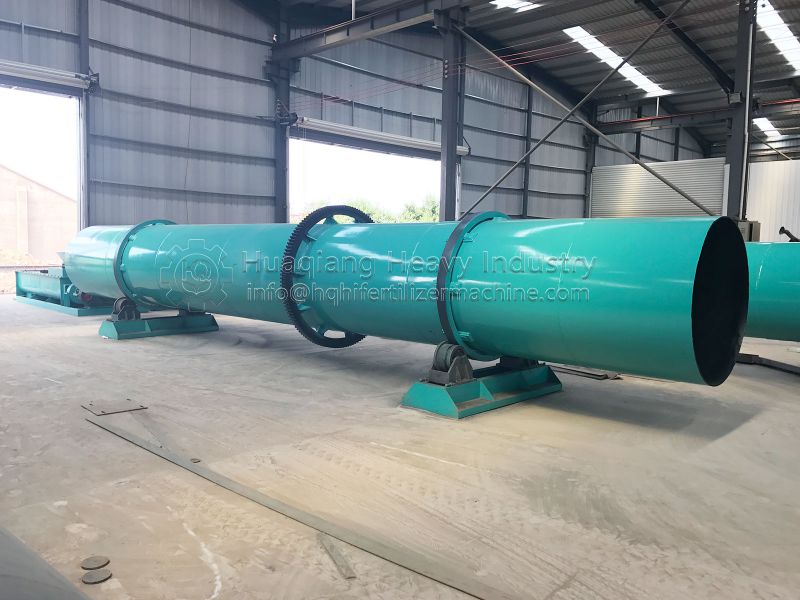
Fertilizer coolers are crucial post-processing equipment in fertilizer production lines, bridging upstream and downstream processes. Their core function is to rapidly cool fertilizer granules (typically 65–85°C) after high-temperature drying in a dryer to near ambient temperature (generally ≤40°C), facilitating timely packaging, storage, and transportation. This also prevents granule softening, sticking, clumping, and nutrient degradation caused by residual heat.
In the fertilizer industry, the rotary drum cooler is the most prevalent type of equipment. Similar in structure to a drum dryer, it does not heat the drum itself. Instead, it relies on forced convection heat exchange between ambient air or regulated cold air and the tumbling material inside the drum to achieve efficient cooling. This equipment features a compact structure, uniform cooling, stable operation, low energy consumption, low breakage rate, and strong adaptability. It is a standard component in production lines for organic fertilizers, compound fertilizers (NPK), ammonium phosphate, ammonium sulfate, and various soil conditioners.
Equipment Structure Composition
The entire machine consists of five main parts (main unit) + supporting auxiliary systems. The main unit structure is the same as that of a rotary drum dryer, and parts are interchangeable:
(I) Main Unit Core Components
Cylinder Body (Cooling Core): High-quality medium carbon steel plate, rolled and welded. The cylinder is installed at a 2°~5° inclination. Wear-resistant lifting plates are welded to the inner wall, continuously scattering materials as the cylinder rotates to form a uniform material curtain, maximizing the contact area with cold air. Labyrinth seals are installed at both ends of the cylinder to prevent cold air leakage and dust overflow.
Support Bracket Assembly: Channel steel and steel plate are welded together to form front and rear brackets. Built-in wear-resistant cast steel rollers and thrust rollers support the entire weight of the machine. Lifting lugs are pre-installed at the four corners of the brackets, and foot mounting holes are provided on the base. The cylinder’s level and inclination angle are adjusted using wedge blocks and pads.
Transmission Drive System: National standard inspection-free main motor + V-belt + reducer + nylon pin coupling transmits rotational torque. The transmission frame is integrally welded, resulting in low operating vibration and suitability for long-term continuous loads. Large Gear Ring Drive Pair: A wear-resistant alloy steel large gear ring is fixed to the outside of the cylinder and meshes with the small gear on the drive shaft to drive the cylinder to rotate. The wear-resistant material extends the service life of the entire machine.
Rolling Belts (Pulleys): Two annular wear-resistant steel belts are fixed to both ends of the cylinder, fitting snugly against the support rollers for rolling support, reducing friction loss between the cylinder and the support rollers.
(II) Supporting Auxiliary Equipment (Essential for Production Lines)
Exhaust Fan Cooling System: Equipped with a centrifugal exhaust fan, it forms a negative pressure convection cooling airflow inside the cylinder, serving as the core medium for cooling and heat exchange;
Dust Removal and Recovery System: Cyclone/bag filter dust collector collects fine particles from the cooling exhaust gas for recycling;
Infeed and Discharge Conveying Equipment: Belt conveyor and bucket elevator connect the dryer discharge, cooler feed, and screening sections;
Sealing Components: Flexible sealing components for feeding and discharging to prevent short-circuiting of cold air and dust leakage.
Applicable Raw Materials
| Category | Content Description |
|---|---|
| Material Requirements | Suitable for granular materials such as compound fertilizer, organic fertilizer, humic acid fertilizer, bio‑organic fertilizer and controlled‑release fertilizer; materials should be in granular form with good flowability. |
| Particle Size Requirements | Particle size difference should be ≤1 mm; powder, wet and caked materials are not allowed; ensure materials have good mixing uniformity. |
| Material Moisture | Moisture content should be controlled below 12%; high moisture may cause material sticking and affect production efficiency. |
Working Principle of the Equipment
The fertilizer cooler operates on the principle of counter-current heat exchange and mechanical tumbling.
- Counter-current Cold Air (Core Principle)
The cooling method employs counter-current cold air flow—that is, forced cooling through reverse contact between cold air and the material. Cold air is drawn in from the rear of the equipment (discharge end), flowing counter-currently to the material entering from the feed end. This allows the cold air to cool the material about to be discharged first, achieving the most efficient heat exchange.
- Material Tumbling and Heat Dissipation
As the cylinder rotates, lifting plates installed on the inner wall of the cylinder continuously scoop up and evenly distribute the material. The material is constantly tumbled, lifted, and scattered within the drum, forming a material curtain, greatly increasing the contact area between the material and the cold air. Simultaneously, under the suction of the induced draft fan, the airflow inside the cylinder accelerates, promoting the cooling process.
- Material Propulsion and Discharge
Due to the inclined installation of the cylinder (angle 2-5 degrees), the material gradually moves towards the drum outlet end under the influence of gravity and during the scattering process. The cooled material flows out from the discharge port. With the continuous rotation of the electric motor and the continuous feeding of materials, large-scale continuous production is achieved.
- Dual Effect of Cooling and Dehumidification: During the cooling process, the cold air not only removes heat from the materials, lowering their temperature, but also further removes some moisture, ensuring the fertilizer granules reach the ideal packaging state.
- Classification of Cooling Methods: Based on material characteristics and process requirements, coolers can be classified into various types, including air-cooled, water-cooled, and air-water hybrid cooling.
Applications of the Equipment
Fertilizer coolers have a wide range of applications:
- Organic Fertilizer Production (Core Application)
Cooling of granular fertilizers in organic fertilizer and bio-organic fertilizer production lines.
Effectively prevents fertilizer agglomeration, ensuring granule strength and microbial activity.
- Compound Fertilizer and Blended Fertilizer Production
Cooling fertilizers at specific temperatures and particle sizes in compound fertilizer and blended fertilizer production.
Used in conjunction with a dryer, it is a key piece of equipment in compound fertilizer production.
- Other Industries
This equipment can also be used for cooling other powdery and granular materials. In lime production, it is used as an important piece of equipment in the rotary kiln system for cooling clinker.
Equipment Capacity Range
Uniform drum inclination angle 2°~5°, stable discharge temperature after cooling ≤40℃:
| Model | Hourly Capacity (t/h) | Main Motor Power (kw) | Motor Model | Reducer Model | Whole‑machine Weight (t) |
|---|---|---|---|---|---|
| LQ10100 | 1~3 | 5.5 | Y132L2‑4 | ZQ250 | 3.8 |
| LQ12120 | 3~5 | 7.5 | Y132M‑4 | ZQ350 | 5.7 |
| LQ15150 | 5~7 | 15 | Y160L‑4 | ZQ400 | 9.7 |
| LQ18180 | 7~10 | 18.5 | Y180M‑4 | ZQ500 | 13.6 |
| LQ20200 | 9~15 | 22 | Y200L2‑6 | ZQ650 | 22 |
Customization Service: We can customize large-capacity models by lengthening the drum and increasing the diameter according to the production line model and annual output requirements.
Target Customers for Fertilizer Coolers
The main target customer groups for fertilizer coolers include:
- Organic Fertilizer Manufacturers: Manufacturers using livestock manure and agricultural waste as raw materials to produce commercial organic fertilizers, requiring the cooling of dried granules to a safe temperature.
- Compound (Mixed) Fertilizer Plants: Enterprises producing inorganic or organic-inorganic compound fertilizers such as NPK, ammonium phosphate, and potassium sulfate; coolers are standard equipment for these plants.
- Large-Scale Livestock Farms: Enterprises with their own manure resource utilization centers, requiring cooling equipment to complete the processing of finished organic fertilizer products.
- Sludge Treatment and Environmental Protection Companies: Cooling of municipal sludge and industrial organic sludge after drying and granulation.
- Biomass Energy and Feed Enterprises: Cooling of distiller’s grains, medicinal residues, straw pellets, and feed pellets.
- Soil Remediation and Conditioner Manufacturers: Cooling of soil conditioner granules such as gypsum, limestone, and humic acid.
Equipment Operation and Maintenance Methods
(I) Pre-start Preparation
- Equipment Inspection: Remove any stuck material from the feed hopper and discharge chute; check the feeding device and auxiliary device transmission for proper functioning.
- Lubrication Confirmation: Apply grease to the gear meshing surfaces before starting; confirm that the bearings, belts, and reducer are well lubricated.
- No-load Test Run: New machines or those after major overhauls need to run under no-load for 8 hours. Bearing temperature rise should be stable, and the termination temperature should not exceed 50°C; gear noise should be uniform, with no abnormal vibration.
(II) Operation
- Start-up Sequence: Start the induced draft fan first → Start the main motor → Start the feeding equipment.
- Parameter Monitoring: Monitor the cylinder speed, discharge temperature, motor current, and negative pressure status in real time.
- Shutdown Sequence: Stop feeding → Stop the main motor after the material in the cylinder is emptied → Finally, stop the induced draft fan.
(III) Daily Maintenance
| Maintenance Position | Maintenance Cycle | Maintenance Content |
|---|---|---|
| Gear Meshing Surface | Every shift / Before start‑up | Apply grease for lubrication |
| Belt Surface | Every 7 days | Apply grease once |
| Bearing Housing | Every 3 months | Fill or replace grease |
| Reducer | Before first use / Every 4 months | Fill or replace gear oil |
| V‑belt | Monthly inspection | Check tension and wear condition |
| Lifting Plate / Gear Ring | Quarterly | Check wear, deformation and fastening status |
| Sealing Parts | Quarterly | Inspect aging and damage, replace timely |
(IV) Safety Precautions
- No one may walk under the cooler while it is running;
- No internal inspections or repairs are permitted during operation, and protective devices must not be removed;
- Do not touch the motor or electrical wires without wearing insulated gloves;
- Do not start the cooler without a proper grounding wire;
- If an electrical leak is detected, stop the machine immediately until the grounding wire is repaired.
Common Faults, Causes, and Standardized Solutions
| Fault Phenomenon | Main Causes | Solutions |
|---|---|---|
| Low Cooling Capacity | Insufficient air volume; excessive feeding rate; low cylinder rotating speed | Increase air supply of induced draft fan; adjust feeding speed or properly raise cylinder rotating speed |
| Belt Slippage | Belt and concave joint side not clamped tightly; riding wheel wear | Clamp belt and joint with shims (apply force evenly to prevent cylinder jump); repair or replace riding wheel according to wear degree |
| Machine Offset / Axial Drift | Riding wheel wear; retaining wheel wear | Repair, shift or replace riding / retaining wheel according to wear; adjust riding wheel angle to reset cylinder |
| Gear Dislocation / Abnormal Noise | Pinion wear; loose connection between big gear ring and cylinder | Reverse‑mount pinion to use unworn surface; replace gear if double‑sided wear is severe; calibrate connection of big gear ring and cylinder |
| Cylinder Vibration | Loose connection between riding‑wheel assembly and base; uneven side wear on belt | Adjust connection and tighten nuts to position riding wheel correctly; machine belt side or replace belt subject to wear condition |
| Seal Failure / Dust Leakage | Aging & damaged sealing parts; insufficient negative pressure | Replace heat‑resistant rubber seals; check induced‑draft fan operation and pipeline tightness |
Application of Coolers in Complete Fertilizer Production Lines
Complete Standard Production Line Process Flow: Raw Material Crushing → Batching and Mixing → Granulation (Disc/Drum/Extrusion) → Rotary Drum Dryer → Rotary Drum Cooler (Core Cooling Section) → Rotary Drum Screening Machine → Coating Machine (Optional) → Automatic Packaging Machine Section Matching Logic: The temperature of the dryer-discharged granules is 60~90℃. They must be cooled to ≤40℃ by the cooler; otherwise, moisture will accumulate inside the packaging bags after high-temperature granules are packaged, leading to rapid clumping, mold growth, and nutrient loss. The cooling process simultaneously removes residual moisture from the granule surface, improving granule strength and reducing breakage during screening and transfer. The cooling exhaust gas is equipped with a dust collector to recover fine powder, which is then returned to the front-end mixer for regranulation, achieving zero raw material waste. Machine Matching Principle: The cooler cylinder diameter and capacity must correspond one-to-one with the upstream dryer to ensure balanced material transport during continuous production.
Analysis of the advantages and disadvantages of the equipment
| Item | Description |
|---|---|
| Advantages |
|
| Disadvantages |
|