
Equipment Introduction
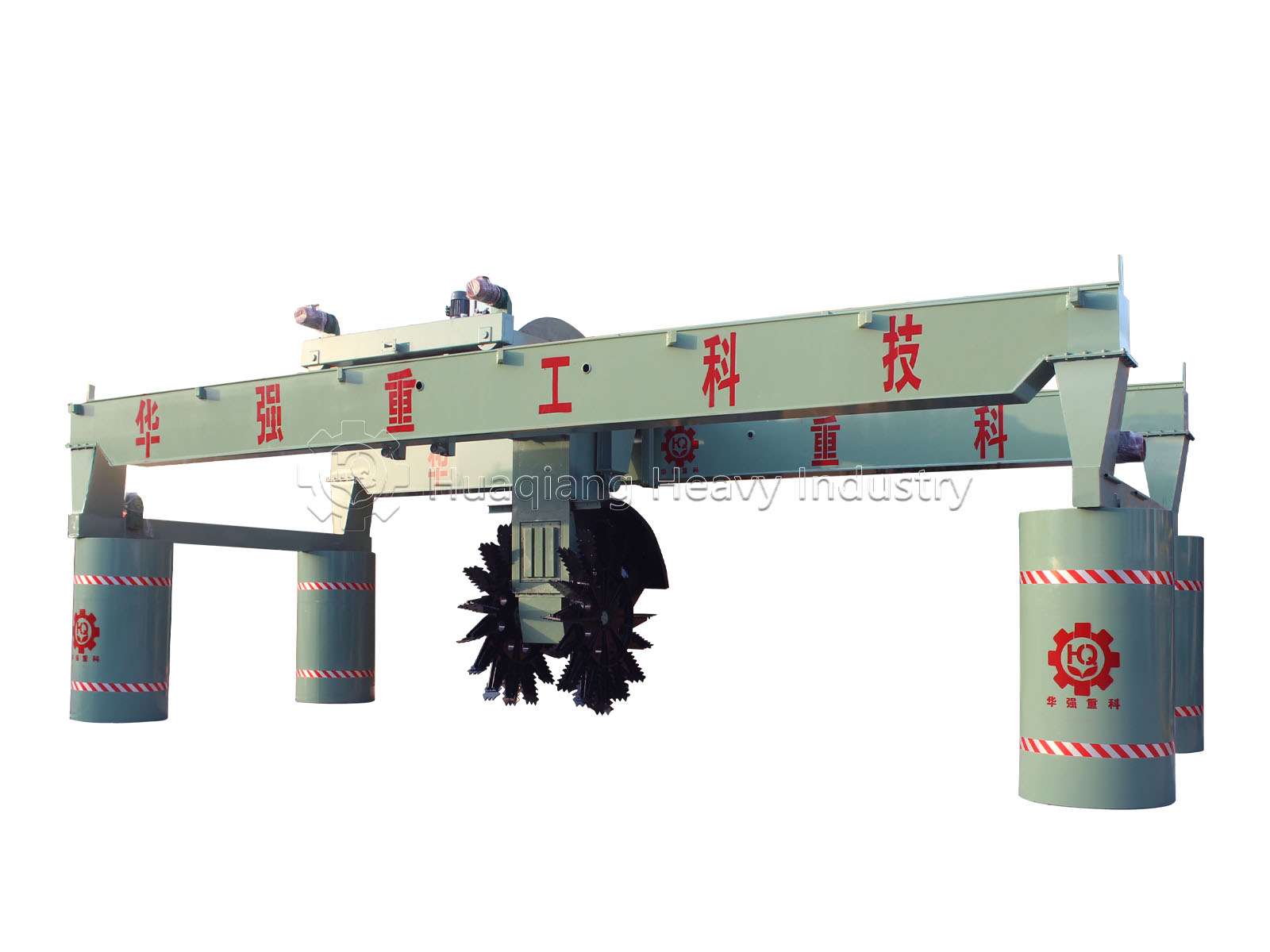
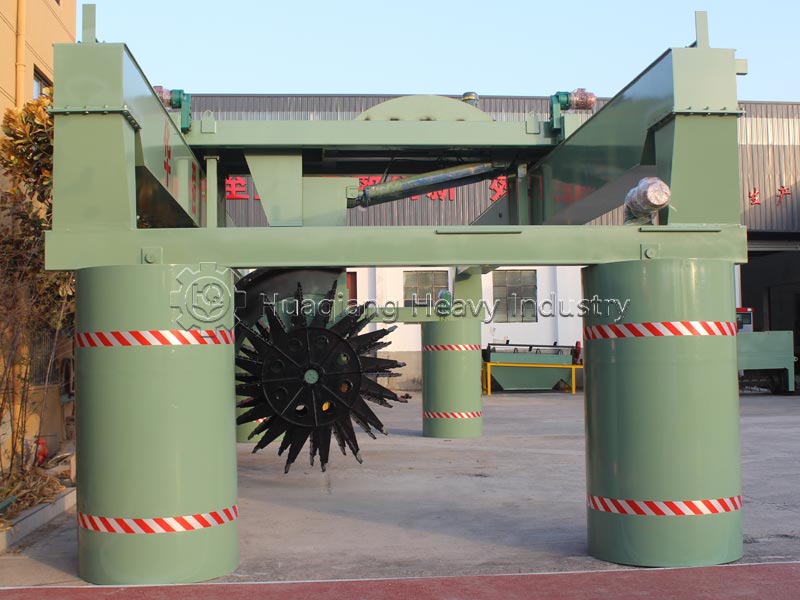
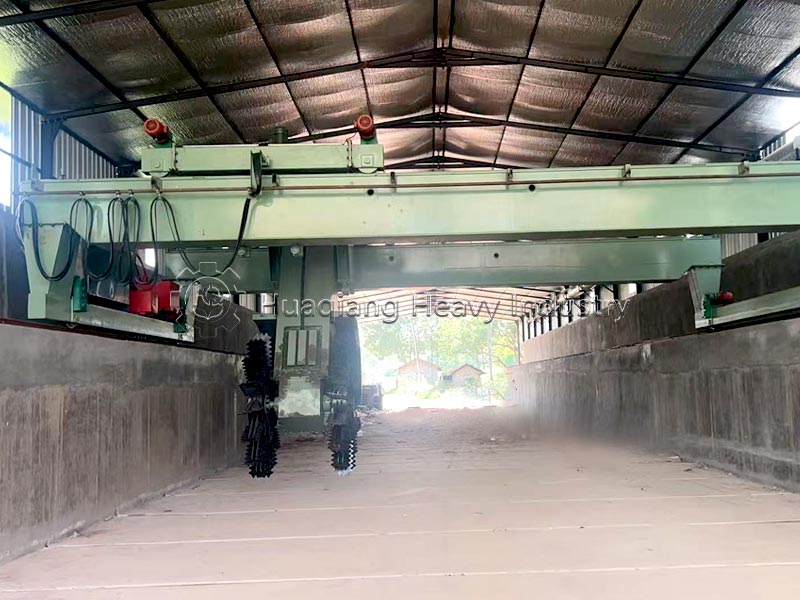
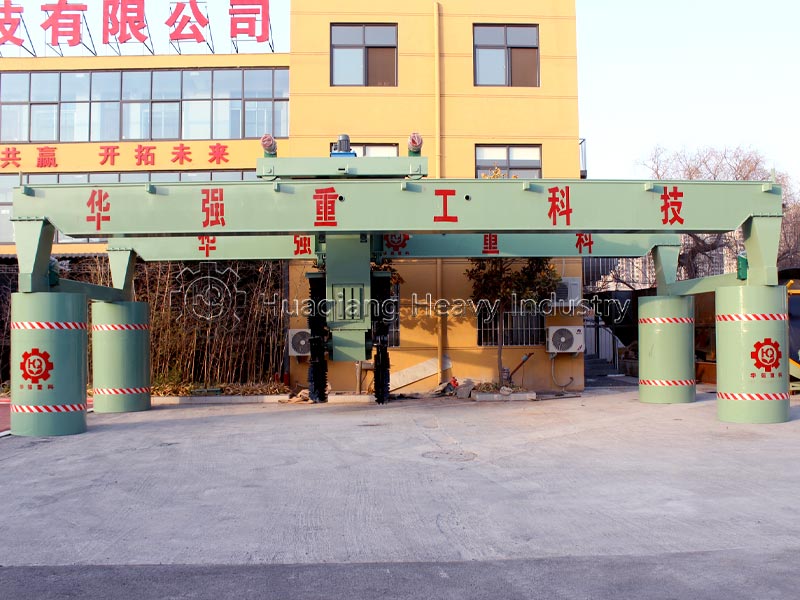
The large wheel compost turning machine(large wheel compost turner) is an aerobic fermentation turning/mixing device used for organic waste such as livestock and poultry manure, sludge, sugar mill filter mud, pomace, straw sawdust, etc. Its core functions are:
1. Lifting and turning the material from the bottom of the pile to the top through disc lifting and turning, and then conveying it forward/outward;
2. Increasing the contact between the material and air, thus improving the efficiency of aerobic fermentation;
3. Achieving uniform turning, crushing and mixing, and removing moisture (to a certain extent), shortening the composting cycle.
The equipment is suitable for trench-type fermentation: It can be used with fermentation chambers/fermentation tanks to form a continuous or batch fermentation production line. The equipment typically has a centralized control cabinet, supports manual/automatic control, and is equipped with safety protection such as limit switches.
Equipment Structure Composition
The large wheel compost turning machine mainly consists of the following core components:
1. Turning Device (Core Working Component)
This comprises a motor, reducer, discs, and manganese steel toothed turning plates. Special curved turning blades (rake teeth or blades) are evenly distributed on the discs, creating a powerful scattering of the material during rotation. The turning device uses an intermediate chain drive mechanism to drive two large diameter turning discs symmetrically.
2. Power Transmission Device
This consists of a motor, reducer, bearing housing, and main shaft, and is a crucial device providing power to the turning discs. The motor directly transmits power to the reducer, which is connected to the main shaft of the turner.
3. Traveling Device
This consists of a traveling motor, transmission gears, and traveling wheels. The equipment runs smoothly along the fermentation tank track, enabling the turner to move longitudinally along the fermentation tank.
4. Hydraulic Lifting Device
This consists of a hydraulic pump station, solenoid valve body, hydraulic oil pipes, and hydraulic cylinder. The hydraulic system controls the lifting depth of the discs, adjusting the turning operation height.
5. Frame (Cable Tray)
Typically consists of a cross-bracing cable tray and a traversing trolley. The cable tray spans both sides of the fermentation tank, supporting the weight of the entire equipment.
6. Electrical Control System
Centralized control cabinet, enabling manual or automatic control functions. Equipped with a fully automatic intelligent control system, supporting functions such as automatic movement, reciprocating turning, timed start/stop, and stepless speed regulation. Limit switches serve for safety and limiting functions.
Applications of the Equipment
The large wheel compost turning machine is widely used in the following fields:
1. Livestock and poultry manure treatment: Harmless treatment and resource utilization of livestock and poultry manure such as pig manure, chicken manure, cow manure, and sheep manure.
2. Agricultural waste treatment: Crop straw, rice husks, edible mushroom residue, sugarcane bagasse, and other waste residues.
3. Sludge treatment: Sludge from urban sewage treatment plants, sugar mill filter mud, and paper mill sludge.
4. Municipal solid waste treatment: Composting of organic municipal solid waste and kitchen waste.
5. Industrial organic waste: Food processing waste, pharmaceutical residues, and brewing waste.
6. Landscaping: Composting and fermentation of garden pruning waste and fallen leaves.
Applicable scenarios: Large-scale organic fertilizer plants, compound fertilizer plants, large-scale farms, sludge and waste treatment plants, horticultural farms, and button mushroom cultivation plants, etc. It can be used in conjunction with solar fermentation chambers and fermentation tanks; the matching fermentation tanks can discharge continuously or in batches.
Raw Materials for the Equipment
The large wheel compost turning machine can handle a wide range of raw materials, mainly including:
| Raw Material Category | Specific Raw Materials | Pretreatment Requirements |
|---|---|---|
| Livestock & Poultry Manure | Pig manure, chicken manure, cow manure, sheep manure, duck manure | Moisture content 50%–65%, mix with auxiliary materials |
| Crop Straw | Corn straw, wheat straw, rice straw, bean straw | Must be crushed to ≤10 cm |
| Agricultural By-products | Rice husk, peanut shell, cottonseed hull, mushroom residue, vinasse & meal residue | Used as auxiliary materials to adjust C/N ratio |
| Sludge Materials | Municipal sludge, sugar mill filter mud, papermaking sludge | Mix with dry materials to adjust moisture content |
| Domestic Organic Waste | Kitchen waste, fruit peel, vegetable leaves | Sort and remove non-biodegradable impurities |
| Others | Biogas residue, distiller’s grains, Chinese herbal medicine residue, sawdust | Proportioning according to material characteristics |
Raw Material Proportioning Requirements:
1. Carbon-to-nitrogen ratio (C/N) adjusted to approximately 25:1
2. Moisture content controlled at 50%–65%
3. pH value controlled at 6–9
4. Materials pre-piled in the fermentation tank, with a pile height of 1.5–3 meters.
Equipment Working Principle
The working principle of the large wheel compost turning machine is based on the biological requirements of aerobic fermentation, revolving around the rotation of the disc for turning, material lifting, and oxygen supply:
Step 1 – Equipment Positioning and Disc Lowering
The equipment spans the fermentation tank, running along tracks on both sides of the tank. The hydraulic lifting device is activated to slowly lower the disc to the bottom of the fermentation tank, adjusting its position off the ground.
Step 2 – High-Speed Disc Rotation and Turning
The main motor drives the reducer, which transmits power to the turning disc via a sprocket. The disc rotates at high speed (typically 200-400 rpm), and the alloy blades on the rim cut into the pile like milling cutters.
Step 3 – Material Lifting and Dispersing
High-strength throwing blades on the disc lift the material from the bottom of the tank to the top surface of the pile, scattering it into the air through centrifugal force. During operation, the material is continuously lifted, scattered, and dispersed.
Step 4 – Tilting, Mixing, and Relocation
During operation, the disc can turn, mix, and move the material in the fermentation tank to a distance of 2-7 meters. The symmetrical tumbling and dispersing of the material via a rotary disc, coupled with the movement of a speed-adjustable trolley, achieves thorough tumbling and dispersing without any blind spots.
Step 5 – Oxygenation and Heat Dissipation: During the dispersal process, the material comes into full contact with oxygen in the air, allowing aerobic microorganisms to accelerate the decomposition of organic matter under sufficient oxygen conditions. Simultaneously, the entire heat dissipation and cooling process is completed uniformly, effectively preventing problems such as localized high-temperature burning, acidification, and caking within the pile.
Common equipment problems and solutions
| Common Faults | Cause Analysis | Treatment Suggestions |
|---|---|---|
| Short turning distance | Deformed rake teeth/shaft, foreign matter winding, gear jamming | Repair and clean rake teeth, remove foreign objects, replace gears |
| Unstable traveling / abnormal noise | Foreign matter inside traveling mechanism, lack of lubricating oil | Clear foreign matter, add lubricating oil |
| Difficult motor startup / buzzing sound | Worn bearings, deformed shaft, abnormal voltage | Replace bearings, calibrate the shaft, restart after voltage returns to normal |
Equipment Application in Production Line
I. Typical Fermentation Production Line Flow (Aerobic Trench Fermentation)
Raw material pretreatment (crushing, humidification, proportioning); Trench stacking; Large disc turner turning and aeration; Maturation; Discharge (continuous or batch operation possible); Post-processing (screening, granulation, drying, etc., selected according to product process)
II. Role of the Turner in the System
1. The turner is not a simple mixing device; it has integrated functions of lifting, turning, and pushing.
2. It plays a decisive role in the uniformity of material fermentation and the stability of the temperature and humidity field of the pile, ensuring the aerobic fermentation effect.
3. The equipment has strong adaptability and can be perfectly integrated with subsequent sections of the production line such as discharge, transfer, and granulation, realizing the integration and continuous production of the entire process system.
Fermentation Process of the Equipment
The large wheel compost turning machine serves the aerobic composting fermentation process, its core function being to provide sufficient oxygen for aerobic microorganisms.
1. Aerobic Fermentation Principle
Composting fermentation is a microbial-dominated exothermic process. The disc turner, through turning and tossing, ensures full contact between the material and air, providing oxygen for aerobic microorganisms and promoting the decomposition of organic matter. The turner also has a crushing function, significantly saving time and labor, and significantly improving production efficiency and product quality.
2. Fermentation Temperature Control
Temperature control is crucial in the fermentation process:
Suitable Temperature Range: 55–65℃ is the critical temperature for killing pathogens and weed seeds.
Excessively High Temperature (above 70℃): Beneficial microorganisms’ activity decreases or even die, resulting in “compost burning.”
Excessively Low Temperature: It is difficult to maintain the high-temperature period, prolonging the harmless treatment time.
Control Methods: Controlling the heat dissipation rate of the compost pile by adjusting the turning frequency and depth.
3. Fermentation Cycle
With continuous turning and oxygen supply from the disc turner, the compost pile temperature is balanced and stable, maintaining a stable sterilization temperature of 55–70℃. The entire fermentation and maturation cycle typically takes 20-25 days to complete harmless maturation, thoroughly killing insect eggs and pathogens, and meeting the standards for organic fertilizer raw materials. In some high-efficiency scenarios, the fermentation cycle can be shortened to 7-10 days.
4. Turning Frequency
The turning frequency needs precise control:
Too low a frequency: Heat accumulates inside the pile, with local temperatures exceeding 70℃, leading to “piling fire.”
Too high a frequency: The pile temperature drops frequently, making it difficult to maintain a high temperature period.
Intelligent Control: Modern rotary turners integrate sensors and a PLC control system, which can automatically adjust the turning frequency and depth.
Equipment Operation Method
I. Pre-Trial Run Inspection
1. Check that the reducer and all lubrication points have sufficient lubricating oil.
2. Check the power supply voltage. The rated voltage is 380V, and the voltage drop should not be less than 10% (i.e., 340V) or more than 10% (i.e., 415V). Do not start the machine if it exceeds the range.
3. Check that the connections of the motor and electrical components are secure, and ground the motor with a wire for safety.
4. Check that all connections and bolts are secure. If any are loose, tighten and weld them firmly.
5. Check the material accumulation height.
II. No-Load Trial Run
1. First, run the turning equipment. If the rotation direction is reversed, stop immediately and change the three-phase circuit connection.
2. While the equipment is running, listen for any abnormal noises from the reducer.
3. Touch the temperature of each bearing to see if it is within the temperature range.
4. Observe whether the rotating wheel rake teeth rub against the ground. If there is friction, adjust the wheel bolt angle.
Operating Sequence (Manual Mode):
1. Start the power; turn on the trolley power and move it to the designated position, then stop.
2. Pump station operation, lower the wheel.
3. Start the main motor, the wheel rotates.
4. Start the trolley, bring the wheel into contact with the material, the trolley stops; the trolley starts and moves to one side. When the trolley moves from left to right, the trolley automatically shuts off power.
5. Start the trolley, the trolley moves forward (the distance depends on the width of the material being turned and the depth of the trough) to the specified distance, the trolley stops.
6. Start the trolley’s other switch, the trolley moves back. When the trolley automatically shuts off power, the trolley starts.
7. Stop: the trolley and main motor shut off power, the hydraulic cylinder works, the wheel retracts to a horizontal position, power is cut off.
III. Load test run
1. Start the turning equipment, start the hydraulic lifting device, and place the wheel at the bottom of the fermentation tank.
2. Depending on the ground level, if the overall level error of the same ground is less than 15 mm, the wheel can be controlled at about 30-50 mm off the ground.
3. If the fermentation tank ground is not level, the turning blades can only be controlled at more than 50 mm off the ground.
4. After adjusting the wheel’s distance from the ground, set the equipment to the working walking speed for turning.
5. During the turning process, observe carefully. If the blades hit the ground, immediately lift the turner to avoid damaging the equipment.
6. During load testing, the transmission components should operate smoothly without abnormal noise.
7. The electrical control system should operate stably, with sensitive start-stop and accurate action.
IV. Safety Precautions
1. No one should pass in front of or behind the turner during production. Warnings should be given before starting the machine, and personnel should stay away from the machine.
2. No maintenance or lubrication should be performed during production.
3. When turning, the machine must travel at the specified speed and must not exceed the speed limit.
4. No one other than the machine operator should operate the machine without authorization.
5. To avoid overloading the motor during the turner’s operation and damaging it, check for any accumulated material in front of the reamer before shutting down the machine. Avoid stopping the machine when there is any material.
6. Operators should not operate the turner after drinking alcohol, or when feeling unwell or unwell.
7. For safety reasons, all tracks of the turner must be grounded.
8. When replacing cable trays or cables, the power must be disconnected.
Equipment Parameters
| Model | Main Motor | Small Car Travel Motor | Big Car Travel Motor | Hydraulic Pump Motor |
|---|---|---|---|---|
| LP-10m | 55KW | 1.5KW×4 | 1.5KW×2(4) | 4KW |
| LP-12m | ||||
| LP-15m | ||||
| LP-20m |
Equipment Maintenance Methods
1. Pre-shift Inspection Items (Before starting each shift):
Check that fasteners are secure;
Check that the bearing clearances of transmission components are appropriate: too loose will cause slippage, too tight will result in excessive rotational resistance;
Add grease/butter (the diagram clearly states: add grease to the bearing housing);
Check the gearbox oil level;
Check that electrical connectors are secure.
2. Post-shift Maintenance (At the end of each shift):
Clean up any residue and leftover materials from the machine and surrounding area;
Add lubricating oil to all lubrication points;
Disconnect the power switch.
3. Weekly Maintenance Items:
Check the gearbox oil level and replenish the gear oil;
Clean up any residual or accumulated materials from the equipment to ensure proper heat dissipation and normal operation;
Check the contactor contact condition in the electrical control cabinet; replace any damaged contactors immediately.
4. Periodic Inspection Items:
Check the operation of the motor and reducer: if there is any abnormal noise/overheating, stop the machine immediately;
Check bearing wear: replace bearings if excessively worn.
Advantages of the Equipment
Compared to traditional trough-type compost turners, the large wheel compost turning machine offers the following advantages:
1. Larger Turning Depth: The turning depth can reach 2.6 meters, meaning a larger material load per unit area and saving factory floor space.
2. Wide Span: A single machine can span 24-30 meters, suitable for ultra-large fermentation tanks.
3. Low Energy Consumption: Utilizing a unique disc structure, the turning resistance is lower, resulting in lower energy consumption compared to traditional compost turners for the same workload.
4. No Dead Corners: With the trolley’s lateral movement, turning can be achieved without dead corners throughout the entire fermentation tank.
Large wheel compost turning machines, as core equipment in the fermentation section of large and medium-sized organic fertilizer production lines, have become the preferred fermentation equipment for large-scale organic fertilizer plants, large-scale farms, and sludge treatment centers due to their advantages such as large span, deep depth, high automation, and low energy consumption. Their ground-trough aerobic fermentation technology can transform organic raw materials such as livestock manure and agricultural waste into high-quality organic fertilizer within 15-30 days, achieving the dual goals of resource utilization and environmental protection.
Whether you need a compost turner or plan an entire fertilizer production line—from fermentation and turning, crushing and mixing, to granulation, drying and cooling, screening and packaging—we can provide you with a one-stop solution.