
We are a professional manufacturer of organic fertilizer equipment and a customized service provider for fertilizer production lines
-
NO.313, Wanshan Road, Xingyang City, Zhengzhou City, Henan Province, China
Company Address
-
Call Us: +86-18703630069
(Sat - Thursday)
-
inquiry@hqhifertilizermachine.com
Our Email
Rotary Drum Granulator
Equipment Introduction
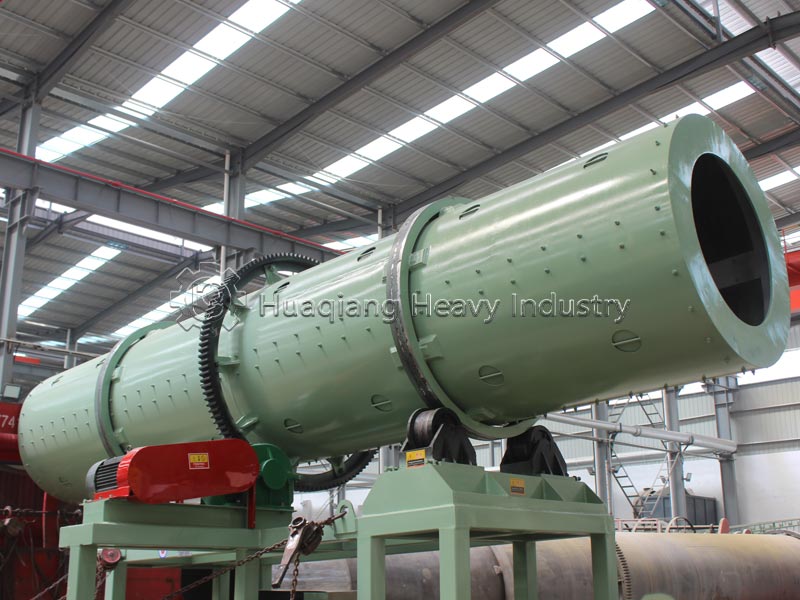
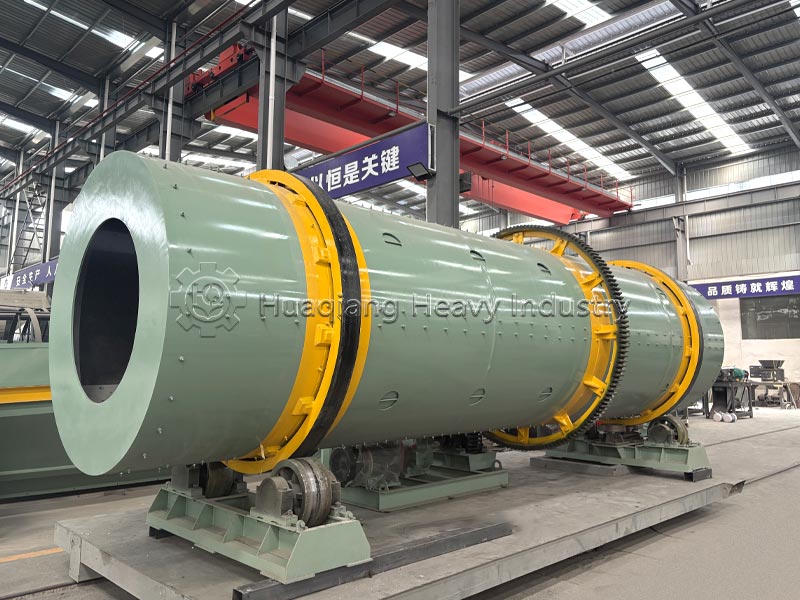
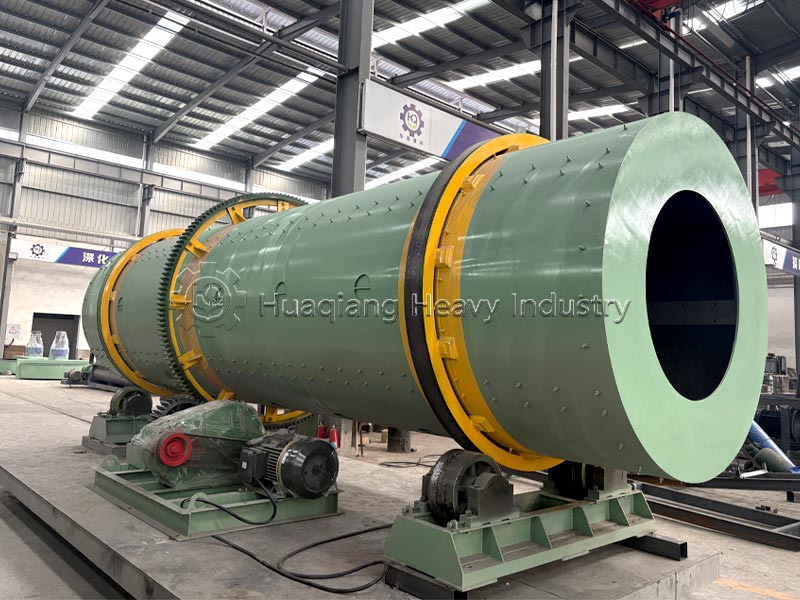
A rotary drum granulator, also known as a drum granulator, is a molding machine that processes powdery or slurry materials into spherical granules through a rotating drum. This equipment is one of the key pieces of equipment in the compound fertilizer industry, suitable for cold and hot granulation, as well as large-scale production of high, medium, and low concentration compound fertilizers.
The rotary drum granulator adopts a wet granulation process. A certain amount of water or steam is used to moisten the base fertilizer inside the drum, allowing it to react fully. Under certain liquid phase conditions, the rotation of the drum causes the material particles to agglomerate into spheres through extrusion pressure. Steam, gaseous ammonia, or phosphoric acid, nitrogen solutions, phosphorus-ammonia slurries, and heavy calcium carbonate slurries can be introduced into the machine to complete the chemical reaction and heating process of compound fertilizer granulation within the drum; a small amount of water can also be added for cold granulation of compound fertilizers.
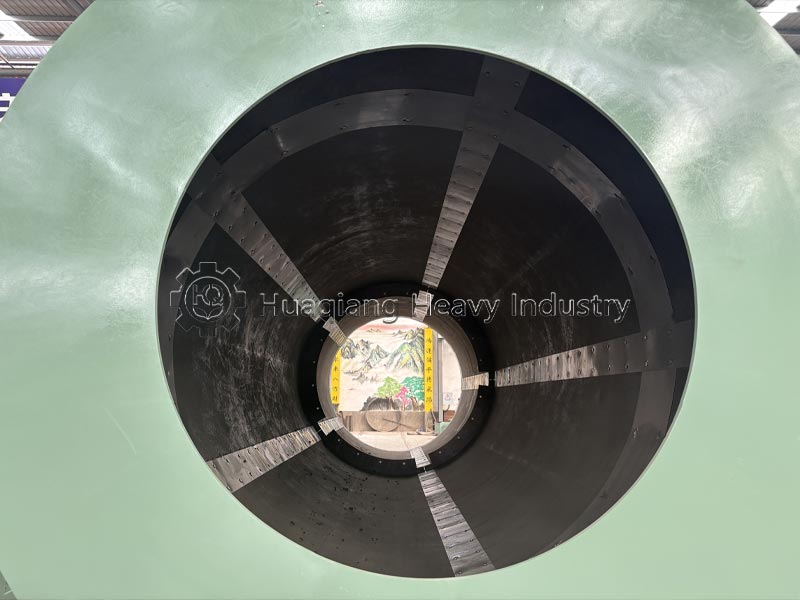
The drum body of this machine uses a special rubber plate lining or acid-resistant stainless steel lining, achieving automatic descaling and nodule removal, eliminating the need for traditional scraper devices. The equipment features high pellet strength, good appearance quality, corrosion resistance, wear resistance, low energy consumption, long service life, and convenient operation and maintenance. The rotary drum granulator overcomes many disadvantages of the disc granulator in terms of batching, particle forming rate, particle strength, output, labor intensity, dust in the granulation workshop, and cost, making it the preferred granulation equipment for high-concentration compound fertilizer production.
Equipment Structure Composition
The rotary drum granulator mainly consists of the following components:
| Component Name | Material / Specification | Core Function Description |
|---|---|---|
| Drum Body | Welded high-quality medium carbon steel plate, lined with special rubber plate or acid-resistant stainless steel plate | The core working cavity of the equipment, providing a core space for materials to tumble, agglomerate and form granules. The lining prevents material sticking, resists corrosion and improves granulation performance |
| Girth Gear | High-tech wear-resistant material | Fixed outside the drum body, precisely meshes with the pinion to transmit power to the drum and drive its uniform rotation; it is the core transmission component |
| Riding Ring | ZG270-500 cast steel with high-frequency quenched surface | Mounted on both sides of the drum body, cooperates with support rollers to bear the full weight of the drum and materials, ensuring stable rotation with excellent wear and impact resistance |
| Support Rollers | Anti-corrosion and wear-resistant alloy material | Supports the operation of riding rings, bears all radial loads of the drum and materials, reduces rotation friction and guarantees long-term stable equipment operation |
| Support Frame | Q345B medium carbon steel & channel steel welded structure with normalizing treatment | The load-bearing base structure of the equipment, provides stable installation support for support rollers and drum body. Anti-deformation and anti-vibration, suitable for heavy-duty industrial production |
| Drive Unit | Motor + pulley + hard-tooth surface reducer + pinion | Supplies stable rotating power for the drum. The reduction unit outputs high torque to adapt to continuous heavy-duty operation, with variable frequency speed regulation available |
| Feed End | Sealed feed hopper / spiral feed inlet | Evenly receives raw materials and returned granules to realize quantitative and continuous feeding. The sealing structure eliminates dust overflow and material leakage |
| Discharge End | Sealed discharge hood | Smoothly discharges finished formed granules. The sealing structure blocks dust and steam leakage to meet workshop environmental compliance requirements |
| Spray System | Stainless steel pipeline + high-pressure atomizing nozzles | Uniformly sprays clean water, binders, nutrient liquid and other liquid media into the drum, activates capillary adsorption of materials and promotes powder agglomeration into spherical granules |
| Steam/Ammonia Line | Perforated distribution pipe | Dedicated for thermal granulation and chemical granulation processes. Evenly delivers steam and reaction gas into the drum for material heating, conditioning and chemical reaction granulation |
| Lifting Flights | Lightweight wear-resistant steel plates evenly arranged along the drum inner wall | Lift and scatter materials as the drum rotates to realize full mixing and tumbling, preventing material accumulation and wall adhesion for uniform granulation |
| Ring Dam | Adjustable structural design | Accurately controls the depth of material bed inside the drum, extends or shortens material residence time to match forming processes of different raw materials |
| Hood | Steel structure + flexible sealing material | Encloses the granulation cavity to control overflow of dust, steam and harmful gas, complying with environmental protection standards and ensuring production safety |
The cylinder is lined with a special rubber plate or acid-resistant stainless steel plate, which can realize automatic scar removal and tumor removal, eliminating the traditional scraper device. Breathing holes are provided behind the rubber lining and on the cylinder wall. When the cylinder rotates upward, the rubber plate automatically sag and deform due to its own weight and the gravity of the adhesive material, causing the adhesive material to crack and fall off, achieving self-cleaning.
Applications of the Equipment:
1. Fertilizer Production: High, medium, and low concentration compound fertilizers, organic-inorganic compound fertilizers, phosphate fertilizers (such as DAP/MAP), and basic granules for controlled-release fertilizers.
2. Metallurgy and Mining: Pelletizing of iron concentrate and granulation of ore powder.
3. Environmental Protection: Harmless granulation treatment of municipal sludge, fly ash, and desulfurization gypsum.
4. Feed Industry: Large-scale forming of fish feed and compound feed for large poultry and livestock.
Raw Materials for the Equipment:
Compound fertilizer (NPK): urea, potassium chloride, ammonium phosphate, and other basic fertilizers.
Organic fertilizer: fermented livestock and poultry manure, humic acid, and municipal sludge.
Chemical materials: such as de-icing agents and certain catalyst carriers.
Special raw materials: gaseous ammonia or liquid acid can be directly introduced for tubular reaction granulation.
Working Principle of the Equipment
The working principle of the rotary drum granulator is based on the tumbling and agglomeration mechanism:
1. Material Input: Powdered raw materials and return materials enter the inclined rotating drum through the feed end. The drum inclination angle is typically 2°–5°, allowing the material to move slowly towards the discharge end under gravity.
2. Tumbling Motion: The drum rotates at a speed of 10–15 RPM. The material is lifted to a certain height under the action of centrifugal force, friction, and lifting blades, and then rolls down under gravity, forming a continuous tumbling bed. The tumbling motion causes sufficient collision and compression between particles.
3. Binder Injection: During the tumbling process, a liquid-phase binder (water, steam, dilute phosphoric acid, nitrogen solution, etc.) is sprayed onto the bed through a spray system, wetting the particle surface and causing them to adhere to each other under surface tension.
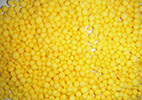
4. Agglomeration and Growth. The moistened particles collide and adhere to the surrounding powder during tumbling, undergoing nucleation, layering, compaction, and rounding processes, gradually growing to the target particle size (typically 2–4 mm).
5. Chemical Reaction (Thermal Granulation). In thermal granulation mode, steam, gaseous ammonia, or phosphoric acid slurry can be introduced to complete the chemical reaction and provide heat within the cylinder, causing the material to agglomerate into spheres under the influence of humidity and temperature.
6. Discharge. Driven by the cylinder’s tilt and rotation, the particles move towards the discharge end and are finally discharged from the outlet.
During operation, the bed volume should be controlled at 20%–30% of the cylinder capacity. Rotation speed is a critical parameter: too slow a speed causes material to accumulate at the bottom, while too fast a speed causes centrifugal force to prevent the material from tumbling against the wall.
Granulation Process
The rotary drum granulator adopts a wet granulation process. The core process parameters and control points are as follows:
1. Process Principle: The base fertilizer is moistened within the drum using a certain amount of water or steam, allowing for a thorough chemical reaction (or physical mixing). Under specific liquid phase conditions, the rotation of the drum causes the material particles to agglomerate into spheres due to pressure.
2. Process Classification
Hot Granulation: The granulation process involves introducing steam, gaseous ammonia, or adding phosphoric acid, nitrogen solution, phosphorus-ammonia slurry, or heavy calcium carbonate slurry into the drum, where the chemical reaction and heating are completed.
Cold Granulation: A small amount of water is added for compound fertilizer granulation.
3. Key Process Parameters
Drum Inclination Angle: Generally 2°-2.5°
Drum Rotation Speed: Generally 6.5-18 r/min, commonly 10-20 r/min
Material Moisture Content: Compound fertilizer 2%-4%; Organic fertilizer 20%-30%
Particle Strength: Can reach over 25N
Pelletizing Rate: Can reach 70%, with a small amount of returned material that can be re-granulated.
4. Process Characteristics
Steam heating increases material temperature, resulting in lower moisture content after pelletizing and improved drying efficiency.
Pelletizing rate reaches 70%, with small returned particle size that can be re-granulated.
High output, low power consumption, and low maintenance costs.
High particle strength and good appearance quality.
Process parameters can be adjusted by controlling particle characteristics through rotation speed, moisture content, and proportions.
Common Equipment Problems and Solutions
1. Low Particle Formation Rate, Excessive Fine Powder, and Inability to Form Balls
Core Causes: Insufficient material fineness, insufficient/uneven atomization spray volume, excessive cylinder speed, low material moisture content, and improper binder ratio; Solutions: Refine the material powder, unclog or replace atomizing nozzles, fine-tune and reduce cylinder speed, increase spray volume, and optimize binder ratio to ensure sufficient powder wetting and agglomeration.
2. Excessively Wet Particles, Severe Adhesion and Clumping
Core Causes: Excessive spray volume, excessively high material moisture content, excessively slow cylinder speed, and excessively long material residence time in the cylinder; Solutions: Reduce atomization spray volume, dry pre-treated materials, appropriately increase cylinder speed, and shorten material residence time.
3. Drum misalignment, axial movement, and operational vibration
Core causes: Uneven force on the support rollers, worn and ineffective thrust rollers, cylinder tilt angle deviation, loose foundation anchors, and uneven material loading; Solutions: Calibrate the support rollers for levelness and coaxiality, replace worn thrust rollers, recalibrate the cylinder tilt angle, tighten foundation bolts, and ensure even feeding to avoid uneven loading.
4. Abnormal noise during equipment operation and excessive gear noise
Core causes: Improper gear meshing clearance, insufficient grease, worn gears, damaged support roller bearings due to lack of oil, and foreign objects stuck in the transmission parts; Solutions: Adjust gear meshing clearance, add high-quality grease, replace worn gears and bearings, and clean foreign objects from inside the equipment.
5. Nozzle clogging and poor atomization
Core causes: High levels of impurities in the adhesive liquid, material dust clogging the nozzles, and long-term lack of cleaning of accumulated scale; Solutions: Filter the adhesive liquid, unclog nozzles daily, clean the spray pipes regularly, and install a pipe filter.
6. Decreased production capacity and slow discharge speed
Core causes: Severe material adhesion to the cylinder liner, uneven feed rate, improper speed matching, and insufficient transmission torque; Solutions: Thoroughly clean the material adhering to the cylinder, stabilize quantitative feeding, optimize speed parameters, and check the operating condition of the reducer and motor.
7. Dust overflow and seal leakage
Core causes: Aging and wear of seals, excessive inlet and outlet gaps, and failure of negative pressure dust removal; Solutions: Replace flexible seals, adjust sealing gaps, and install negative pressure dust removal equipment.
Operating Procedures
1. Pre-start Inspection: Check for foreign objects inside the cylinder; check the rollers, gears, and transmission device for proper functioning; check the spray system and steam pipeline for blockages; check the electrical system.
2. Preheating (Hot Granulation): First, introduce steam to preheat the cylinder until the internal temperature reaches the working conditions.
3. Start-up: First, start the transmission device to rotate the cylinder. Confirm the rotation direction is correct, the operation is smooth, and there is no abnormal noise before feeding material.
4. Feeding: First, establish the bed with returned material, then gradually add fresh raw materials. Control the feeding rate to match the cylinder’s processing capacity.
5. Liquid Spraying/Steaming: Adjust the spray volume or steam volume according to the material state to maintain suitable liquid phase content and temperature.
6. Operation Monitoring: Observe parameters such as current, temperature, and pressure; listen to the equipment’s operating sound; periodically check the quality of the discharged granules.
7. Shutdown: First, stop feeding, and then shut down the machine after the material inside the cylinder has been basically emptied. For long-term shutdowns, clean any remaining material inside the cylinder. 8. Iron blocks, stones, wood blocks and other debris are strictly prohibited from entering the cylinder to prevent damage to the lining and lifting blades.
Equipment Maintenance Methods
Lubrication Management: The large and small gears and support rollers must be lubricated with grease regularly, typically once per shift.
Balance Check: Observe whether the contact surfaces of the tire and support rollers are evenly worn. If there is a deviation, adjust the support roller angle promptly.
Cleaning the Liner: Although the rubber liner has a self-cleaning function, the inside of the drum should be thoroughly cleaned before long-term shutdown to prevent material clumping, which could lead to excessive restart load.
Application of Equipment in Production Lines
Drum granulators are typically used as the core granulation equipment in production lines, located after crushing and mixing processes and before drying, cooling, and screening processes.
1. Typical Flowchart of Compound Fertilizer/Blended Fertilizer Production Line
Raw material crushing → Batching and mixing → Drum granulation (steam or water introduced) → Drying → Cooling → Screening → Coating → Automatic packaging
The various processes are connected by equipment such as belt conveyors. The material exiting the granulator is dried, cooled, and screened to obtain the finished product.
2. Typical Flowchart of Organic Fertilizer Production Line
Fermentation Section (Fermentation, Composting, and Dehydration of Livestock and Poultry Manure) → Crushing and Sieving → Drum Granulation → Cooling → Screening → Packaging
3. Typical Flowchart of Ammonium Sulfate Production Line
Raw Material Preparation (Mixing Ammonium Sulfate Powder with Potassium Chloride, Urea, Monoammonium Phosphate, etc.) → Mixing and Stirring → Drum Granulation → Drying and Screening → Cooling and Packaging
4. Supporting Equipment for Production Line
Crushing Process: New Semi-Wet Material Crusher, Vertical/Horizontal Crusher
Stirring Process: Vertical Mixer, Horizontal Mixer, Twin-Shaft High-Intensity Mixer
Conveying Process: Belt Conveyor
Granulation Process: Drum Granulator (Core)
Drying and Cooling Process: Rotary Dryer, Cooler
Screening Process: Drum Screen, Vibrating Screen
Coating Process: Granule Coating Machine
Packaging Process: Automatic Quantitative Packaging Machine
Equipment Parameters
| Model | Diameter(mm) | Length(mm) | Inclination(°) | Rotation Speed(r/min) | Capacity(t/h) | Motor Power(Kw) |
|---|---|---|---|---|---|---|
| ZG1.2*4.0 | 1200 | 4000 | 2.5 | 17 | 1-3 | 5.5 |
| ZG1.5*6.0 | 1500 | 6000 | 2.5 | 11.5 | 3-5 | 7.5 |
| ZG1.8*7.0 | 1800 | 7000 | 2.5 | 11.5 | 6-10 | 18.5 |
| ZG2.0*8.0 | 2000 | 9000 | 2.5 | 11 | 10-15 | 22 |
| ZG2.2*12 | 2200 | 12000 | 2.5 | 10.5 | 15-20 | 37 |
Target Customers for this Equipment:
1. Compound fertilizer manufacturers, chemical fertilizer plants, and functional fertilizer R&D and production enterprises;
2. Large-scale organic fertilizer processing plants, bio-organic fertilizer enterprises, and soil remediation enterprises;
3. Solid waste resource utilization and environmental protection companies, and agricultural and forestry waste recycling enterprises;
4. Mineral powder processing, chemical auxiliary material production, and environmental granule production enterprises;
5. Project owners building new fertilizer industrial parks and expanding mass production lines;
6. Environmental equipment distributors, engineering suppliers, and production line customization service providers.
Rotary drum granulators, with their core advantages of high output, high pelletizing rate, flexible processing (both hot and cold processing), and high pellet strength, have become the preferred granulation equipment for large-scale production in the fertilizer industry, including compound fertilizers and organic fertilizers. Their core technology lies in utilizing a rotating drum and wet granulation process to agglomerate powdery materials into high-strength spherical pellets under liquid phase conditions. The equipment is robust and durable, easy to operate and maintain, and has a wide capacity range from 3 tons/hour to 35 tons/hour. Compared to disc granulators, rotary drum granulators offer higher output and are more suitable for large-scale continuous production; compared to extrusion granulators, rotary drum granulators use a wet process, resulting in higher pellet roundness and better appearance. With the large-scale and intensive development of the fertilizer industry, the market demand for rotary drum granulators will continue to grow due to their comprehensive advantages of high capacity, high quality, and low operating costs.
Whether you are building a new fertilizer production line and need a complete equipment solution, upgrading an existing production line and need equipment selection advice, or dealing with equipment malfunctions and needing technical support—we are always ready to provide you with professional and sincere service.