

Designed Specifically for Small-Scale Production
For small-scale organic fertilizer plants, livestock farm-affiliated fertilizer workshops, or family farms with an annual output of several hundred to two or three thousand tons, equipment investment costs and production flexibility are often more important than single-machine capacity. The cage crusher is designed to meet this need. With its simple structure, affordable price, and easy maintenance, it has become a common crushing solution for small-scale organic fertilizer production lines.
Working Principle: Multi-Layer Rotating Cage Bars
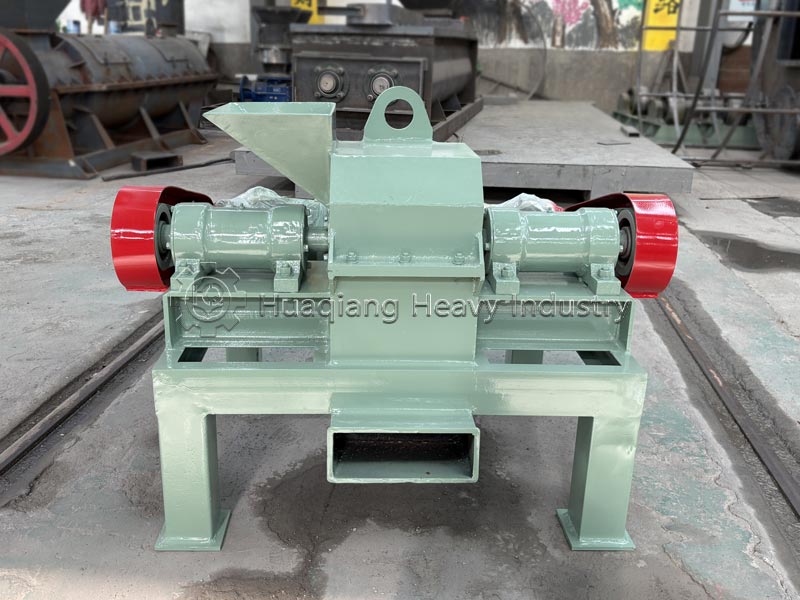
The cage crusher is a medium-sized vertical crushing device. Internally, it consists of multiple layers of concentrically arranged steel cage bars, divided into inner and outer cages. During operation, the motor drives the main shaft to rotate, and the inner and outer cages rotate at high speed in different directions. Material falls into the inner cage from the top feed inlet and is thrown towards the outer cage under centrifugal force. During the process of passing through multiple rotating cage bars, the material is subjected to continuous, high-intensity impacts and collisions, gradually being crushed into fine powder. The crushed material is discharged from the bottom outlet by gravity, without the need for a screen, thus reducing the risk of clogging.
Equipment Advantages: Low Investment, High Return
Cage crushers demonstrate unique competitiveness in small-scale production scenarios:
Low Investment Costs: Cage crushers typically cost only one-third to one-half the price of hammer or chain crushers of the same specifications, significantly lowering the equipment purchase threshold for small-scale users.
Simple and Reliable Structure: The machine has no complex hydraulic or pneumatic components, minimizing potential failure points. As long as the motor is running normally, the equipment can operate stably, making it ideal for small production sites with limited technical capabilities.
Easy Cleaning and Maintenance: The casing adopts a split structure, easily opened by unscrewing bolts. Replacing worn cage bars requires only simple tools, and ordinary workers can complete the task independently after simple training.
Strong Adaptability to Materials: It can process fermented organic materials with a moisture content of 20% to 40%. Even with small amounts of fiber or small clumps, it is not prone to clogging, and the output fineness can be controlled below 3 mm, meeting the requirements for subsequent granulation or direct packaging.
Economical Energy Consumption: Small models are equipped with 11-22 kW motors, consuming less than 20 kWh per hour. The crushing cost per ton of material is only a few yuan, comparable to large-scale equipment.
Applicable Scenarios and Selection Recommendations
Cage crushers are best suited for the following scenarios: small-scale organic fertilizer production lines with an annual output of less than 2000 tons; experimental or customized production requiring flexible formula changes; and processing fermented materials such as livestock and poultry manure, straw, and soybean meal.
The cage crusher is an ideal half-wet material crusher machine for small-scale organic fertilizer production. For a bio organic fertilizer production line or npk fertilizer line, the cage crusher prepares the material for subsequent processes. After crushing (output fineness <3 mm, suitable for 20%-40% moisture materials), the material is ready for granulation. For a roller press granulator production line, the dry material is fed into a double roller press granulator for compaction. After granulation, the product is processed through a rotary drum screening machine, fertilizer dryer machine (for wet processes), fertilizer cooler machine, and fertilizer packing machine. The cage crusher’s advantages for small-scale production (annual output <2000 tons): low investment (1/3 to 1/2 the price of hammer/chain crushers), simple structure (no complex hydraulics), easy cleaning (split casing), strong adaptability (handles 20%-40% moisture, fibers, small clumps), and economical energy consumption (11-22 kW motor, <20 kWh/hour). Selection criteria: cage bar material (high manganese steel or 65Mn), motor power (with margin), and anti-clogging device. For users planning expansion, start with a cage crusher, then upgrade to a chain or semi-wet crusher as output increases—the initial investment is not wasted. The cage crusher is a cost-effective entry point for small-scale organic fertilizer and compound fertilizer production. Understanding its role in the overall production line is essential for efficient, low-cost operation. Contact us for model selection and trial runs with your raw materials.
Key considerations when selecting a model include: cage bar material (high manganese steel or 65Mn recommended), motor power (with a certain margin recommended), and whether it is equipped with an anti-clogging device. It is worth mentioning that users with plans to expand production can start with a cage crusher and then consider upgrading to a chain crusher or semi-wet material crusher as output increases—the initial investment will not be wasted, and the small-scale equipment can still be used for return material crushing or auxiliary production.