

Crushing and mixing occur before the granulation section, yet directly determine the pelletizing rate and nutrient consistency. Typical signs of selection errors include: frequent material blockage in the crusher, large fluctuations in fineness, or a high CV value in the mixer leading to inconsistent nitrogen, phosphorus, and potassium content in the same batch of particles. The correct order of judgment is simple: first consider the material’s moisture content, then determine the fineness, and finally, consider capacity.
Crushing Section: Moisture is the dividing line between a cage crusher and a semi-wet material crusher.
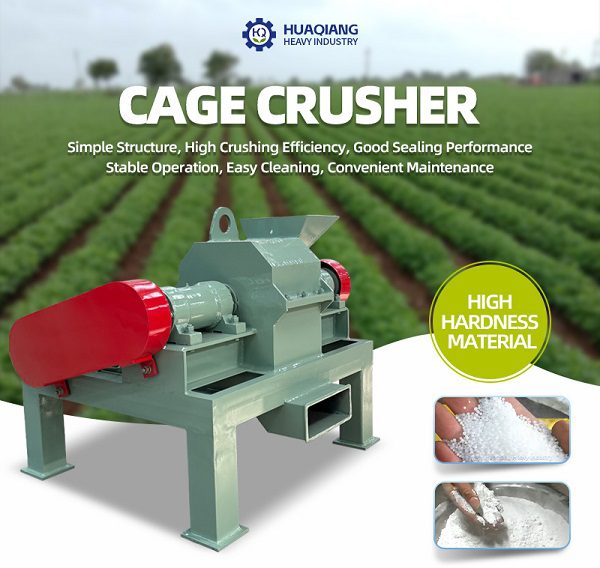
A cage crusher is designed for dry materials or low-moisture brittle materials with a moisture content ≤15%. It features multiple layers of rotating cage bars that break down materials through impact and shearing. It has no screen structure, and the output fineness can be adjusted between 20–80 mesh, with a capacity ranging from 1–10 t/h. It seamlessly integrates with disc granulation lines. For high-fiber dry materials such as straw, mushroom residue, and medicinal residue, cage crushers have a throughput approximately 30% higher than chain crushers, producing finer and more uniform particles, which is beneficial for subsequent mixing with microbial agents. However, cage crushers are not well-suited for highly moist and sticky materials; forced feeding can cause the cage bars to clump together and the current to spike. The half-wet material crusher fills this gap. Its dual-rotor structure primarily uses shearing and tearing, and can process highly moist materials such as fermented livestock and poultry manure and biogas residue with a moisture content of 20%–40%. The crushed material is loose and flocculent, preventing clogging and sticking. Fermentation output can be directly fed into the half-wet crusher, eliminating the need for pre-drying, making it a common configuration at the front end of chicken and cow manure organic fertilizer production lines. A simple way to judge: if the material clumps together but doesn’t release water when squeezed, a cage crusher is riskier; if it’s noticeably damp and clumps together, go directly to the half-wet material crusher.
Mixing Section: CV Value Difference Between Horizontal Ribbon Mixers and Vertical Disc Mixers
Mix uniformity is measured by the coefficient of variation (CV). A lower CV indicates more consistent nutrient content within the same batch. The double-layered, counter-rotating ribbon mixer in a fertilizer horizontal ribbon mixer creates axial convection, allowing for a stable CV value of ≤5% and uniformity of 97%–99%. This is particularly effective for formulas with large density differences, such as light organic materials and heavy inorganic salts. The trade-off is slightly higher residue and less adaptability to highly moist, sticky materials compared to vertical disc mixers.
Vertical disc mixers rely on a bottom rotating disc to toss and tumble materials. They have a simpler structure, consume approximately 20% less energy than horizontal mixers, are more tolerant of highly moist materials, and are less prone to sticking to the walls. Their CV is typically between 5% and 10%, making them suitable for mild mixing of BB fertilizers or small-scale, single-formulation organic fertilizer lines. The selection principle can be simplified as follows: For formulas containing trace elements or microbial agents, with large density differences, and high batch consistency requirements, choose a horizontal ribbon mixer; for materials that are relatively moist, of a single variety, and with limited budget and space, a vertical disc mixer is suitable.
Capacity Coordination: Crusher Slightly Higher Than Mixer, Pretreatment with 10%-15% Margin
The capacity of crushing and mixing is not necessarily better the higher it is; rather, it should form a gradient of “crushing slightly faster than mixing, mixing slightly faster than granulation.” The hourly capacity of the crusher should ideally be slightly higher than that of the mixer to avoid the mixer waiting for materials. The overall design capacity of the pretreatment section should leave a 10%-15% margin for the subsequent granulation section to absorb batch-to-batch moisture and fineness fluctuations in raw materials. The target fineness is usually controlled at 20-40 mesh before granulation; too coarse a mesh results in low pelletizing rate, while too fine a mesh increases the moisture requirement for granulation.
The appropriate combination of crushing and mixing machines can be determined by considering “raw material moisture + target fineness + daily processing capacity.” Cage crusher parameters are available on the product page; suitable scenarios for semi-wet material crushers are also available on the product page; comparative data on mixers are available in the study on the uniformity of horizontal and vertical mixing.