

The Art and Science of Pellet Magic
In the fascinating world of organic fertilizer production, the disc granulator acts like a skilled artist, transforming loose powder into uniform, consistent pellets. This traditional yet highly efficient technology, with its unique granulation method, holds an irreplaceable position in the fertilizer manufacturing sector.
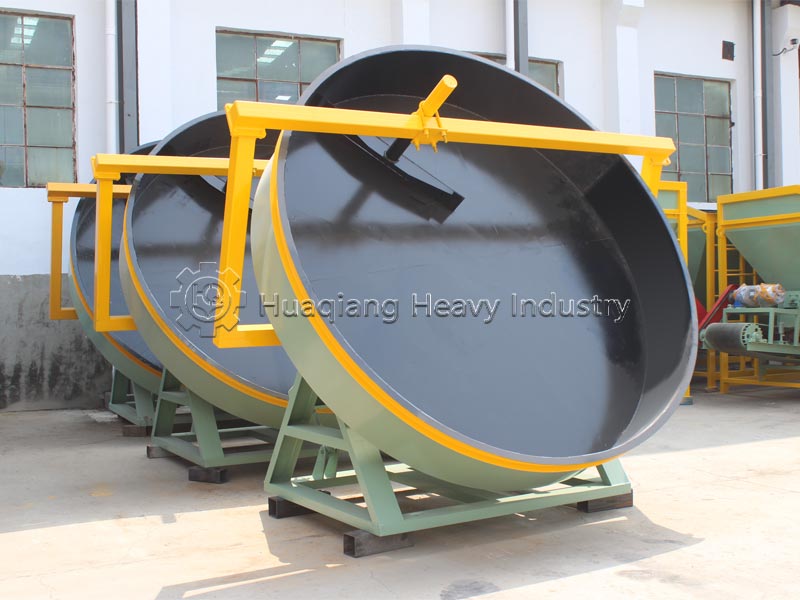
The heart of a organic fertilizer disc granulator is a large, inclined rotating disc, typically adjustable between 40-60 degrees. When premixed materials enter the disc, under the dual forces of rotation and gravity, they embark on a magical journey—powders adhere, roll, compact, gradually forming evenly sized pellets, much like rolling snowballs.
Advantages: Why Choose Disc Granulation?
- Superior Pellet Quality
Disc granulators produce pellets with smooth surfaces and high sphericity, offering moderate mechanical strength. This “spheroidization effect” is not only aesthetically pleasing but also beneficial for subsequent packaging, storage, and transportation, reducing dust generation. - Precise Particle Size Control
By adjusting disc inclination, rotation speed, and retention time, operators can precisely control pellet diameter, typically adjustable within the 2-8mm range. This flexibility meets the needs of different crops and fertilization methods. - Strong Process Adaptability
Whether processing composted livestock manure, plant straw, or food processing waste, disc granulators handle them effectively. Their tolerance for material moisture content (typically 20-35%) makes them ideal for organic fertilizer production. - Relatively Low Energy Consumption
Compared to extrusion or spray granulation, disc granulators primarily rely on mechanical rotation rather than high pressure or temperature, achieving energy savings of 25-40%. - Simple Maintenance and Low Cost
With simple structure and no complex hydraulic systems, disc granulators have low failure rates and easy maintenance, making them particularly suitable for small to medium-sized fertilizer producers.
Comparative Analysis: Disc Granulation in Dialogue with Other Technologies
In the family of granulation equipment, each technology has its unique positioning. Extrusion granulators produce high-density, strong pellets but with higher energy consumption; rotary drum granulators suit large-scale continuous production but require substantial investment; spray fluidized bed granulation creates fine, uniform particles but only for specific materials.
Disc granulators find the perfect balance point—they produce quality pellets while maintaining reasonable investment and operational costs. More importantly, their “visual” operation process allows operators to observe granulation status in real-time and adjust process parameters promptly, an advantage many closed granulation systems cannot match.
Synergistic Beauty: Harmonious Dance in Production Lines
In complete organic fertilizer production systems, disc granulators form perfect synergistic effects with other equipment:
Collaboration with half-wet material crushers: Crushers provide uniformly sized raw materials, laying the foundation for quality granulation
Integration with melting pot: melting pot ensures thorough mixing of nutrients, while disc granulation transforms them into user-friendly forms
Connection with drying and cooling systems: Pellets proceed to drying systems for final quality shaping
This between equipment transforms organic waste into high-value fertilizer, achieving a magnificent transition from “waste” to “resource.”
Future Vision: The Path to Intelligent Upgrades
Traditional doesn’t mean outdated. Modern disc granulators are undergoing intelligent transformations:
Equipped with PLC control systems for one-click operation and parameter memory
Installation of online moisture monitors for real-time water adjustment
Adoption of variable frequency speed control technology for precise disc speed regulation
Design of automatic disc cleaning devices to reduce manual cleaning intensity
These innovations breathe new life into ancient granulation technology, allowing it to continue playing a key role in the digital agriculture era.
Ecological Considerations: A Choice for Sustainable Development
In today’s pursuit of green agriculture, the value of disc granulators becomes even more prominent. They don’t require chemical binders, relying only on materials’ natural adhesiveness or minimal natural binders (like bentonite) to complete granulation, ensuring fertilizer’s environmental friendliness.
More importantly, disc granulators help achieve resource cycling of organic waste. Livestock manure and agricultural straw that might otherwise pollute the environment are transformed into quality organic fertilizers that improve soil health, truly practicing the ecological principle of “from the land, back to the land.”