
When choosing core granulation equipment for your new or upgraded fertilizer production line, double roller granulators (also known as roller extrusion granulators) and disc granulators are often the two main options. Their working principles, applicable scenarios, and economic aspects differ significantly. Choosing the right equipment isn’t simply about comparing prices, but requires a precise match based on your product positioning, raw material characteristics, and investment plan. This article will delve into the differences between these two types of fertilizer granulators to help you make an informed decision.
Working Principles and Core Characteristics: Fundamentally Different Technological Approaches
Understanding the fundamental differences between the two devices is the first step in making the right choice.
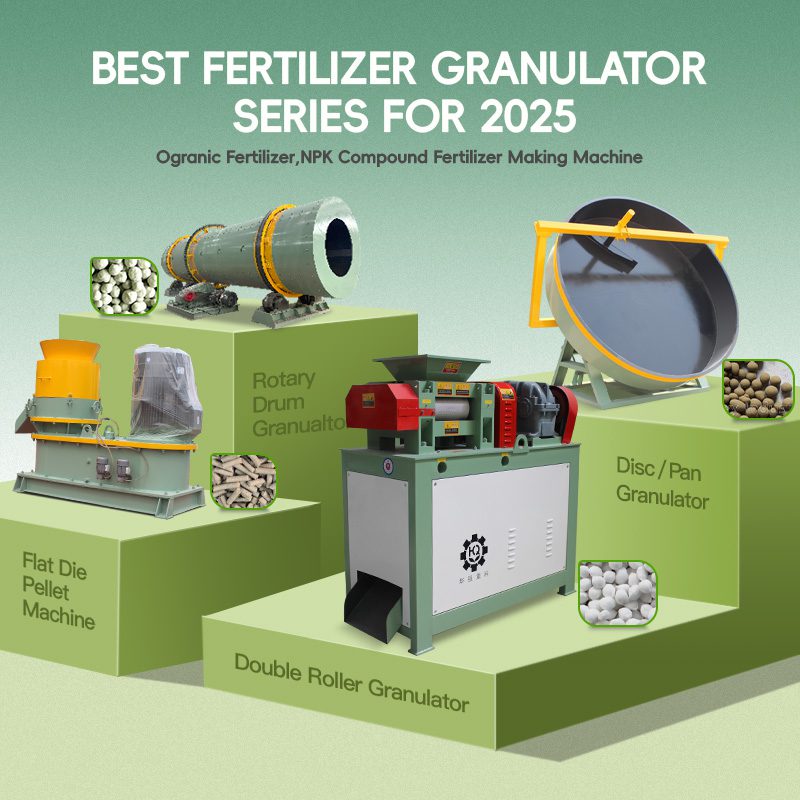
Disc granulators utilize the classic “agglomeration into spheres” method. It consists of a large, inclined rotating disc into which the mixed powdered material is fed. During rotation, by spraying a suitable amount of liquid (water or binder), the fine powder, under the combined action of centrifugal force, gravity, and adhesion, continuously collides, adheres, and coats itself, growing from small to large, gradually forming smooth, spherical granules. This process simulates natural agglomeration and requires a certain degree of plasticity in the material.
Double roller granulators, on the other hand, utilize a “powerful extrusion” physical molding method. They use a pair of precisely matched, synchronously counter-rotating rollers to forcibly press the dry powdered material into the concave molds on the roller surface. Under linear pressure of tens to hundreds of tons, the material is compressed into dense, regular flat or pillow-shaped granules. This process does not rely on moisture or heat, but purely uses immense mechanical force to tightly bind the material molecules together.
Applicable Scenarios: Precise Matching from Raw Materials to Products
What type of fertilizer you plan to produce is the primary factor in determining equipment selection.
If your main focus is on organic fertilizers or organic-inorganic compound fertilizers requiring high granule roundness, then a disc granulator is usually the more suitable choice. It has good adaptability to fermented organic materials with high moisture content, the granulation process is gentle, and it can better maintain the characteristics of organic matter. The spherical granules produced are more popular in the market. It is also often used in small and medium-sized compound fertilizer production lines for small-batch, multi-variety production.
The application of double-roller granulators, on the other hand, focuses on the production of special fertilizers, blended fertilizers (BB fertilizers) base granules, and compound fertilizers requiring high hardness. It is especially suitable for producing heat-sensitive fertilizers (such as those with added microbial agents and vitamins) because it completely avoids the drying process. At the same time, for high-nitrogen and high-salt index formulations, traditional steam granulation is difficult, but extrusion granulation can easily handle them. Its products dissolve relatively slowly, which also meets the market demand for slow-release characteristics.
Economics and Operation & Maintenance: Considering Long-Term Operating Costs
Equipment investment is the initial cost, while the difficulty of operation, energy consumption, and maintenance costs determine the long-term operating burden.
In terms of energy consumption, the double-roller granulator has a significant advantage. It does not require a subsequent drying process, consuming only electricity, saving up to 30%-50% of fuel costs, and producing almost no exhaust gas, resulting in less environmental pressure. Disc granulators usually require a subsequent drying system, resulting in higher energy consumption and environmental investment.
In terms of operation and maintenance, both have their own characteristics. Disc granulators are intuitive to operate; particle size can be controlled by adjusting the tilt angle, rotation speed, and liquid spray volume. However, the granulation rate and particle uniformity depend heavily on the operator’s experience, and the wear of the disc liner requires regular replacement. Double-roller granulators have a high degree of automation; particle size and shape are determined by the roller molds, resulting in better consistency. However, the rollers are the core wear parts, and wear is faster when pressing high-hardness or corrosive materials. Regular repair or replacement of the molds is a significant ongoing cost.
In terms of capacity and flexibility, large disc granulators have certain limitations in single-unit capacity; large-scale production often requires multiple units in parallel. Double-roller granulators, by increasing the width and number of rollers, can theoretically achieve very high single-line capacity, making them more suitable for large-scale continuous production of standardized products.
Conclusion and Recommendation: There is no best, only the most suitable
Returning to the initial question: which one is more suitable for you? If your core business is producing commercial organic fertilizers, prioritizing granular appearance, and dealing with high-moisture raw materials, a disc granulator is a time-tested and reliable option.
However, if your goal is to produce differentiated specialty fertilizers, prioritize energy efficiency, or work with dry powder raw materials and complex formulations, then a double-roller granulator will be a powerful tool to help you achieve cost reduction and product innovation through advanced technology.
Whether you choose a disc granulator or a double roller granulator, the post-granulation process is essential for final product quality in a complete npk fertilizer line. After granulation, the material typically requires further processing. A fertilizer drying machine reduces moisture content to safe levels (often below 2-5%), crucial for preventing caking during storage. Following drying, a rotary drum screening machine separates oversized and undersized granules, ensuring a uniform final product. The rejected materials are often recycled back into the production process. Efficient material transport between these stages is achieved using a bucket elevator, minimizing degradation and dust. Finally, the consistent, screened granules are fed into an automatic packing machine, which precisely weighs and seals the product into bags, ready for distribution. This integrated post-granulation system is critical for transforming raw granules into a stable, market-ready fertilizer.