
Can you shape a diamond with just your fist? Of course not. Some transformations require more than gentle tumbling or sticky binders. They require force—immense, concentrated, irresistible force. That’s the philosophy behind the double roller press granulator, the heart of dry granulation technology.
Walk into a facility running a roller press granulation line, and you’ll notice something immediately: there’s no steam. No dryer. No towering dryer drums or clouds of evaporating moisture. Instead, the air feels dry, almost desert-like. This is granulation without water, without heat, without the energy-hungry processes that dominate conventional fertilizer production. This is pressure doing what pressure does best.
Why Go Dry?
Before we explore how it works, let’s understand why anyone would choose dry granulation. Traditional wet granulation uses water or steam to create stickiness, then enormous dryers to remove that moisture. It’s effective, but it’s also energy-intensive. Fuel costs add up. Emissions require permits. And some materials simply don’t like water—they hydrolyze, degrade, or become sticky in ways that ruin the process.
Dry granulation solves these problems. No water means no drying. No drying means lower energy consumption, smaller carbon footprint, and simpler permitting. Materials that can’t tolerate moisture finally have a home. And the granules produced? Dense, hard, and surprisingly uniform.
The Heart of the Line: Roller Press Granulator
At the center of this dry world sits the roller press granulator. Picture two massive steel rollers, mounted side by side, rotating toward each other under tremendous hydraulic pressure. Their surfaces are machined with pockets or corrugations—some designs use briquette-shaped cavities, others continuous grooves.
Prepared powder feeds into the gap between these rollers from above. As the rollers turn, they draw material down into the narrowing space, compressing it with forces measured in tons per square centimeter. The powder doesn’t have a choice; it must compact. By the time it reaches the narrowest point, it’s no longer powder—it’s a solid sheet or briquette, depending on the roller design.
Stand next to a running roller press, and you’ll feel something primal. The hydraulic system groans as pressure builds. The rollers rumble with barely contained power. This is not gentle tumbling. This is force applied with surgical precision.
From Sheet to Granule
What emerges from the roller press isn’t granules—not yet. It’s a continuous ribbon of compacted material, or a stream of briquettes if pocketed rollers are used. Either way, the real work is just beginning.
The compacted material falls into a flake crusher, a machine designed specifically to break sheets into smaller pieces without creating excessive fines. Think of it as the first rough cut, reducing massive compacts to chunks roughly the size of gravel.
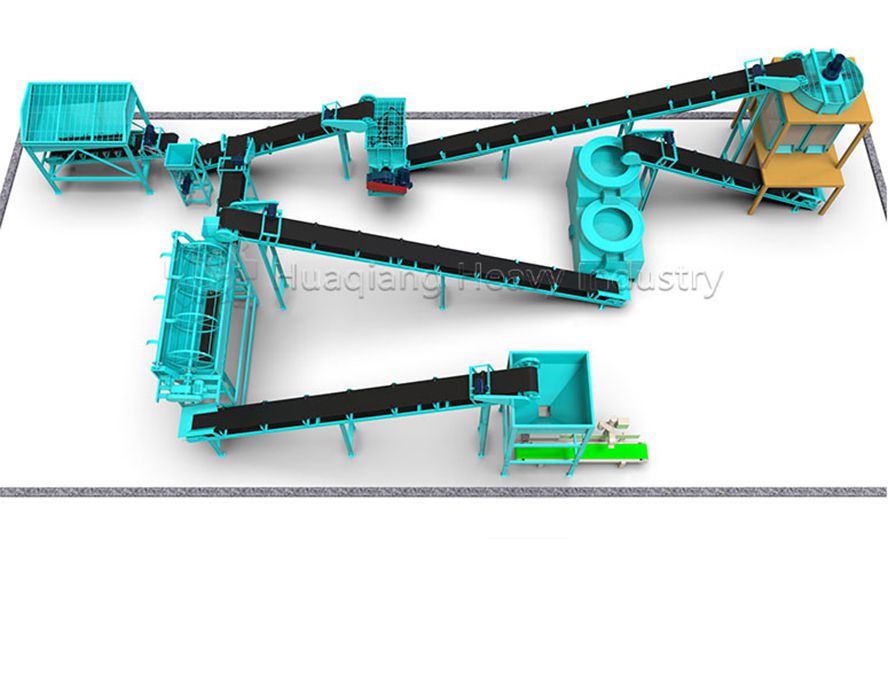
From there, material moves to a granulator—often a oscillating or rotating sieve that sizes the chunks further. Screens separate the stream into three fractions:
Oversize: Too large, sent to a crusher for another reduction pass.
On-size: Perfect granules, ready for polishing or packaging.
Undersize: Fines and dust, returned to the roller press for another try.
Nothing is wasted. Every particle either becomes product or cycles through again until it does.
The Preparation Behind the Pressure
Of course, the roller press doesn’t work alone. Behind it stands a carefully designed preparation system.
Raw materials first pass through a cage crusher or hammer mill, ensuring consistent particle size before compaction. Inconsistent feed leads to inconsistent compression, which leads to variable granule quality. Good preparation prevents that.
Next, a double shaft mixer may blend materials and, if needed, add small amounts of dry binder or lubricant. Some formulations benefit from a tiny percentage of material that helps particles lock together under pressure. Others rely solely on the mechanical interlocking created by compression.
A de-aeration step sometimes precedes the roller press. Removing air from the powder prevents trapped pockets that would weaken compacts. It sounds minor, but it makes a noticeable difference in final granule strength.
What Thrives on Dry Granulation?
Certain materials practically beg for dry processing. Potassium chloride and potassium sulfate compact beautifully, producing dense granules that resist caking. Ammonium sulfate responds well to pressure. Many compound NPK formulations, especially those with heat-sensitive components, benefit from avoiding thermal stress.
Organic-based fertilizers increasingly use roller compaction. Heat destroys beneficial microbes and can degrade organic matter. Dry processing preserves what matters while creating granules that handle well and release nutrients appropriately.