
Vertical conveying is a common requirement in fertilizer production lines—lifting crushed raw materials to the batching silo, sending fermented materials to the granulator, or lifting finished granules to the packaging machine. Ordinary conveyors often struggle with vertical heights, and multiple machines combined not only occupy a lot of space but also easily spill material at the joints. Huaqiang Heavy Industry’s bucket elevator is specifically designed for vertical conveying. Through automatic and continuous upward conveying via buckets, it boasts a small footprint, stable conveying, and zero spillage, making it the preferred equipment for vertical conveying in fertilizer production lines.
Core Advantages: Three Guarantees for Vertical Conveying
Vertical Conveying, Saving Space
The bucket elevator adopts a vertical layout, requiring only a minimal footprint to achieve heights of several meters or even tens of meters. The maximum lifting height can be customized according to customer needs—from 3 meters to 30 meters—making it particularly suitable for fertilizer production enterprises with compact plant spaces that require full utilization of vertical space.
Reasonable Bucket Design, No Material Spillage
Huaqiang bucket elevators employ a densely arranged bucket structure, with bucket shapes precisely matched to material characteristics: deep buckets are used for conveying powders, and shallow buckets for conveying granules. During the lifting process, the buckets remain in a closed or semi-closed state, allowing the material to rise steadily with the buckets. Upon reaching the top, it is accurately discharged under centrifugal force or gravity, resulting in no spillage or dust generation throughout the process, with a raw material utilization rate approaching 100%.
Stable and Reliable Operation, Adjustable Conveying Capacity
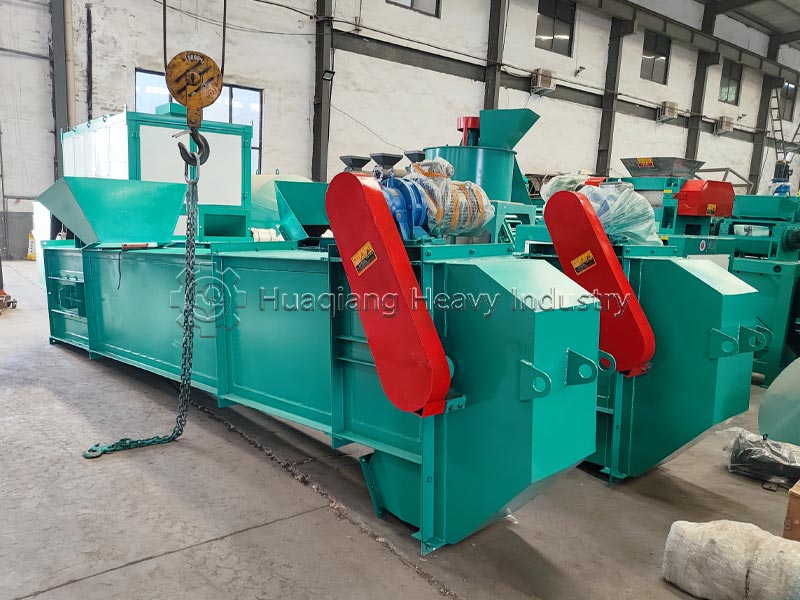
The equipment is equipped with an explosion-proof motor and a low-noise reducer, ensuring smooth operation and minimal vibration. The conveying capacity can be flexibly controlled by adjusting the motor speed or the number of buckets to meet different production capacity requirements. For materials prone to moisture absorption and clumping, Huaqiang equipment can be equipped with a vibrating feeder to ensure uniform feeding and prevent blockages.
Key Operational Points: Ensuring Optimal Elevator Performance
Three Pre-Start Checks
Check Bucket Fixation: Check the bolts connecting each bucket to the conveyor belt to ensure they are tight, preventing buckets from loosening or falling off during operation. Bucket detachment is one of the most serious malfunctions of bucket elevators, potentially leading to complete machine damage.
Inspect the Transmission System: Confirm the reducer oil level is normal, chain tension is appropriate, and belts are free of cracks. Perform a short test run, observing the correct running direction and any abnormal noises.
Inspect the Feeding Device: Ensure the vibrating feeder or feed chute is properly positioned, allowing material to fall evenly into the buckets and preventing belt misalignment due to uneven loading.
Uniform Feeding to Avoid Jamming: Bucket elevators are most susceptible to damage from overloading—feeding too much material at once can easily lead to bucket overload, jamming, or even chain breakage. The correct approach is to maintain continuous and uniform feeding, controlling the feed rate to 80%-90% of the equipment’s rated conveying capacity. Huaqiang equipment’s vibrating feeder automatically adjusts the feeding speed, working in conjunction with the elevator to ensure optimal feeding conditions.
Speed Control to Prevent Spillage: When conveying granular fertilizer, the lifting speed must be appropriately controlled. Excessive speed may cause material to be thrown out of the machine casing due to excessive centrifugal force during unloading; excessive speed will result in low efficiency. The lifting speed is typically controlled between 1.2-1.6 m/s, which can be fine-tuned according to material characteristics and particle size. Huaqiang equipment is equipped with frequency converter speed regulation, making operation simple and precise.
III. Common Fault Troubleshooting: Quick Diagnosis, Immediate Repair
What to do if the machine is jammed?
Cause: Mostly due to material lumps or hard impurities entering the bottom of the hopper, jamming the hopper or drive chain.
Solution: Stop the machine immediately, open the inspection door of the machine base, and manually clear the obstruction. Check if the feed inlet grille is intact to prevent large objects from re-entering.
Prevention: Install a screen or iron remover at the feed inlet to intercept stones, nails, and other debris.
What to do if material spills?
Cause: Damage to the hopper causing material leakage, or the conveyor belt running off-center causing material to spill from one side.
Solution: Check the hoppers for damage or deformation and replace them promptly; check the conveyor belt tension and joint straightness, and adjust the self-aligning rollers to correct misalignment.
Prevention: Regularly check the wear of the hoppers, and replace severely worn ones promptly; calibrate the conveyor belt position monthly.
What if the conveying capacity decreases?
Causes: Reduced motor speed (unstable voltage or motor failure), or severely worn hoppers reducing their volume.
Solution: Check the power supply voltage and test the motor speed; check the wear of the hoppers and replace worn hoppers in batches.
Prevention: Inspect the motor and transmission system quarterly, and check the hopper wear every six months.
Case Study: 8-meter Lift, No Spillage or Jamming
An organic fertilizer plant in Hebei Province needed to lift fermented chicken manure to the 8-meter-high granulator inlet. The original plan was to use multiple belt conveyors connected together, but after estimation, this would require nearly 100 square meters of space, and there would be serious spillage at the joints. After introducing the Huaqiang bucket elevator, the vertical conveying problem was solved with only 3 square meters of space. It operates stably at a rate of 5 tons per hour, with no spillage or jamming after a year of continuous operation. The factory manager remarked, “The bucket elevator looks simple, but when used properly, it’s truly worry-free.”
Daily Maintenance: Four Key Points to Extend Lifespan
Regular Lubrication: Add grease to the head and tail shaft bearings and tensioning device screws weekly. Change the reducer lubricating oil every six months.
Residue Removal: After each shift, check the bottom of the machine base for accumulated material and clean it promptly to prevent material from clumping and jamming the buckets.
Tension Check: Check the conveyor belt tension monthly. Too loose a belt will slip, while too tight a belt will damage the bearings. After adjustment, ensure the pulleys are in the same vertical plane.
Wear Monitoring: Check the bucket wear quarterly. When the bucket volume decreases by 20% due to wear, the entire batch needs to be replaced.
From space-saving vertical layouts to spill-free, sealed conveying; from intelligent control for uniform feeding to rapid troubleshooting response—Huaqiang bucket elevators, with their professional design and reliable performance, have become the “efficiency champions” of vertical conveying in fertilizer production lines. When your materials flow smoothly between equipment on each floor, and when there are no more worries about spillage on the production line, you will understand: choosing the right elevator means choosing the optimal path for vertical conveying.
Integrated Material Handling in NPK Fertilizer Lines
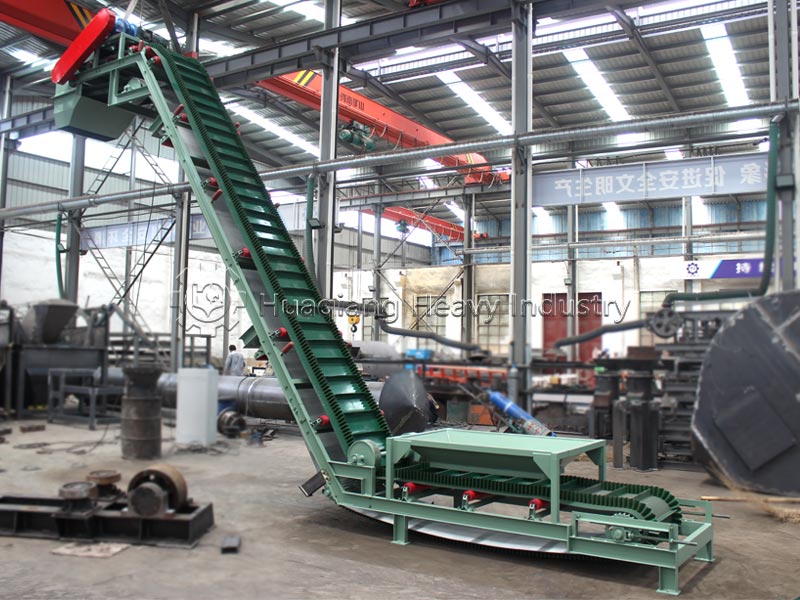
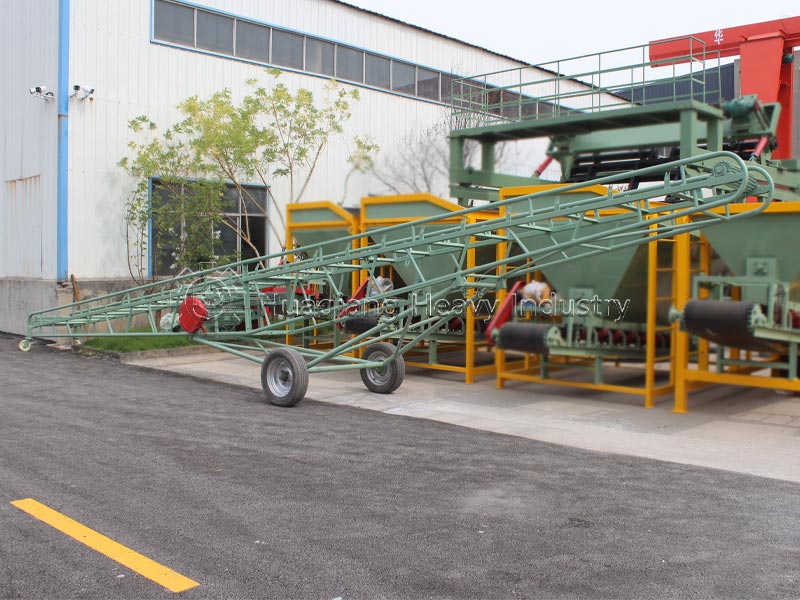
The bucket elevator is a critical component for vertical lifts, but a complete npk fertilizer line relies on a coordinated network of different conveyors to ensure seamless material flow. After granulation, the material often needs to be transported to a fertilizer drying machine. This horizontal transfer is efficiently handled by a durable belt conveyor. From the dryer, a bucket elevator lifts the material to the elevated inlet of a rotary drum screening machine for precise classification. The screened, uniform granules are then transported, often by a screw conveyor for shorter, enclosed transfers or another belt conveyor for longer distances, to the hopper of an automatic packing machine. This integrated system—combining the horizontal reach of a belt conveyor, the enclosed transfer of a screw conveyor, and the vertical efficiency of a bucket elevator—creates a smooth, dust-controlled, and highly efficient material handling network, ensuring that every granule moves reliably from one process stage to the next, culminating in a precisely packaged final product.