
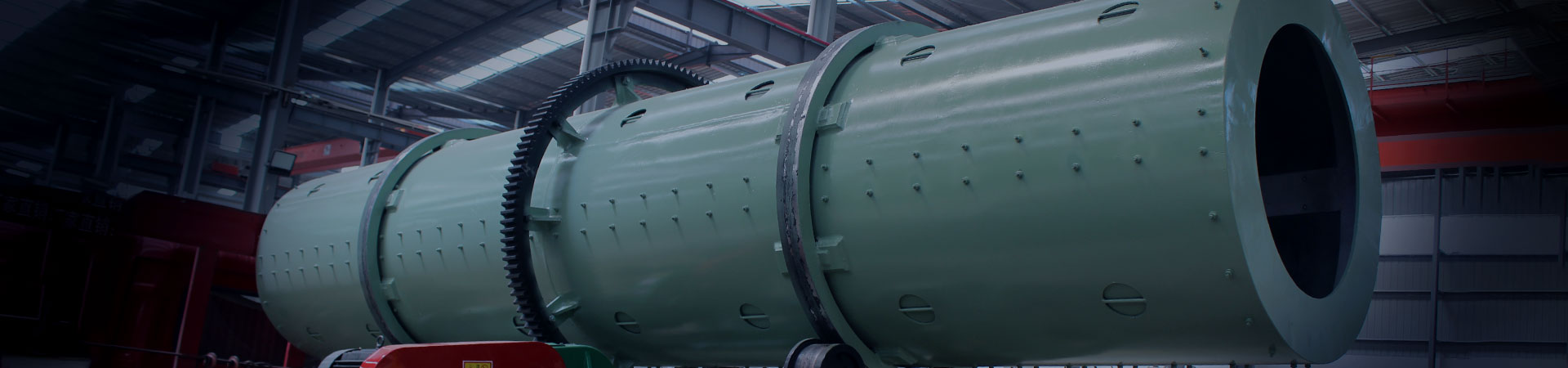
On fertilizer production lines, double-shafts paddle mixers are often simply categorized as “premixing equipment.” However, this machine, with two parallel rotating shafts, has a value far exceeding simply “mixing several raw materials together.” From the preparation of raw materials and auxiliary materials before fermentation to the precise conditioning before granulation, the double-shafts paddle mixer plays multiple roles in the entire fertilizer production line—it is a mixer, a conditioner, and a core hub for material pretreatment.
Precise Moisture Control: Laying the Foundation for the “Golden Moisture Content” for Granulation
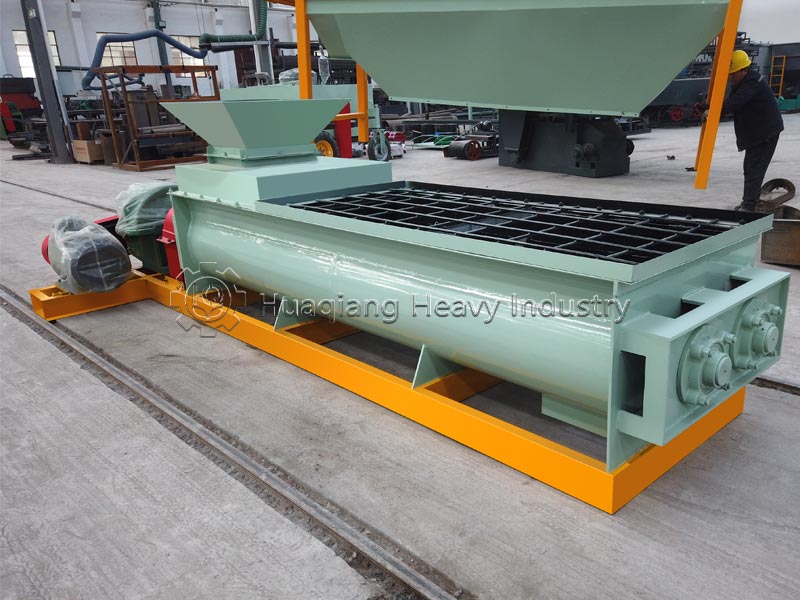
Different granulation processes have drastically different requirements for material moisture content. Wet processes such as disc granulation and drum granulation require the raw material moisture content to be within a specific range for successful pelleting—too low moisture content makes it difficult for the powder to bind, resulting in a low pelleting rate; too high moisture content causes the granules to easily stick together, deform, and form large clumps. The atomizing spray system equipped on the top of the double-shafts paddle mixer can evenly spray water mist onto the material during the mixing process, achieving integrated mixing and moisture conditioning. Adding water while stirring allows for more even penetration of moisture into the material, preventing localized over-wetting or over-drying. The double-shafts paddle mixer utilizes the synchronous rotation of two symmetrical spiral shafts to add water and stir while conveying powdery materials, achieving uniform humidification. For the production of organic-inorganic compound fertilizers, the double-shafts paddle mixer can also condition and thicken the material by adding water or steam, resulting in a better forming rate when it enters the granulator.
Clump Breakup and Material Dispersion: Ensuring Smooth Operation of Subsequent Processes Fermented manure, straw, and other organic raw materials often exhibit varying degrees of clumping—clumps of different sizes, if not broken up beforehand, directly affect the granulation effect and particle uniformity. The blades on the two mixing shafts of the double-shafts paddle mixer, during rotation, provide intense shearing and kneading of the material. This vigorous stirring action effectively breaks up any small clumps in the material, providing soft, fine raw materials for the granulation process and preventing equipment blockage. The patented technology even includes a design that integrates crushing and mixing functions—using a dual-shaft motor to drive crushing rollers to crush lumpy fertilizer before mixing. The dual-shaft mixer’s counter-rotating structure effectively breaks down the material’s agglomeration, ensuring that lumpy materials are fully dispersed before entering the granulator.
Pre-fermentation Conditioning and Inoculation: Process Extension to the Fermentation Stage
The application of dual-shaft mixers is not limited to pre-treatment before granulation. In many organic fertilizer and solid waste co-processing projects, dual-shaft mixers are placed in the raw material preparation stage before fermentation. In this process station, the equipment completes the mixing of dry and wet auxiliary materials, initial adjustment of the carbon-nitrogen ratio, and spraying of fermentation broth in one go. The extended U-shaped tank design can accommodate larger volume mixing needs. The value of this pre-application lies in adjusting the moisture content, carbon-nitrogen ratio, and microbial distribution of the materials to their optimal state before fermentation begins, creating ideal starting conditions for aerobic fermentation. For bio-organic fertilizer production, the double-shafts paddle mixer can evenly disperse microbial inoculants, added in quantities of only a few parts per thousand, into every grain of raw material.
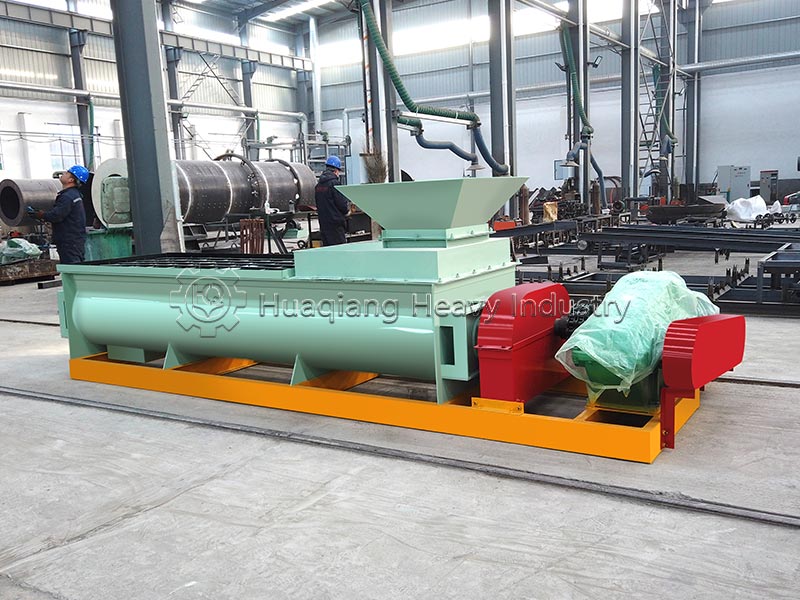
- Forced Blending of Materials with Different Specific Gravities: Solving the Problem of “Component Segregation” Fertilizer production often involves blending light organic matter with heavy chemical fertilizer powder—materials with significant differences in specific gravity are prone to stratification and segregation. The double-shafts paddle mixer, relying on a bidirectional convection mixing mode, can break down the barriers to material stratification. When the two shafts rotate in opposite directions, one shaft pushes the material from the center to both ends, while the other shaft gathers the material from both ends towards the center, forming a complex multidimensional circulating flow. This strong mechanical disturbance ensures that nitrogen, phosphorus, and potassium single-element fertilizers with significant differences in specific gravity are fully interwoven with light organic fertilizer powder. The coefficient of variation for mixing uniformity can be controlled within 5%, and the output uniformity is as high as 98% or more.
- Liquid Additive Spraying and Anti-caking Treatment: Precise Solid-Liquid Two-Phase Encapsulation
The double-shafts paddle mixer also has a liquid addition function. By installing atomizing nozzles at the top of the tank, amino acids, humic acid, rooting agents, or anti-caking oils can be evenly sprayed onto the surface of the churning materials, achieving solid-liquid two-phase encapsulation and mixing. The “boiling” state generated by the churning of the materials ensures uniform encapsulation of the liquid additives, preventing “clumping” or “dot-like” accumulation. The extremely small gap between the screw ribbon and the tank (typically 5 to 8 mm) effectively scrapes off adhering substances from the tank wall, providing strong self-cleaning capabilities and facilitating cleaning during production changes.
Conclusion: The double-shafts paddle mixer has long transcended its single-function positioning as a “premixing device.” It serves as a precise conditioning platform before granulation, a raw material blending station before fermentation, a crusher and disperser for caking materials, and a uniform spraying device for liquid additives. In the entire fertilizer production line, this equipment, with its multi-functional capabilities, becomes a crucial hub connecting various processes. Understanding the multiple roles of the double-shafts paddle mixer is understanding the technological logic behind the shift in fertilizer production from “extensive processing” to “precision manufacturing.”
The double-shafts paddle mixer is far more than a simple blending unit — it is the process hub that ensures every downstream step operates at peak efficiency. In a bio organic fertilizer production line, it homogeneously distributes microbial inoculants and moisture, creating the ideal feedstock for subsequent granulation. For spherical granulation, the organic fertilizer disc granulator and the broader disc granulation production line rely on the mixer’s precise moisture and clump‑free output to achieve high sphericity and uniform size. Alternatively, for dense, high‑strength pellets, a roller press granulator production line benefits from the mixer’s forced blending of light organics with heavy minerals, preventing segregation and ensuring consistent compaction. After granulation, fertilizer screening equipment classifies the product, and any oversized or undersized material is returned to the mixer for re‑conditioning — closing the loop and achieving near‑100% raw material utilisation. Thus, the double‑shafts paddle mixer acts as the intelligent gateway that transforms variable raw materials into a stable, uniform feed, enabling the entire production line — from fermentation to final packaging — to deliver consistent, high‑quality fertiliser with minimal waste and maximum process control.