
An NPK fertilizer production line is, put simply, a system that mixes nitrogen, phosphorus, and potassium – the three big nutrient players – into uniform pellets. But don’t let the simplicity fool you. Its real features go far beyond just “mixing.” Today, let’s walk onto the site and see what makes this line so special, and meet the hard working “iron fellows” along the way.
Feature one: Flexible formulation – blend any way you want.
The heart of an NPK fertilizer production line is the batching system. Multiple electronic belt feeders automatically meter urea, MAP (monoammonium phosphate), MOP (potassium chloride), SOP (potassium sulfate), and other materials at preset ratios. You can produce a high nitrogen corn fertilizer one hour and a high potassium potato fertilizer the next – even add secondary or trace elements. Changing formulas is as simple as tapping a few keys in the control room, with no need to stop the line or empty bins. That’s a kind of flexibility single nutrient lines can never match.
Feature two: Multiple granulation options – there’s one for every need.
An NPK line can be built around different granulation cores:
A rotary drum granulator suits large capacities and uses steam to make strong, durable pellets.
A disc granulator has low investment and fast product changeover, perfect for small to medium plants.
A roller press granulator uses no water and no dryer, ideal for moisture sensitive formulas.
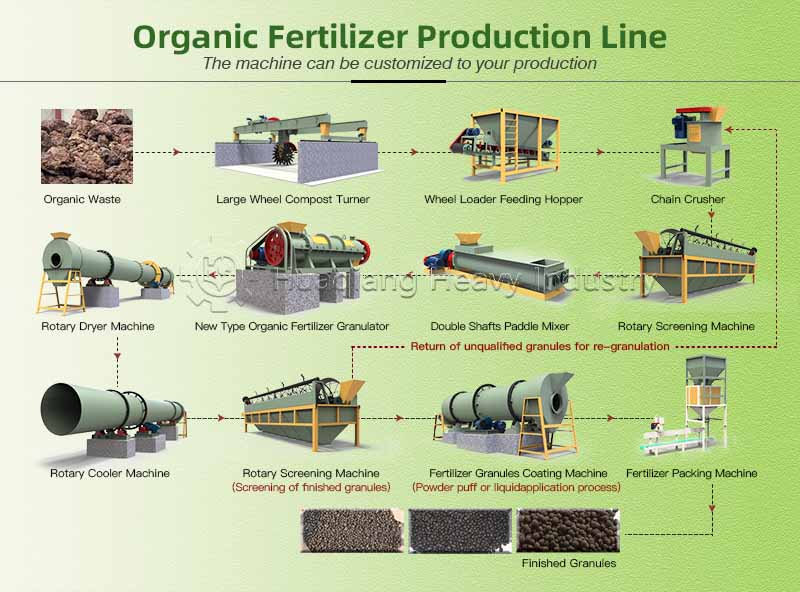
Whichever you choose, the downstream stages – drying, cooling, screening, coating, and packaging – remain the same. The whole line runs like a precise, well oiled assembly line.
Feature three: Great appearance – pellets that sell themselves.
NPK pellets, after polishing, coating, or coloring, come out uniform in color, smooth on the surface, and perfectly round. Many lines add a coating machine that sprays a thin layer of anti caking oil or mineral powder, so the pellets won’t clump even after six months in a bag. When farmers see such attractive pellets, trust comes instantly – after all, who doesn’t love something that looks good?
Of course, a granulator alone is never enough. Upstream and downstream of an NPK line stands a whole brotherhood:
A chain or vertical crusher reduces caked materials to fine powder.
A horizontal mixer makes N, P, K and fillers hug each other tightly.
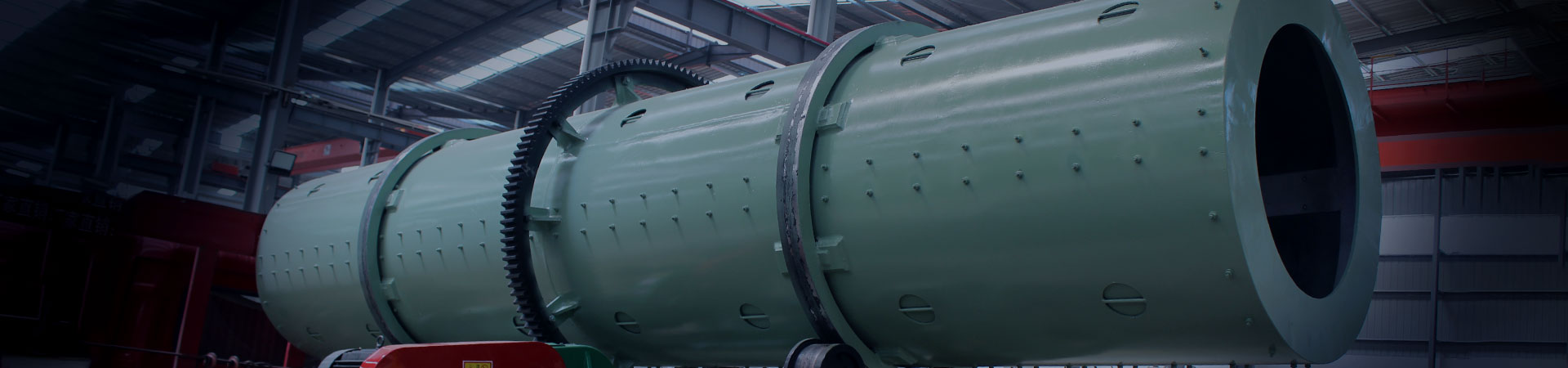
A drum fertilizer dryer drives moisture from 6–8% down to below 2% with hot air.
A cooler rapidly brings down the temperature of the hot pellets.
A vibrating screener separates on spec pellets from fines and oversize, sending the rejects back for re granulation.
A coating machine puts a protective “jacket” on each pellet.
Finally, an automatic packaging scale and a sewing machine stack the bags neatly, ready for shipment.
On the installation site, workers are connecting the chute between the dryer and the cooler. An old hand shines a flashlight inside, checking for welding burrs: “If there’s any rough spot here, the pellets will get scratched – and that ruins the appearance.” An overhead crane slowly lowers a vibrating screener, while younger workers use spirit levels to get it perfectly flat, tightening nuts with a satisfying ratcheting sound. The whole workshop smells of rust, grease, and welding smoke – but everyone knows that once this line starts turning, the crops in the fields will have something to rely on.
So, the real feature of an NPK production line isn’t any single machine – it’s the coordination of the entire system. It can swallow all kinds of raw materials and spit out uniform, beautiful, high efficiency compound fertilizer pellets. N, P, K – the three brothers – together with the whole family of crushers, mixers, granulators, dryers, coolers, screeners, coaters, and packers – deliver that heavy bag of hope into your hands. Doesn’t that deserve a round of applause?