
We are a professional manufacturer of organic fertilizer equipment and a customized service provider for fertilizer production lines
-
NO.313, Wanshan Road, Xingyang City, Zhengzhou City, Henan Province, China
Company Address
-
Call Us: +86-18703630069
(Sat - Thursday)
-
inquiry@hqhifertilizermachine.com
Our Email
Belt Conveyor

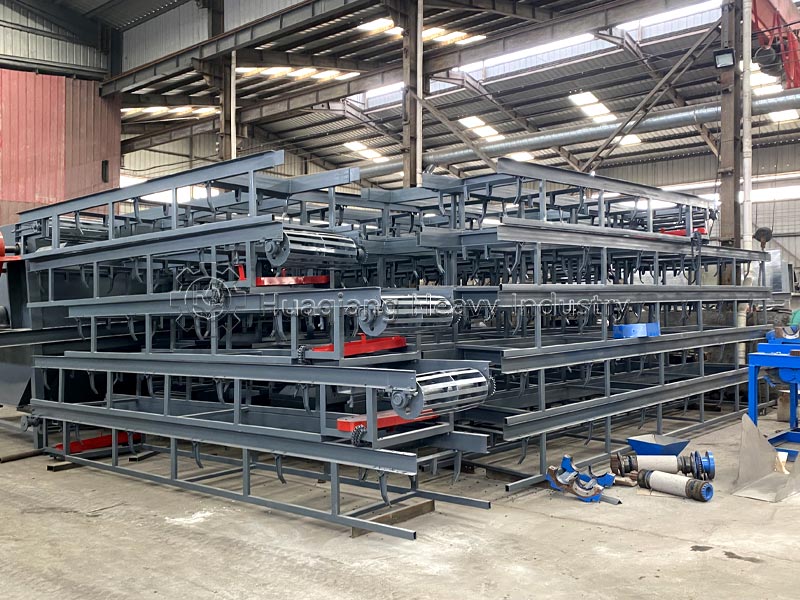
Equipment Introduction
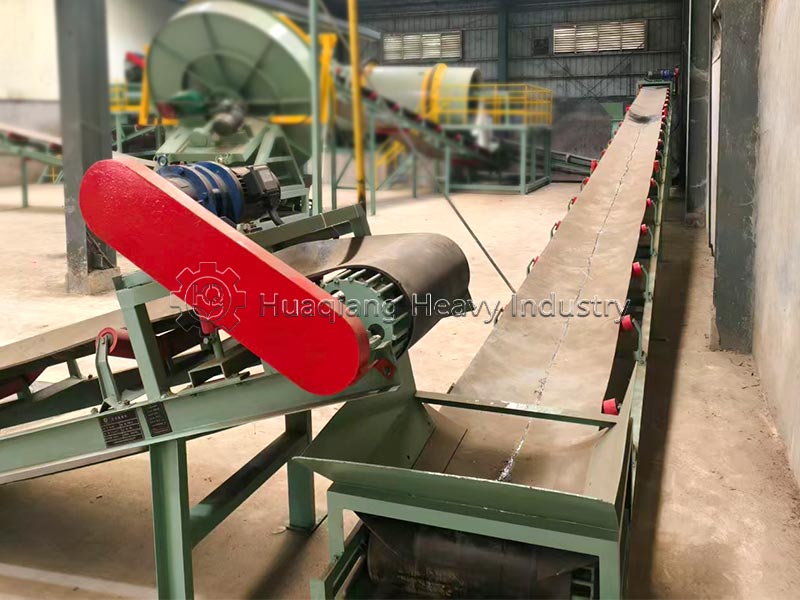
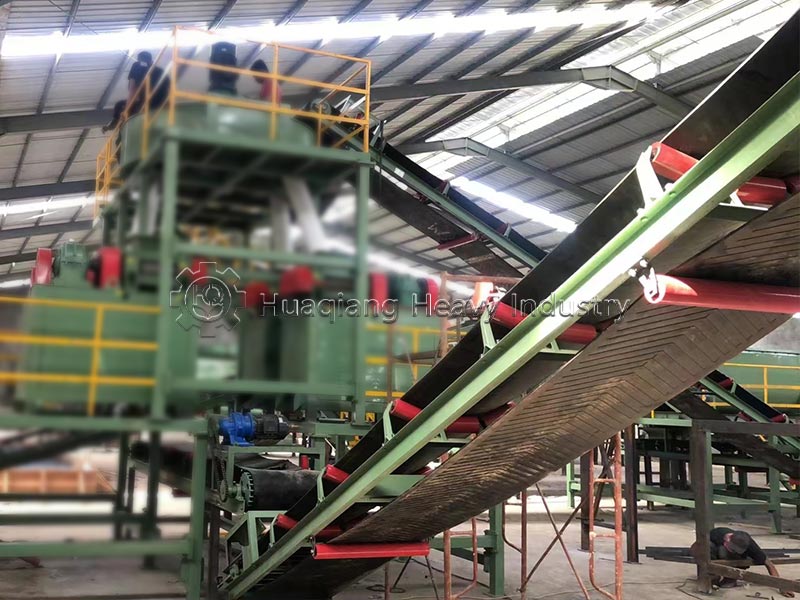
(I) Standard Fixed Belt Conveyor
The fixed belt conveyor is a fundamental continuous bulk material conveying equipment in the fertilizer, chemical, and grain industries. It relies on a ring-shaped rubber belt to carry materials and uses roller friction transmission to complete horizontal and small-angle (≤15°) material transfer. It is a basic supporting equipment for material flow in the entire fertilizer production line.
Core Advantages
- Large conveying capacity, stable operation, low breakage rate of granular fertilizers, suitable for powdery, granular, and bagged fertilizers;
- Simple structure, low maintenance cost, standardized parts, stable continuous 24-hour operation;
- Can be enclosed for dust prevention, and can be equipped with a sealing cover to meet the environmental protection requirements of organic fertilizer plants;
- Flexible inclination angle, suitable for both horizontal and incline operation, and can connect to various main units with different heights;
- Adaptable to full-capacity production lines, belt width optional from 500–1200mm, and can be freely spliced for different lengths.
(II) Telescopic Belt Conveyor (Telescopic Loader)
The telescopic belt conveyor is a derivative model of the belt conveyor. It adds a nested telescopic frame, belt storage bin, and telescopic drive mechanism to the fixed belt. The machine body can freely extend and retract like a telescope, with an adjustable length of 3–26m. It is primarily used for loading and unloading bagged fertilizer from trucks and containers, and is only suitable for transferring finished bagged fertilizer; it cannot replace long-distance raw material transportation within a production line.
Core Advantages
- Flexible and adjustable length, allowing direct access into the depths of the truck bed, reducing manual back-and-forth handling distances;
- Hydraulic lifting + bidirectional conveying, suitable for both loading and unloading, adaptable to different vehicle heights;
- Small footprint when retracted, suitable for placement in narrow spaces in warehouses and factories;
- Variable frequency speed control, complete safety protection, 1-2 people can complete the loading and unloading of a whole truckload of fertilizer, reducing labor costs by more than 60%.
(III) Comparison of Core Differences between the Two
| Comparison Item | Fixed Belt Conveyor | Telescopic Belt Conveyor |
|---|---|---|
| Body Length | Fixed length, extendable by sectional splicing | 3‑26m free telescoping, greatly reduced retracted dimension |
| Core Application | Continuous transfer of raw materials and granules inside production line | Loading & unloading bag‑finished fertilizer for trucks, warehouse inbound & outbound |
| Frame Structure | Single‑section fixed channel‑steel frame | Multi‑section nested sliding‑rail telescopic frame with belt storage compartment |
| Lifting Function | None, fixed height | Standard hydraulic lifting, adjustable height |
| Conveyable Materials | Powder, granules, lumps and bagged materials | Only bag‑finished fertilizer and boxed cargo |
| Installation Mode | Fixed installation on concrete foundation | Equipped with universal casters, movable, no civil‑engineering foundation required |
Applicable Raw Materials
- Fixed Belt Conveyor Compatible Materials (All Types of Fertilizer)
1) Powdered Raw Materials: Fermented chicken manure powder, humic acid, bentonite, coated talc powder, chemical fertilizer powder;
2) Granular Materials: Granulated organic fertilizer, compound fertilizer, cooled coated finished granules;
3) Lump Materials: Straw, mushroom residue, oilseed cake, small pieces of fermented compost;
4) Finished Bagged Materials: 5kg/20kg/50kg bagged fertilizer; Limitations: Large hard stones and highly sticky mud clumps are prone to clogging; direct conveying is not recommended.
- Telescopic Belt Conveyor Compatible Materials
Only suitable for bagged finished fertilizer (10–60kg woven bags/coated bags) and boxed fertilizer; cannot convey powdery or bulk granules (expansion joints easily leak powder, no sealed structure).
Working Principle
- Working Principle of Belt Conveyor
The belt conveyor operates based on the principle of friction drive:
1) Power Output: The drive motor, after being reduced in speed and increased in torque by a reducer, drives the drive drum to rotate;
2) Friction Traction: The tensioning device maintains sufficient positive pressure between the conveyor belt and the drive drum, generating friction; as the drum rotates, the friction drives the closed conveyor belt to run continuously in a preset direction;
3) Material Loading: The material is placed on the conveyor belt and moves synchronously with the belt due to the friction of the belt surface; the load-bearing idler supports the loaded belt, and the return idler supports the unloaded belt;
4) Unloading and Return: After the material reaches the unloading point at the head of the conveyor, it is unloaded by gravity or by the unloading plow; the unloaded belt is turned back by the tail reversing roller and returns to the starting point to enter the next cycle.
Core Formula: Transport Capacity (tons/hour) = 3600 × Belt Speed (m/s) × Material Density (t/m³) × Effective Cross-sectional Area (m²). Belt width, belt speed, and material characteristics are the three key variables determining the conveying capacity.
- Working Principle of Telescopic Belt Conveyor
Based on the principle of a regular belt conveyor, the telescopic belt conveyor adds a length adaptive mechanism:
1) Telescopic Action: An independent telescopic motor drives the traction translation frame, which slides relative to the outer frame via wire rope or chain traction, allowing for free adjustment of the overall machine length;
2) Belt Length Adaptation: During telescopic movement, the Z-shaped reversing section in the belt storage bin automatically retracts or releases excess belt, maintaining a match between the belt length and the frame length;
3) Bidirectional Operation: The conveyor belt can rotate in both directions, enabling both loading and unloading; combined with height adjustment, it can precisely connect to truck beds or containers of different specifications.
Equipment Structure Composition
| Equipment Type | Structural Parts / Unique Modules | Function Description |
|---|---|---|
| General Belt Conveyor (Core Common Structure) | Conveyor Belt | Flexible load‑bearing component for carrying materials. Common materials include rubber, PVC, PU, steel wire rope, etc. Selectable according to material characteristics and actual working conditions. |
| Drive Unit | Composed of motor, reducer, coupling, fluid coupling and brake. It is the core power source of equipment to provide driving torque for belt running. | |
| Pulley Group | Including head drive pulley, tail redirecting pulley and snub pulley. Rely on friction to drive the belt for continuous operation and ensure stable conveying. | |
| Idler Group | Divided into trough‑shaped carrying idlers, buffer idlers and V‑shaped return idlers. Mainly used to support conveyor belt and effectively reduce running resistance. | |
| Tensioning Device | Adopts screw or weight‑hammer structure. Keep proper belt tension continuously, guarantee sufficient friction between belt and pulley to prevent slipping. | |
| Frame & Auxiliary Devices | Including head hopper, guide chute, head/tail cleaner, skirt board, guard rail, emergency stop and other safety components to guarantee stable and safe equipment operation. | |
| Telescopic Belt Conveyor (Exclusive Additional Structure) | Telescopic Mechanism | Consists of 2‑5 sections nested frames. Realize overall telescoping by steel wire flexible traction or chain drive to meet different conveying distance requirements. |
| Belt Storage Bin | Adopts 2‑layer folded structure adapting to belt length variation. Specially stores surplus belt during telescoping process and ensures smooth telescopic operation. | |
| Lifting Device | Hydraulic or electric lifting system. Adjust discharge‑end height within 800‑2200 mm for different vehicle types and unloading‑height scenarios. | |
| Traveling Mechanism | Equipped with heavy‑duty universal casters or rail‑travel system. Support flexible equipment movement and accurate positioning for multi‑station loading‑unloading work. | |
| PLC Control System | Integrates functions of telescoping, lifting, forward‑reverse rotation, stepless speed‑regulation and fault alarm. Realize intelligent and integrated precise equipment control. |
Target Customers for Fixed Belt Conveyors:
- Complete production plants for organic fertilizer, compound fertilizer, and bio-fertilizer;
- Large-scale livestock groups with their own manure-to-fertilizer workshops;
- Enterprises engaged in the resource-based and environmentally friendly disposal of sludge and kitchen waste;
- Fertilizer equipment integrators and production line engineering installation companies;
- Grain, feed, building materials, and chemical powder processing plants.
Target Customers for Telescopic Belt Conveyors:
- Finished product storage and agricultural input logistics transit warehouses for fertilizer plants;
- Fertilizer trading distributors and wholesale distribution centers for bagged fertilizers;
- Agricultural input e-commerce warehousing and express logistics loading and unloading companies;
- Small and medium-sized agricultural input stores that only need to handle bagged fertilizers and do not process bulk raw materials.
Standard Operation and Maintenance Methods
General Operating Procedures (Applicable to both types of equipment)
- Start-up Sequence: Start the equipment under no-load conditions → Run under no-load conditions for 3 minutes without abnormal noise before feeding/loading bagged materials; Do not start under heavy load.
- Shutdown Sequence: First stop feeding, wait until all material on the conveyor belt is cleared, then turn off the main motor.
- Safety Prohibitions: Do not cross the conveyor belt or reach into the rollers/idlers during operation; power must be disconnected and a sign posted before maintenance; wear insulated gloves when operating electrical circuits, and ensure the equipment is properly grounded before starting.
(I) Graded Maintenance of Fixed Belt Conveyors
- Daily Inspection: Check for belt misalignment and damage; clean material stuck to the sweeper; check for jammed idlers; check for accumulated fertilizer on the rollers; test the emergency stop and backstop functions;
- Weekly Lubrication: Add grease to the head and tail roller bearings and self-aligning idler bearings;
- Quarterly Maintenance: Check the gear oil level in the reducer and replace it with new gear oil every 4 months; clean and lubricate the tensioning device screw;
- Annual Overhaul: Repair/replace vulcanized belt joints; replace worn idlers and rollers as a whole; correct the overall machine frame level.
(II) Special Maintenance for Telescopic Belt Conveyors
- Daily: Clean fertilizer dust and debris from the telescopic slide rails to prevent jamming; check the front-end anti-collision photoelectric sensor and emergency stop switch;
- Weekly: Lubricate the telescopic chain/rack; check the hydraulic oil level in the tank for leaks; clean the belt sweeper;
- Monthly: Lubricate the bearings of the telescopic drive motor; check the seals of the lifting hydraulic cylinder;
- Quarterly: Inspect the wear of the entire slide rail; tighten all loose fasteners; clean the frequency converter control system.
List of Vulnerable Parts
- Fixed Belt Conveyors: Rubber conveyor belt, idlers, sweeper blades, roller bearings, belt joints, anti-backflow brake pads;
- Telescopic Belt Conveyors: Conveyor belt, telescopic slide rail slider, telescopic chain, hydraulic seal, anti-collision photoelectric sensor head.
Application Processes of Two Types of Equipment in Fertilizer Production Lines
- Fixed Belt Conveyor System (Core Production Line Link): Raw Material Yard → Belt Conveyor → Crusher → Belt Conveyor → Batching and Mixing Machine → Belt Conveyor → Granulator → Belt Conveyor → Rotary Drum Dryer → Rotary Drum Cooler → Belt Conveyor → Coating Machine → Screening Machine → Belt Conveyor → Finished Product Silo → Packaging Machine. Function: Transports powdery and granular semi-finished products throughout the entire process, connecting all main equipment and ensuring continuous production on the assembly line.
- Telescopic Belt Conveyor System (Finished Product End Only): Packaging Machine Discharge Port → Short-Distance Fixed Belt Conveyor → Telescopic Belt Conveyor → Truck/Container Carriage. Function: Used only for loading and unloading bagged fertilizer after packaging; does not participate in upstream drying, granulation, or other processes; it is an auxiliary equipment for warehousing and logistics.
In summary, belt conveyors form the “basic framework” of industrial material handling, boasting advantages such as simple structure, large capacity, long distance, and low energy consumption. They are widely used in heavy-duty and long-distance scenarios in mining, ports, manufacturing, and agriculture. Telescopic belt conveyors, on the other hand, act as the “flexible arm” at the end of the logistics chain. Building upon ordinary belt conveyors, they add adaptive length and height adjustment capabilities, specifically addressing the high-frequency, variable, and labor-intensive process of vehicle loading and unloading.
The two are not substitutes but rather complementary and synergistic: belt conveyors construct the main logistics channels of the production line, while telescopic conveyors complete the final link in loading and unloading. In modern smart factories and intelligent logistics systems, both are deeply integrated with automated sorting, robotic palletizing, and WMS/WCS systems, jointly forming an efficient, continuous, and flexible material handling ecosystem.