

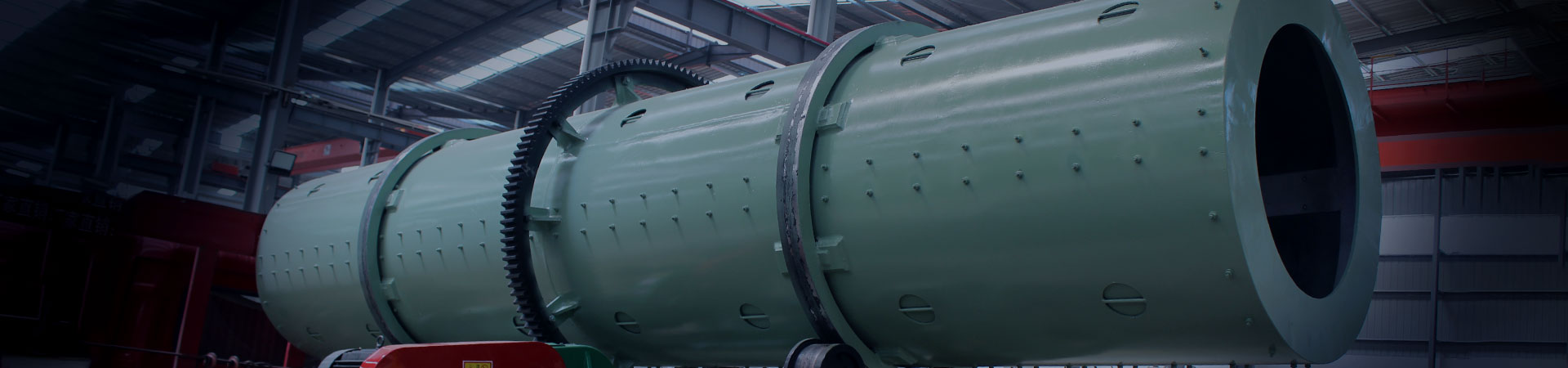
In the era of booming organic agriculture, how can loose compost be transformed into commercial, easy-to-apply granular fertilizer? The organic fertilizer disc granulator is the core magician of this transformation. It doesn’t rely on complex chemical reactions but ingeniously utilizes physical mechanics and material properties to shape fermented organic powder into perfect pellets like “rolling a snowball,” achieving a multiplication of value for organic waste.
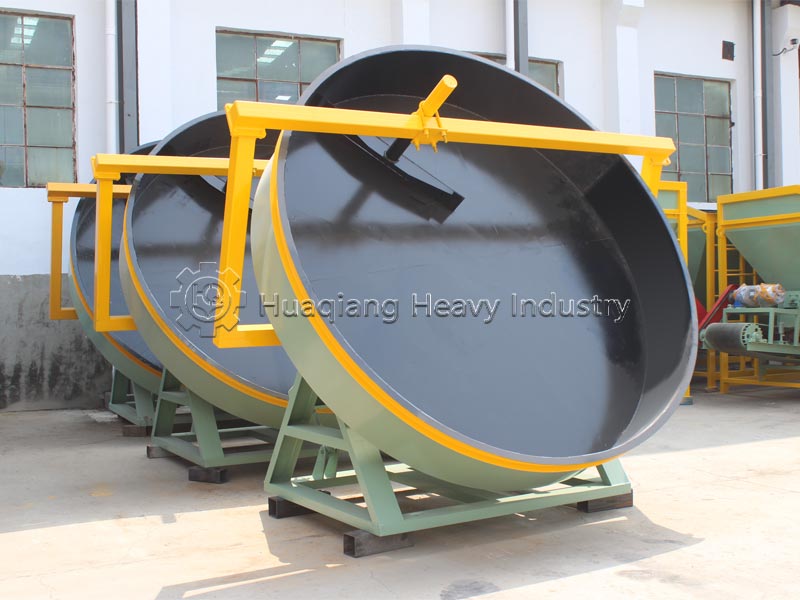
Core Advantages: High Adaptability, Excellent Pelletizing Rate, Cost-Effective
Designed specifically for handling materials with high organic content and inherent stickiness, the disc granulator’s advantages perfectly align with the special needs of organic fertilizer production:
Exceptional Adaptability to Moist, Sticky Materials: This is its most prominent feature. Organic fertilizer raw materials (e.g., fermented livestock manure, straw, sludge) typically contain a certain moisture content (20%-35%) and natural adhesiveness. The disc granulator utilizes the material’s own stickiness and surface tension to form pellets naturally through tumbling, requiring minimal or even no binders, perfectly preserving the natural properties of the organic fertilizer.
High Pelletizing Rate & Aesthetically Pleasing Granules: The inclined, rotating disc creates a regular spiral motion. Fine powder layers and gradually enlarges during tumbling, forming uniform, dense, spherical pellets with smooth surfaces. By adjusting the inclination angle, rotation speed, and water spray, particle size (typically 2-8mm) can be precisely controlled, resulting in excellent roundness and premium product appearance.
Intuitive Process, Flexible & Controllable Operation: The entire production process is fully visible. Operators can observe the pellet-forming status in real-time and instantly adjust process parameters. This “what-you-see-is-what-you-get” control method makes it particularly suitable for organic fertilizer production with complex and variable raw material compositions, facilitating adjustments for different batches and formulas.
Economical Investment & Operating Costs: Relatively simple structure, consisting mainly of the disc, drive system, frame, and liquid spray device. Initial investment and later maintenance costs are significantly lower than complex systems like rotary drum granulators. Low energy consumption makes it ideal for small to medium-sized organic fertilizer plants, on-farm projects, or as a flexible supplement to large production lines.
Working Principle: The Dance of Gravity, Centrifugal Force, and Capillary Action
The core of an organic fertilizer disc granulator is an adjustable-angle (typically 35-55°), shallow-bottomed disc that rotates at a constant speed. Its pelletizing process is an exquisite physical “ballet”:
Feeding & Moistening: Pre-crushed organic fertilizer powder is continuously fed from the top. A spray system above the disc evenly mists a small amount of water (or binder solution), moistening the surface of the fines.
Nucleation & Growth: The moistened fines, under the combined effects of gravity, centrifugal force, and friction on the rotating disc bottom, begin to adhere to each other, forming countless microscopic “seed nuclei.”
Layering & Enlargement: As the disc continues to rotate, these seed nuclei follow a spiral trajectory, continuously adhering to surrounding fines, growing larger layer by layer through compaction, much like rolling a snowball.
Classification & Discharge: When pellets grow to a certain size, their gravity overcomes centrifugal force, causing them to automatically roll over the disc edge. This achieves natural classification (larger pellets discharge first, smaller ones continue growing), ensuring uniformity of discharged pellets.
Collection: The formed moist pellets are collected and sent to subsequent drying processes.
Core Role in the Organic Fertilizer Production Line
In a complete organic fertilizer production line, the disc granulator is the pivotal “forming hub”:
Pre-processing: Fully fermented material is crushed by a Half-Wet Material Crusher to achieve suitable fineness.
Core Pelletizing: The crushed material is steadily fed into the Organic Fertilizer Disc Granulator by a Uniform Feeder, completing the transformation from powder to spherical pellets.
Post-processing: Wet pellets enter a Rotary Dryer and Cooler for solidification and cooling. Finally, a Rotary Screener/Trommel Screen screens out qualified product, with oversized pellets crushed for reuse and fines returned to the granulator disc.
Comparison with Other Pelletizing Equipment
In the field of organic fertilizer granulation, the disc granulator holds a significant place with its unique charm:
VS Rotary Drum Granulator: Drum granulators are suitable for large-scale continuous production but require higher investment, have stricter requirements on material formulation and moisture, and the process is less observable. Disc granulators are more flexible, intuitive, and economical, better suited for small-to-medium scale and multi-variety production.
VS Double Roller Extrusion Granulator: Roller extruders produce cylindrical or oblate pellets with extremely high density but require very dry raw materials (moisture <15%) and have high die costs. Disc granulators can handle organic raw materials with higher moisture, producing natural spherical pellets.
VS Flat Die Pellet Mill: Flat die pellet mills rely on high-pressure extrusion, suitable for producing biomass fuel or feed pellets, with limited adaptability to the fiber and moisture content of organic fertilizers. Disc granulators rely on tumbling agglomeration, making them more suitable for organic fertilizers that need to maintain certain porosity and activity.