


Answer: Plant leaves are covered with a hydrophobic waxy layer and cuticle, a natural protective barrier formed through long-term evolution. This structure causes most fertilizer solutions and water droplets to form spherical shapes on the leaf surface, making them difficult to spread, adhere, and penetrate. Adding surfactants (commercially known as spreading agents, penetrants, or adjuvants) is precisely to overcome this physical barrier.
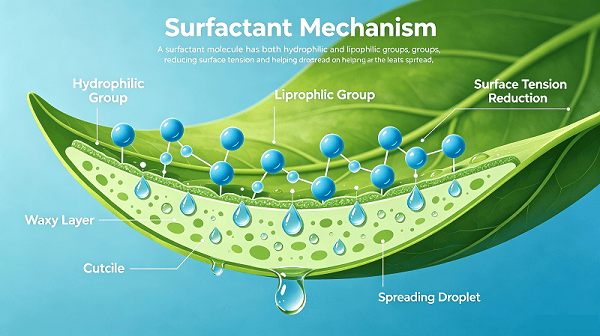
Their core mechanism and value are as follows:
- Reducing surface tension and improving the wettability of droplets on the leaf surface. Pure water or ordinary fertilizer solutions have a high surface tension (approximately 72 mN/m), forming spherical droplets on the hydrophobic leaf surface with a large contact angle and easy rolling off. Surfactant molecules, composed of hydrophilic and lipophilic groups, can be directionally adsorbed at the gas-liquid interface, significantly reducing the surface tension of the aqueous solution (down to below 30 mN/m). When the surface tension of the droplets is lower than the critical surface tension of the leaf, the droplets change from spherical to flat, the contact angle decreases significantly, and the fertilizer solution can be evenly spread on the leaf surface.
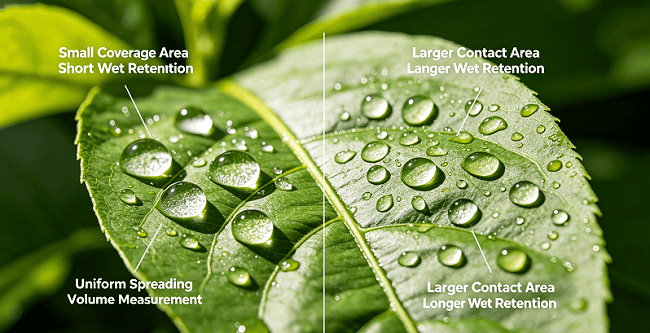
- Increase Contact Area and Extend Wet Retention Time: The degree to which droplets spread on the leaf surface directly affects the absorption efficiency of foliar fertilizers. Adding surfactants can increase the coverage area of a unit volume of fertilizer solution on the leaf several times. Simultaneously, surfactants slow down the evaporation rate of droplets on the leaf surface, extending the time the fertilizer solution remains in liquid form on the leaf surface, creating a sufficient time window for nutrient absorption through the cuticle and stomata.
- Promote Nutrient Penetration and Absorption Through the Cuticle: The main channels for nutrient absorption on the leaf surface are the cuticle and epidermal cells. The lipophilic groups of surfactants can react similarly with the waxy layer of the leaf, temporarily altering the cuticle’s structure and forming “temporary channels,” reducing the resistance of nutrient molecules crossing the cuticle. Some surfactants can also enhance cell membrane permeability, further improving the efficiency of nutrient molecules entering the leaf interior.
- [Application Recommendations]: As a technical reference for fertilizer manufacturers, we recommend paying attention to the following points in the development and application of foliar fertilizer products: Targeted Addition: Not all spraying scenarios require the addition of surfactants. The effects are more pronounced on crops with thicker waxy leaf layers (such as rapeseed, citrus, and cabbage).
Appropriate Concentration: Higher surfactant concentrations are not always better. Excessive use may lead to excessive damage to the leaf cuticle, increasing the risk of disease infection, and may also burn the leaves. The optimal dilution ratio should be determined through gradient testing during product development.
Selecting the Appropriate Formulation: Commonly used surfactants include organosilicones, alkylphenol polyoxyethylene ethers, and vegetable oils. Organosilicon spreading agents have excellent spreading properties, while vegetable oils combine penetration and nutrient functions. Formulation design must be tailored to the nutrient form (ionic or chelated) of the foliar fertilizer and the application target.
Product Quality Control: In foliar fertilizer production lines, when adding surfactants, attention must be paid to their compatibility with other components in the fertilizer solution (especially chelated trace elements) and their pH compatibility range to avoid problems such as layering, crystallization, and turbidity/precipitation.
If you still have any questions about fertilizer production equipment or would like to learn more about customized solutions, please contact us immediately. Whether it’s equipment selection and pricing, installation, commissioning and operation training, or later maintenance and process upgrades, we can provide you with professional and timely answers and support to help your project be implemented efficiently.