


The safe packaging temperature for organic fertilizer is generally controlled at ≤40℃. For scenarios requiring high storage stability, it is recommended to further reduce it to below 35℃. The outlet temperature of the cooler does not need to be absolute room temperature; 5-8℃ higher than the ambient temperature is sufficient. Excessive cooling may cause the granule surface to fall below the dew point during humid seasons, leading to moisture absorption and re-entry. The core risk of excessively high packaging temperatures is residual heat driving moisture migration: as the granules slowly cool inside the bag, internal moisture condenses on the surface, forming crystal bridges and causing agglomeration. If there is a lack of buffering and dehumidification between the cooling section and the packaging, even if the temperature drops, the granules may still absorb moisture again during the packaging period.
I. Packaging Temperature – Agglomeration Rate Comparison: What do 35℃, 40℃, and 50℃ mean?
Treat packaging temperature as a continuous variable. Different thresholds correspond to different levels of agglomeration risk, rather than a binary judgment of “meeting standards/not meeting standards.”
≤35℃ (low-risk range). This is the operational target for sufficient cooling. With a small temperature difference between the particles and the environment, the driving force for moisture migration within the bag is weak. Combined with humidity control within the bag, the agglomeration rate can be kept to a low level. Cooling time typically needs to be ≥30 minutes (or 8-15 minutes in the cooler) to stably reach this range.
35-40℃ (acceptable but requires control). The industry generally uses ≤40℃ as the upper limit for safe packaging, and the cooler discharge is usually targeted at this. Within this range, as long as the humidity in the packaging workshop is not high and the packaging bags are not excessively sealed, the risk of agglomeration is controllable; however, in high-humidity areas or with long storage periods, the residual temperature of 35-40℃ may still become the starting point for crystal bridge formation.
40-50℃ (high-risk borderline). Some materials consider 50℃ as a threshold for assessment “before product packaging,” but in actual production, packaging temperatures around 50℃ can still lead to agglomeration, especially for high-concentration products. If the temperature of the cooling machine discharge consistently exceeds 45-50℃, the probability of clumping within a week after packaging increases significantly. In this case, the priority should be to check the cooling airflow and feed rate, rather than trying to fix the problem in the packaging section.
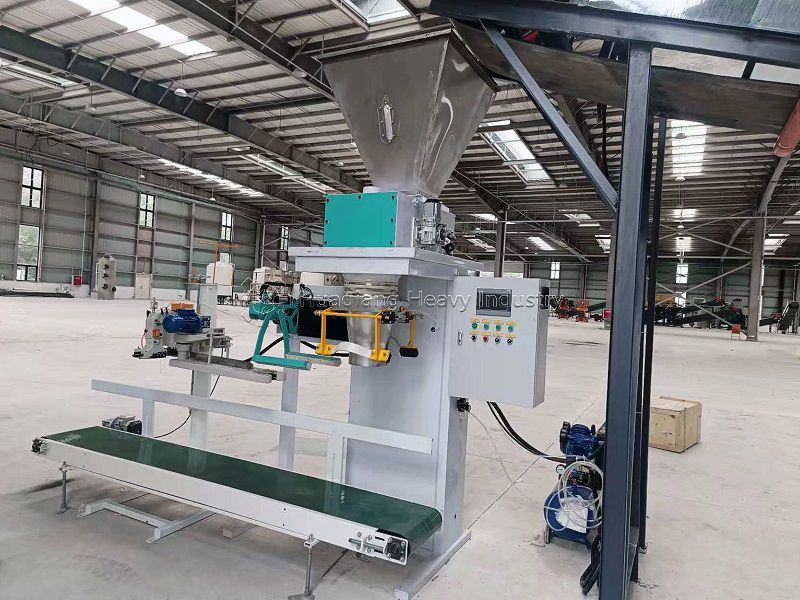
II. Cooling Section and Packaging Buffer Bin: Achieving the Temperature Standard Does Not Guarantee Safety Once Packed
Lowering the temperature of the granules with the cooling machine is only the first step. Between the cooled discharge and the packaging machine, the granules are exposed for a period of time. The configuration of the buffer bin determines whether the temperature advantage during this process will be offset by moisture.
The cooling machine discharge typically enters the buffer bin via a conveyor system, and then the bin continuously supplies material to the packaging machine. The buffer bin’s function is not merely “material storage”; it also serves to equalize the temperature and prevent material interruption in the packaging machine. With a buffer bin and a vibration-damping device, problems such as dampness, clumping, and bridging in organic fertilizer can be solved, ensuring continuous operation of the packaging section. However, if the buffer chamber lacks dehumidification and ventilation, the cooled granules will still absorb moisture from the air while remaining inside, especially in humid southern regions. The buffer chamber before the packaging machine needs to be equipped with dehumidification and ventilation to prevent “cooling to standard, but then re-dampening while waiting for material to arrive.”
A practical principle of the design: Set up online temperature detection at the cooling outlet. When the temperature consistently exceeds 45℃, automatically reduce the feed rate or increase the airflow, rather than waiting for the granules to enter the buffer chamber and then relying on “letting them sit longer” to cool them down. The volume of the buffer chamber should be sufficient to cover short-term shutdowns of the packaging machine, but should not be so large that granules remain inside for extended periods to absorb moisture—buffering is a rhythm adjustment, not a replacement for cooling.
III. Additional Controls for Packaging in High Humidity Areas: Temperature, Humidity, and Packaging Bags Must Be Managed Simultaneously
In coastal areas or areas with high temperature and humidity, simply lowering the packaging temperature to below 40℃ is insufficient to prevent clumping. Ambient humidity and the moisture permeability of the packaging materials will directly offset the temperature advantage established by the cooling section.
Workshop humidity control. The relative humidity in the packaging workshop should ideally be controlled below 60%. Warehouse environments typically require a temperature ≤30℃ and humidity ≤60%, and should be equipped with exhaust fans and dehumidifiers. If the packaging workshop lacks dehumidification, the surface of the cooled, low-temperature granules easily becomes a condensation point for moisture in the air, quickly forming condensation inside the packaging bag.
Packaging material selection: Completely sealed packaging is not always optimal. Breathable laminated woven bags (such as PP/PE materials) can, to some extent, prevent internal moisture accumulation. For high-humidity organic fertilizers, complete sealing may lead to bag bulging; a balance between moisture protection and breathability is necessary. If using inner plastic and outer woven bags, ensure the granule temperature has indeed dropped to near room temperature before sealing; otherwise, condensation inside the bag will be locked in by the plastic lining.
Boundaries of auxiliary methods: Adding anti-caking agents (talc, diatomaceous earth, etc., at a dosage of approximately 0.1%–0.5%) can form a physical isolation layer on the granule surface, but its function is to delay crystal bridge formation, not to replace cooling and humidity control. Provided the packaging temperature is within acceptable limits and the workshop humidity is controlled, anti-caking agents provide marginal enhancement. If either temperature or humidity is out of control, anti-caking agents can only postpone the onset of clumping.
IV. FAQ: Organic Fertilizer Packaging Temperature and Frequent Caking Issues
Q1: How long after packaging can it be stacked?
There is no fixed “hour”; the judgment is based on whether the temperature of the granules inside the bag is close to the ambient temperature. If the granule temperature is ≤40℃ during packaging and the temperature difference with the environment is small, normal stacking can proceed after sealing. If the packaging temperature is too high (e.g., above 45℃), even if the outside of the bag doesn’t feel hot to the touch, the residual heat inside the bag is still driving moisture migration. In this case, the pressure of stacking will accelerate crystal bridge formation. A more reliable approach is to control the cooling endpoint temperature from the source, rather than trying to remedy the situation by “how long to leave” the bag after packaging. It is also recommended to control the stacking height to ≤1.2 meters to avoid long-term pressure on the bottom layer.
Q2: The cooler outlet temperature is already ≤40℃, why is clumping still occurring after packaging?
First, check the humidity in the packaging workshop and the residence time in the buffer chamber, then check the sealing of the packaging bags. 40℃ is a reference upper limit, but if the workshop humidity is too high, the particles absorb moisture if they remain in the buffer chamber for too long, or if the packaging bags are completely sealed, preventing condensation from escaping, clumping will still occur. A cooling machine outlet temperature consistently above 50℃ is a strong signal of clumping, but ≤40℃ does not automatically equal “zero risk”—temperature, humidity, and packaging materials must all meet the standards simultaneously.
Q3: Is it better to lower the cooling machine temperature as much as possible?
No. Excessive cooling (far below ambient temperature) can actually cause the particle surface to drop below the dew point in humid seasons, absorbing moisture from the air and becoming damp. The reasonable cooling target is 5-8℃ above the ambient temperature, to coordinate with subsequent dehumidification and packaging, rather than pursuing “the colder the safer.”