

With the acceleration of agricultural modernization, the amount of various agricultural wastes is increasing year by year. How to scientifically treat these wastes and achieve resource utilization has become an important issue in promoting sustainable agricultural development. As a core equipment for the resource utilization of agricultural waste, compost turning machines convert organic waste such as livestock manure, straw, and rice husks into high-quality organic fertilizer. This not only solves the problem of agricultural waste pollution but also provides green and environmentally friendly fertilizers for agricultural production, achieving a unity of economic, social, and ecological benefits.
Agricultural waste contains abundant organic matter and nutrients, making it a valuable renewable resource. However, traditional treatment methods such as indiscriminate dumping, burning, and landfilling not only waste resources but also cause serious environmental problems. Indiscriminate dumping of livestock manure breeds bacteria and insects, produces foul-smelling gases, and pollutes soil and water; burning straw produces a large amount of smoke, affecting air quality and traffic safety; and landfilling occupies a large amount of land resources, and the slow decomposition of waste easily causes groundwater pollution. The emergence of compost turning machines provides an effective solution for the scientific treatment of agricultural waste. Through aerobic fermentation technology, organic waste is converted into organic fertilizer, achieving the recycling of resources.
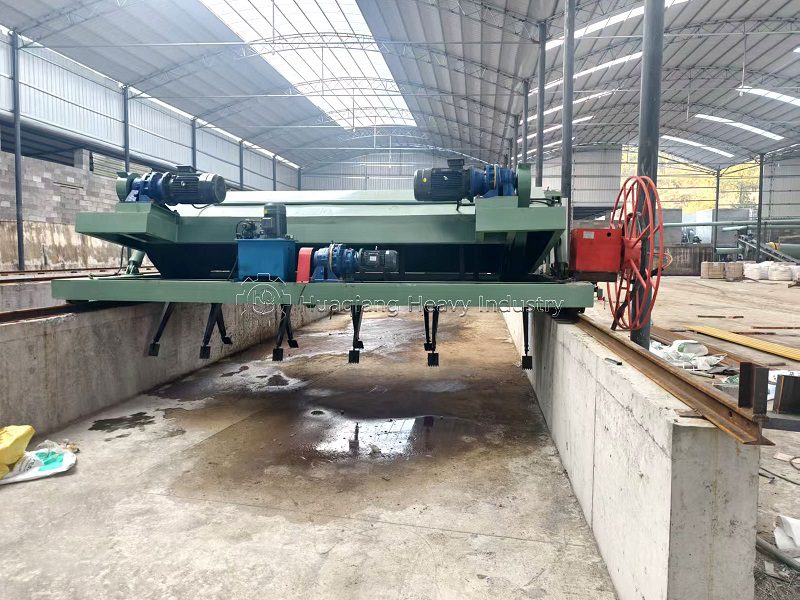
Compost turning machines play an irreplaceable role in the treatment of agricultural waste. First, they accelerate the composting process of organic waste. Under natural conditions, the composting of organic waste takes several months or even years, while the turning operation of the compost turning machine provides sufficient oxygen and suitable environmental conditions for microbial activity, shortening the fermentation cycle to 1-2 months and significantly improving processing efficiency. Secondly, it improves the quality of organic fertilizer. The mixing action of the turning machine ensures uniform mixing of materials and reasonable distribution of nutrients. At the same time, high-temperature fermentation effectively kills pathogenic bacteria, insect eggs, and weed seeds, reducing harmful substances in the organic fertilizer and ensuring the safety of crop growth. In addition, compost turning machines can reduce processing costs by replacing manual turning with mechanized operation, reducing labor input, improving production efficiency, and reducing labor intensity.
Different types of compost turning machines have their own application advantages in agricultural waste treatment. For livestock and poultry breeding enterprises, hydraulic compost turning machines and double-screw compost turning machines are ideal choices. These enterprises generate large amounts of livestock and poultry manure daily, which has high moisture content and high viscosity, requiring powerful equipment that can turn and mix the material evenly. Hydraulic compost turning machines provide sufficient power to effectively turn high-moisture materials; double-screw compost turning machines can achieve deep mixing of materials, preventing clumping and promoting fermentation. For rural cooperatives and family farms, simple compost turning machines and windrow compost turning machines are more suitable. These users handle relatively smaller amounts of waste and have limited space. Simple compost turning machines have low investment costs and are easy to operate, while windrow compost turning machines do not require fixed fermentation tanks, offering greater flexibility and meeting the needs of small-scale production.
Compost turning machines also play an important role in straw treatment. Straw is rich in cellulose, hemicellulose, and other organic matter, making it a high-quality composting material. However, straw is hard in texture and difficult to decompose naturally. Through the turning and mixing action of the compost turning machine, the straw can be fully mixed with livestock and poultry manure and other raw materials, adjusting the carbon-nitrogen ratio and creating suitable conditions for microbial fermentation. At the same time, the crushing action of the turning machine can pulverize the straw, increasing the contact area with microorganisms and accelerating the decomposition and maturation of the straw. The treated straw compost not only provides nutrients for crops but also improves soil structure and enhances the soil’s water and nutrient retention capacity.
The application of compost turning machines also promotes the development of circular agriculture. After organic fertilizer is applied to farmland, it can increase the organic matter content of the soil, improve soil physical and chemical properties, enhance soil fertility, and reduce the use of chemical fertilizers. The reduction in chemical fertilizer use not only lowers agricultural production costs but also reduces pollution of soil, water, and air caused by chemical fertilizers, protecting the ecological environment. At the same time, agricultural waste is returned to the farmland after composting, achieving a circular utilization of “waste – organic fertilizer – crops – waste,” forming a sustainable agricultural production model. With the increasing national emphasis on environmental protection and green agricultural development, policy support for the resource utilization of agricultural waste is continuously strengthening, and the market demand for composting turning machines will continue to grow. In the future, composting turning machines will develop towards intelligence, large-scale operation, and multi-functionality, continuously improving equipment processing efficiency and environmental performance, providing stronger support for the resource utilization of agricultural waste, and contributing to the achievement of sustainable agricultural development goals.
While compost turners are the cornerstone of waste recycling, transforming this compost into a commercial product requires a complete bio organic fertilizer production line. This integrated system leverages professional fertilizer manufacturing equipment to process the cured compost. Efficient fermentation composting technology is initiated using machines like the double screws compost turning machine for controlled trough systems or a windrow composting machine for outdoor piles. This suite of equipment forms the initial stage of fertilizer raw material processing machinery and equipment. Following fermentation, the material can be further refined and shaped. For small to medium-scale production of dense, cylindrical pellets, a flat die pelleting machine is an excellent choice. This granulation step transforms the bulk compost into a uniform, market-ready product, completing the value chain from raw waste to valuable, nutrient-rich biofertilizer.