
In today’s era of pursuing efficiency and sustainability in agriculture, the choice of fertilizer production equipment directly impacts output, costs, and environmental footprint. The disc granulation production line, with its outstanding performance, is rapidly gaining favor among global fertilizer manufacturers. It not only enhances production efficiency but also showcases unique advantages in environmental protection and energy savings. So, what makes the disc granulation production line so appealing? Let’s explore its highlights, compare it with other fertilizer equipment, and uncover why it has become a wise choice for the industry.
First, the core strengths of the disc granulation production line lie in its high efficiency and uniformity. By using a rotating disc to evenly mix and pelletize raw materials, this process is continuous and automated, significantly boosting output—a single line can process several tons of material per hour while ensuring consistent particle size and high strength. This uniformity not only optimizes fertilizer storage and transportation but also enhances field application effectiveness, allowing for more controlled nutrient release. In contrast, traditional equipment like drum granulator, though suitable for large-scale production, tend to have higher energy consumption and slightly inferior particle uniformity; while extrusion granulators work well with specific viscous materials, they may limit particle shape diversity, restricting application scenarios.
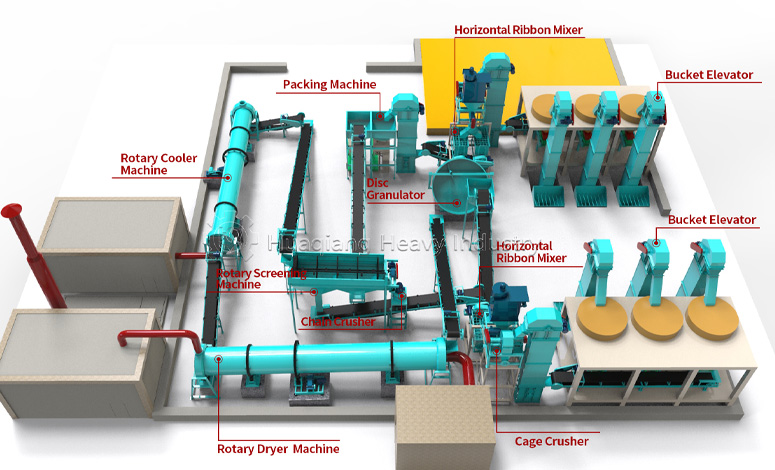
Second, the disc granulation production line excels in energy conservation and environmental protection. Its compact design results in lower energy consumption, helping companies achieve green production goals by reducing electricity usage and waste emissions. Moreover, it adapts to various raw materials, from organic waste to chemical fertilizers, enabling efficient conversion and minimizing resource waste. This makes it an ideal partner for sustainable agriculture in the face of increasingly stringent environmental regulations. Choosing it means not only cutting operational costs but also contributing to the planet.
Furthermore, ease of operation and low maintenance costs add to its appeal. The disc granulation production line features a high degree of automation, reducing manual intervention and lowering labor intensity and safety risks. With simple daily maintenance and low failure rates, it ensures long-term stable operation. Compared to other equipment, such as hydraulic roller granulator that may involve complex temperature control and higher maintenance costs, the disc granulation line offers better cost-effectiveness, making it particularly suitable for small to medium-sized fertilizer enterprises seeking upgrades.
In summary, the disc granulation production line is redefining fertilizer production standards with its efficiency, eco-friendliness, and flexibility. As global agriculture moves toward intelligence and sustainability, choosing it is not just a technological upgrade but a strategic decision for the future. Let’s embrace this innovation together and drive the fertilizer industry toward a more efficient and greener tomorrow!