

We are a professional manufacturer of organic fertilizer equipment and a customized service provider for fertilizer production lines
Company Address
(Sat - Thursday)
Our Email
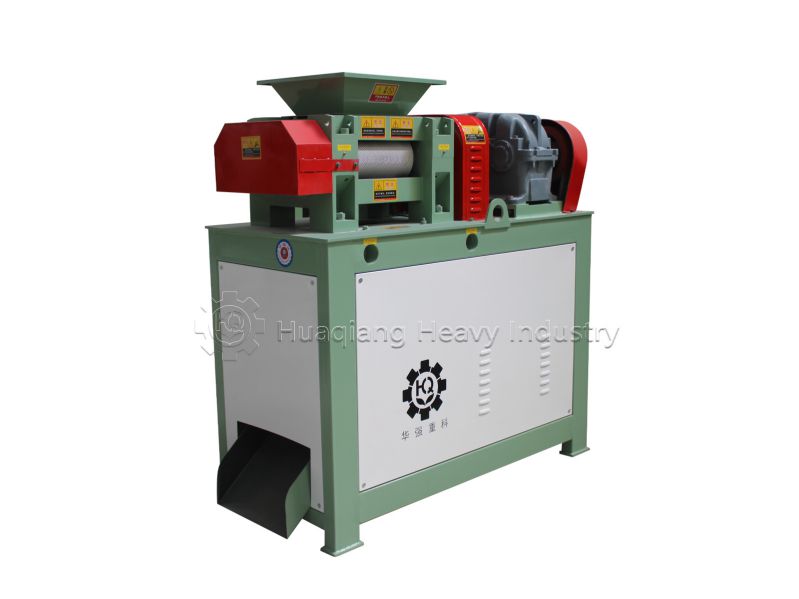
A double-roller extrusion granulator, also known as a roller press granulator, is a molding machine that uses a pair of opposing rotating extrusion rollers to directly compress powdered materials into granules of a specific shape under high pressure. It is the core of the entire extrusion granulation production line. This equipment adopts a dry extrusion granulation process, directly compressing dry powder materials into granules at room temperature, forcing the material into shape through mechanical pressure. Its design concept is to directly compress powdered materials into granules with a certain strength without adding binders (or with very little addition). As an important granulation equipment, the double-roller granulator uses a non-drying, room temperature process, which has significant advantages in energy saving and improving production efficiency. Its core working principle is to extrude a properly proportioned mixture through a feeding mechanism into the gap between a pair of rotating extrusion rollers of the same size.
Under strong extrusion pressure, air inside the material is expelled, the interparticle spacing decreases, and the intermolecular forces increase, thereby compressing the material into dense flakes or strips. As the rollers continue to rotate, the pressure on the material exhibits a specific changing pattern: when the straight line connecting the radii of the two rollers is horizontal, the pressure reaches its maximum value, typically reaching several megapascals or even higher, and then drops rapidly. At this point, the formed material recovers due to its own elasticity, detaching from the roller surface under the action of the rebound force, and smoothly entering the next process. This granulation method fundamentally avoids the energy-consuming drying process in traditional wet granulation. This equipment has advantages such as simple structure, low energy consumption, high degree of automation, and wide applicability, and is particularly suitable for dry granulation and additive-free production needs. Furthermore, this equipment features advanced technology, reasonable design, compact structure, and low energy consumption; it can be used as a standalone unit or combined with multiple units to form a mechanized continuous production line.
The double-roller extrusion granulator mainly consists of the following core components:
Frame and Base:Welded from heavy-duty channel steel or castings, it bears the weight of the entire machine and ensures stability under high pressure.
Transmission System:Typically composed of a motor, pulleys, reducer, and gear transmission. It provides synchronous and opposite rotational power to the two rollers.
Pressure Roller Assembly (Core Component):Consists of two horizontally mounted, parallel rollers. One is a fixed shaft (main shaft), and the other is an adjustable shaft (passive shaft). The shafts are fitted with specially heat-treated roller skins. The roller skin surfaces are engraved with spherical, strip-shaped, or flattened spherical grooves, determining the shape and size of the finished granules.
Pressure Adjustment System (Spring or Hydraulic System):Used to adjust the extrusion pressure between the two rollers to accommodate different material hardness requirements and provides overload protection.
Feeding Mechanism:Usually equipped with a forced feeder (such as a screw conveyor) to ensure that the material is fed evenly and continuously into the angled area between the two rollers. Crushing and screening system: Some models come with crushing rollers and vibrating screens to crush the extruded cake material into particles of a specified size and separate the powder for recycling and granulation.
Applicable Raw Materials
Fertilizer Raw Materials: Urea, ammonium chloride, ammonium sulfate, ammonium nitrate, potassium chloride, potassium sulfate, monoammonium phosphate, superphosphate, etc. (particularly suitable for compound fertilizers and organic-inorganic compound fertilizers).
Chemical Raw Materials: Catalysts, additives, de-icing agents, zinc oxide, calcium carbonate, carbon black, dyes, etc.
Minerals and Metallurgy: Coal powder, coke powder, bentonite, gypsum, metal powders.
Pharmaceuticals and Food: Powdered raw materials, feed additives, etc.
Applications
1. Fertilizer Industry: Produces various high, medium, and low concentration specialty fertilizers and compound fertilizers, including organic fertilizers, inorganic fertilizers, bio-fertilizers, and magnetized fertilizers. Particularly suitable for extrusion granulation of ammonium chloride, ammonium sulfate, ammonium bicarbonate series compound fertilizers, rare earth elements, and potash fertilizers. This equipment is a next-generation product for energy saving and consumption reduction in the fertilizer industry.
2. Chemical Industry: Used for granulation of powder materials such as pigments, detergents, catalysts, strontium carbonate, silica, inorganic salts, chloroisocyanuric acid, bleaching powder, pesticides, and oxides.
3. Pharmaceutical and Food Industry: Used for the preparation of capsule filling granules and powder granules. Particularly suitable for granulating materials that cannot be granulated by adding water or wet methods.
4. Environmental Protection Industry: Processes industrial recycled dust materials, such as foundry dust, lead-zinc-aluminum dust, converter dust, filter dust, and grinding dust. Converts industrial waste such as fly ash and sludge into usable granules, achieving resource utilization. It is also a project promoted through environmental protection engineering.
5. Other Industries Applicable to rare earth, metallurgy, coal, biological agents, and other fields; it can also be used in the building materials industry to manufacture refractory materials, ceramic raw materials, etc.
The basic principle of roller extrusion granulation is “pressure forming.” When material enters between two pressure rollers, it is drawn into the narrow gap as the rollers rotate. During this process, air inside the material is expelled, and the distance between molecules is forcefully shortened, resulting in plastic deformation. When the pressure exceeds the material’s yield point, the powder agglomerates into dense flakes or pre-shaped blanks. Subsequently, it is demolded and crushed under gravity or the action of a crusher.
Its working principle can be summarized as: forced feeding -> compaction forming -> crushing and demolding -> screening and grading.
Material Feeding: Material enters through the feed hopper and is evenly fed between two counter-rotating pressure rollers by a forced feeding screw.
Extrusion Forming: As the rollers rotate, the material is forcibly bitten into the roller gap. The contact pressure increases sharply as the material moves closer to the center line of the roller shaft. At the roller gap (the point of maximum pressure), the material is compressed into dense flakes or spheres.
Demolding and Crushing: After passing through the roller gap, the pressure is rapidly released, and the formed “cake” falls off due to elastic recovery and its own weight, entering the crusher for coarse crushing.
Screening and Recycling: The crushed material enters the screening machine; qualified particles enter the finished product bin; undersized powder and oversized large particles are returned to the raw material end via a conveyor for regranulation.
The granulation process of the double-roller extrusion granulator belongs to the dry extrusion granulation process. Its core process parameters and control points are as follows:
1. Process Principle
The principle of dry granulation is physical extrusion combined with material self-adhesion—by extruding, air between the powder particles is expelled, causing the particles to rearrange. Under high pressure, van der Waals forces, adsorption forces, crystal bridges, and intercalation forces are generated, causing the material to self-adhere into granules without the addition of any binder.
2. Key Process Parameters
Extrusion Pressure: Adjustable according to material characteristics; 15-18MPa for soft raw materials, 20-25MPa for hard raw materials
Roller Gap: Generally 1-1.5mm (0.5-1mm for organic fertilizer)
Material Moisture Content: 2%-15% for inorganic materials, 18%-28% for organic materials
Feed Particle Size: ≤0.5mm
Finished Particle Size: Φ2.5-Φ30mm adjustable
3. Process Features
Room temperature granulation, no heating or drying required
One-step molding, streamlined process
High particle density, high strength, high granulation rate (up to 95% or more)
Avoids high-temperature damage to heat-sensitive materials
No wetting agents added, ensuring product purity

| Model Item | DZJ-I 1.0 | DZJ-I 2.0 | DZJ-I 3.0 | DZJ-I 4.0 |
|---|---|---|---|---|
| Model | DZJ-I 1.0 | DZJ-I 2.0 | DZJ-I 3.0 | DZJ-I 4.0 |
| Capacity (t/h) | 1-1.5 | 1.5-2.5 | 2-3 | 3-4 |
| Power (kW) | 11 | 18.5 | 22 | 45 |
| Roller Dimension (mm) | ø150×220 | ø150×300 | ø186×300 | ø300×300 |
| Feed Material Size (mm) | ≤0.5 | ≤0.5 | ≤0.5 | ≤0.5 |
| Output Granules Size (mm) | ø2.5-ø10 | ø2.5-ø10 | ø2.5-ø10 | ø2.5-ø10 |
| Gearbox Model | ZLY-160 | ZLY-160 | ZLY-180 | ZLY-224 |
| Rotation Speed (r/min) | 60 | 60 | 60 | 60 |
As a highly efficient solid granulation equipment, the double-roll extrusion granulator has been widely used in various industries. For specific model selection advice or equipment and production line integration solutions, please feel free to consult us or discuss practical case studies.
We are a high-quality manufacturer of organic fertilizer equipment Providing excellent consultation and after-sales service
© Copyright 2024 Huaqiang All rights reserved.