
In today’s booming organic fertilizer industry, a “one-size-fits-all” solution is no longer sufficient to meet diverse production needs. Whether it’s a livestock farm processing manure, an agricultural waste treatment center using straw and medicinal residue as raw materials, or a specialized factory producing high-end bio-organic fertilizer, each enterprise faces different raw material characteristics, production capacity targets, and site conditions. Designing a truly “fitted” customized organic fertilizer production line is a prerequisite for ensuring return on investment and achieving efficient production.
Step 1: Define Core Parameters—Capacity, Raw Materials, and Products
The starting point for customized design is answering three questions: How many tons of raw materials are processed daily? What are the raw materials (chicken manure, cow manure, straw, sludge)? What is the final product (powdered organic fertilizer, granular organic fertilizer, organic-inorganic compound fertilizer)?
Capacity determines equipment specifications. The model of the compost turner and the configuration of the granulator are drastically different for a daily output of 10 tons versus 100 tons. Raw materials determine the process route. High-moisture fresh manure requires a screw extruder dewatering machine and a high-moisture material crusher; straw-based raw materials require a chain crusher and a horizontal mixer to adjust the carbon-nitrogen ratio. The product form determines the downstream configuration. Powdered products eliminate the granulation step, reducing investment by 30%-40%; granular products require disc, drum, or roller granulation processes depending on the target market.
Step Two: Fermentation Process Selection – Open-Air or Closed?
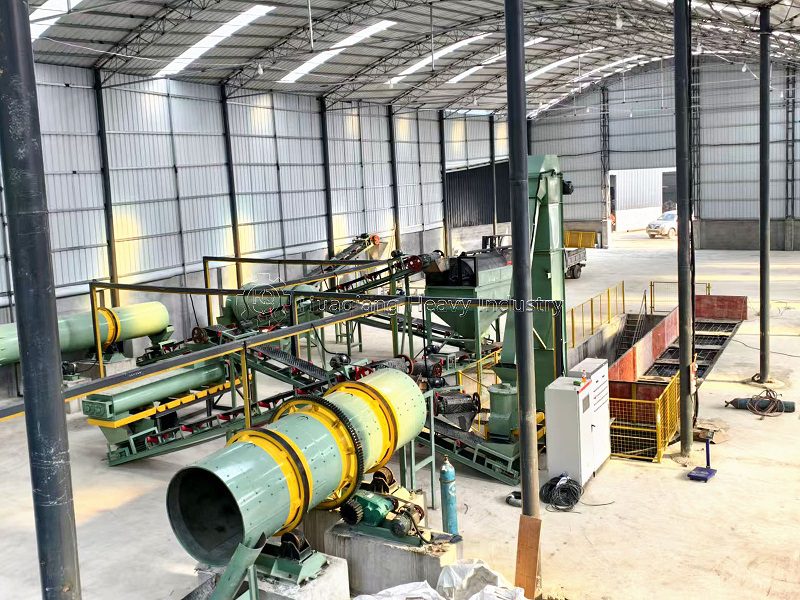
Fermentation is the core step in organic fertilizer production, and the process selection directly affects environmental compliance and operating costs. Projects with open sites far from residential areas can choose windrow-style open-air fermentation with a self-propelled turner, offering low investment and flexible expansion. Projects located in densely populated livestock areas or environmentally sensitive areas must use closed-system fermentation in troughs, equipped with a trough turner and a waste gas collection system to achieve odorless production.
Step Three: Granulation Process Matching – Tailored to Material Requirements
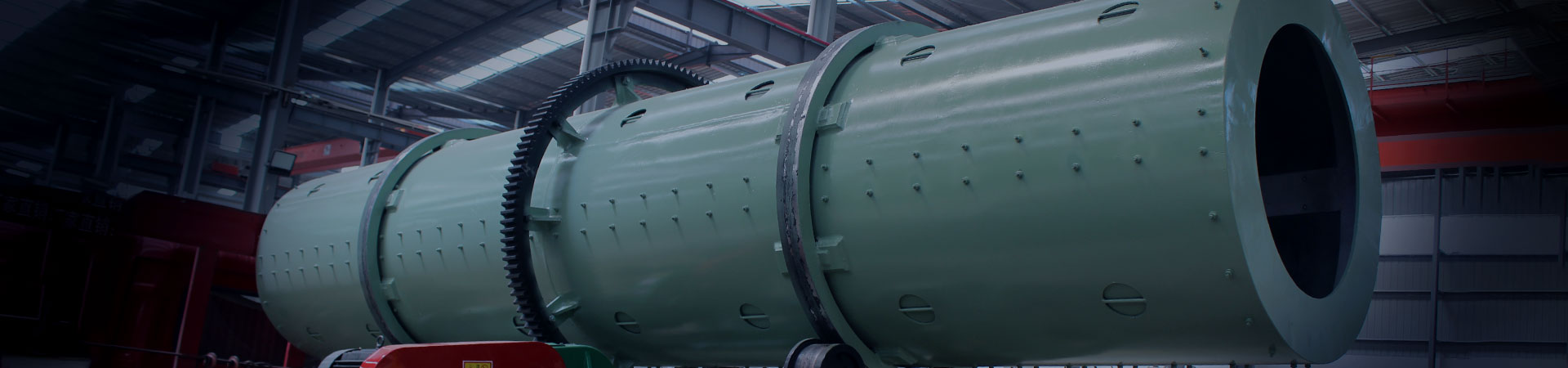
Granulation is crucial for granular organic fertilizer production. High-organic-content, high-fiber raw materials are recommended for roller extrusion granulation, which eliminates the need for drying and produces high-strength granules. Fermentation materials with moderate moisture content are best suited for disc granulation, which requires lower investment and produces round granules. For large-scale continuous production, rotary drum granulation offers high capacity and a high degree of automation.
Step 4: Site and Layout Optimization
Another value of customized design lies in site adaptability. The same set of equipment can be used in a linear layout on a narrow plot or a U-shaped layout on a square plot, maximizing space utilization. Buffer silos are installed between equipment to buffer capacity fluctuations between upstream and downstream processes, preventing production stoppages due to single-machine failures.
Step 5: Intelligent Control and Remote Maintenance
Modern organic fertilizer production lines are fully integrated with PLC control systems. Operators can monitor key data such as fermentation temperature, granulation parameters, and drying hot air from the central control room, and remotely view the operating status via a mobile app. Customized production lines can also be equipped with a fault self-diagnosis system to provide early warnings of potential problems such as bearing wear and motor overload, significantly reducing unexpected downtime.
With 19 years of experience in organic fertilizer equipment R&D and over 1300 successful global project cases, our company provides one-stop customized services from raw material analysis and process design to equipment manufacturing, installation, and commissioning. We welcome you to provide your raw material list and production capacity requirements to obtain a customized production line design solution.
The customized design process ensures that every production line is perfectly tailored. For a bio organic fertilizer production line where microbial activity is paramount, the granulation choice is critical. A disc granulator is often preferred for its gentle tumbling action, preserving microbial viability. The post-granulation finishing steps, however, are universal. The granules are stabilized in a fertilizer dryer machine and fertilizer cooler machine, classified by a rotary drum screening machine, and finally sealed by a fertilizer packing machine. For producers creating complex blends, an npk blending machine can be integrated to precisely add mineral nutrients to the organic base. The integration of these finishing steps—screening, drying, cooling, and packaging—is common to all successful lines, ensuring the final product meets market standards for quality and consistency. The granulator, whether a disc, drum, or roller press, is just one critical component in this integrated, customized system. By carefully selecting each piece of equipment based on raw materials and capacity, a truly fitted line maximizes efficiency and return on investment.