


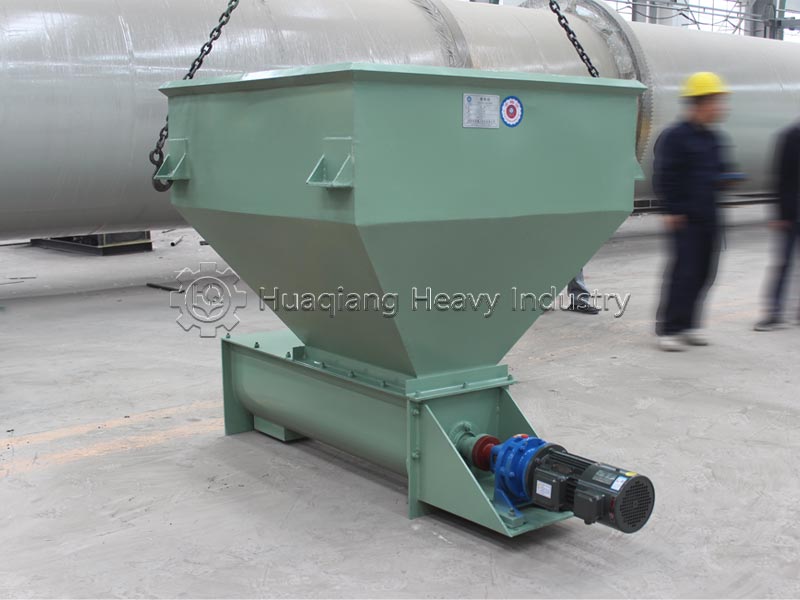
In the orchestra of a modern fertilizer production line, where massive mixers rumble and granulators roar, one component operates with quiet, relentless precision: the uniform feeder. Often overlooked, it is the fundamental element that translates a digital recipe into physical reality. By delivering a perfectly steady, controlled stream of raw materials—be it powder, granules, or flakes—it ensures that every subsequent process, from mixing to granulation, starts with accuracy. It is the silent conductor, setting the exact tempo for the entire production symphony.
Core Advantages: The Foundation of Consistent Quality
The uniform feeder’s value lies not in transformation, but in impeccable control. Its benefits are foundational to any precision manufacturing process:
Unwavering Flow Stability: Its primary mission is to defeat variation. Regardless of changes in hopper pressure, material density, or minor clogging, a high-quality feeder maintains a constant discharge rate, often with an accuracy of ±0.5% to 2%. This stability is the bedrock of formulation consistency.
Precision Across the Scale: Modern feeders offer exceptional turn down ratios (e.g., 100:1), meaning they can accurately meter from tiny trickles for potent additives to massive flows for base materials, all with linear control. This allows for incredibly precise recipe management.
Seamless Process Integration: As a key Industry 4.0 component, it integrates directly with plant control systems (PLC/DCS), enabling remote setpoint changes, real-time data logging, and closed-loop control for fully automated, self-correcting batching lines
Robust and Reliable: Built for 24/7 industrial duty with wear-resistant materials and sealed components, it ensures long-term reliability with minimal maintenance, protecting the uptime of the entire downstream process.
Working Principle: Controlled Movement, Measured Release
While designs vary, the principle is consistent: to move material from a storage vessel at a precisely governed rate.
Activation: The control system sends a setpoint (e.g., 500 kg/hr) to the feeder.
Material Engagement: The feeding mechanism (screw, belt, vibrating tray) activates, drawing material from the inlet.
Rate Regulation: An internal sensor (speed encoder, weight cell) continuously measures the actual output. The control loop instantly adjusts the drive speed to match the measured rate to the target setpoint.
Continuous Discharge: A perfectly steady stream of material is presented to the next stage of the process—a conveyor, mixer, or reactor.
The Uniform Feeder in the Ecosystem of Fertilizer Equipment
The feeder’s role cannot be understood in isolation. It is the critical link that empowers other, more prominent equipment to function as designed.
Enabling the NPK Blending Line: Here, multiple uniform feeders are the stars. One feeder for granular urea, one for DAP, one for MOP—each precisely dosing its material to a Horizontal Ribbon Mixer. The mixer’s ability to create a homogeneous blend is entirely dependent on the feeders’ accuracy. The feeder ensures the “recipe” is correct; the mixer ensures it’s uniform.
Sustaining the Granulation Process: In a rotary drum granulator or disc granulator, a consistent feed of powder and recycle is crucial for stable pellet growth. A uniform feeder (often a belt or screw type) provides this steady diet. Fluctuations in feed cause variations in pellet size, moisture, and quality. The feeder stabilizes the process the granulator relies on.
Fueling the Reaction: In ammoniation-based NPK compound fertilizer lines, the precise feeding of phosphoric acid or sulfuric acid via a Liquid Feeder (or Metering Pump) is a chemical necessity. An error here can halt the reaction or produce off-spec product.
Feeding the Crusher: A half-wet material crusher needs a steady, controlled feed to operate efficiently without clogging or stalling. A vibratory or belt feeder ensures the crusher is fed at its optimal capacity.
In essence:
The Mixer creates homogeneity.
The Granulator forms particles.
The Crusher reduces size.
The Uniform Feeder guarantees the correct amount of material enters each of these machines at the correct time. It is the gatekeeper of mass flow.
Application: The Central Nervous System of Batching
Its application is universal wherever precise proportions matter:
BB Fertilizer Plants: Multi-ingredient batching (as described above).
Compound Fertilizer Granulation Plants: Feeding pre-mix powder and recycle to the granulator.
Coating & Post-Processing: Precisely feeding tiny amounts of coating powder or liquid into a Rounding/Coating Drum.
Additive Incorporation: Dosing micronutrients, inhibitors, or binders into main fertilizer streams.
Conclusion
To invest in a high-precision uniform feeder is to invest in the predictability and quality of your entire production line. It is a force multiplier for every piece of equipment that follows it. While the granulator may be the “heart” of a fertilizer plant, producing the final product, the network of uniform feeders is its “central nervous system,” meticulously controlling the flow of nutrients with silent, unwavering precision. In modern manufacturing, where quality is defined by consistency, the uniform feeder is not an accessory; it is an essential pillar of process control.