
In the modern fertilizer industry, which prioritizes efficiency and environmental protection, roller press granulation technology stands out with its unique approach. It bypasses traditional drying and binder-addition processes, using pure physical pressure to directly “mold” powder into granules, thereby charting a new, energy-saving, and streamlined path for agglomeration.
The Core Secret: The Art of Physical Pressure
The heart of this production line is the double roller press granulator. Its core principle is straightforward yet powerful: two parallel press rollers, engraved with pockets (molds), rotate toward each other under immense hydraulic or mechanical force. Pre-blended dry powder is continuously and evenly fed into the nip between the two rollers. Within this tiny space, the material is subjected to tremendous linear pressure, ranging from tens to hundreds of tons. Powder particles are instantly compressed and densified. Under the shaping force of the roller pockets acting as “molds,” they form dense compacts with specific shapes (typically oval or pillow-shaped), which then fall away by gravity. The entire process is a pure “dry” method, requiring no water, no heat, and no additional binders.
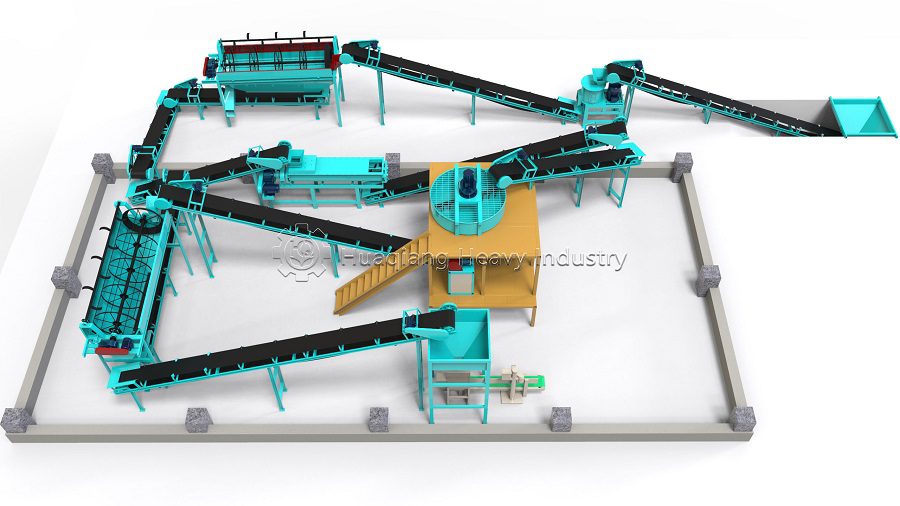
The Complete Line: A Symphony of Dry Processing
An excellent roller press requires a capable “support team” to form a complete dry granulation line:
Raw Material Pre-treatment Unit: A precise batching system ensures the correct ratio of N, P, K, and trace elements. A high-speed mixer then achieves a homogenous blend of all powder ingredients at a near-molecular level—a prerequisite for uniform granules.
Core Compaction Unit: The roller press granulator is the star on stage. Modern machines are equipped with hydraulic adjustment systems for precise pressure control, adapting to different material properties.
Post-Processing Unit: The freshly extruded compacts have sharp edges and uneven strength. They enter a chain crusher and sizing machine to be broken down and trimmed into uniformly sized, regular granules. Subsequently, a rotary screening machine precisely separates finished granules, fines, and oversized particles. Fines are automatically recycled back to the mixer via a return system, achieving 100% raw material utilization.
Finished Product Handling Unit: Qualified granules may enter a coating machine for an anti-caking treatment to improve storage properties, before final packaging and palletizing by an automatic packaging system.
Irreplaceable Advantages: Why Choose Roller Press?
Extreme Energy Efficiency: Eliminates the drying process, the most energy-intensive step, significantly reducing production costs.
High Product Purity: No introduction of water or chemical binders preserves the original chemical properties of the raw materials. It is ideal for heat-sensitive or moisture-unstable materials (e.g., certain nitrogen fertilizers, biological agents).
High Granule Strength: Granules formed by physical compaction have a dense internal structure, offering excellent crush strength and resistance to caking, ideal for long-distance transport and storage.
Environmentally Friendly: No wastewater or exhaust gas (hot flue gas) emissions, ensuring a clean production process.
High Flexibility: Changing the roller molds easily alters the shape and size of the granules.
Thus, the roller press granulation line is particularly suited for producing high-concentration compound fertilizers, trace element fertilizers, organic-inorganic compound fertilizers, and mineral feeds. Looking ahead, with advancements in wear-resistant materials and intelligent pressure control technology, this “dry pathway” will become even more efficient, precise, and reliable, continuing to provide solid technical support for solid waste recycling and specialty fertilizer production.