
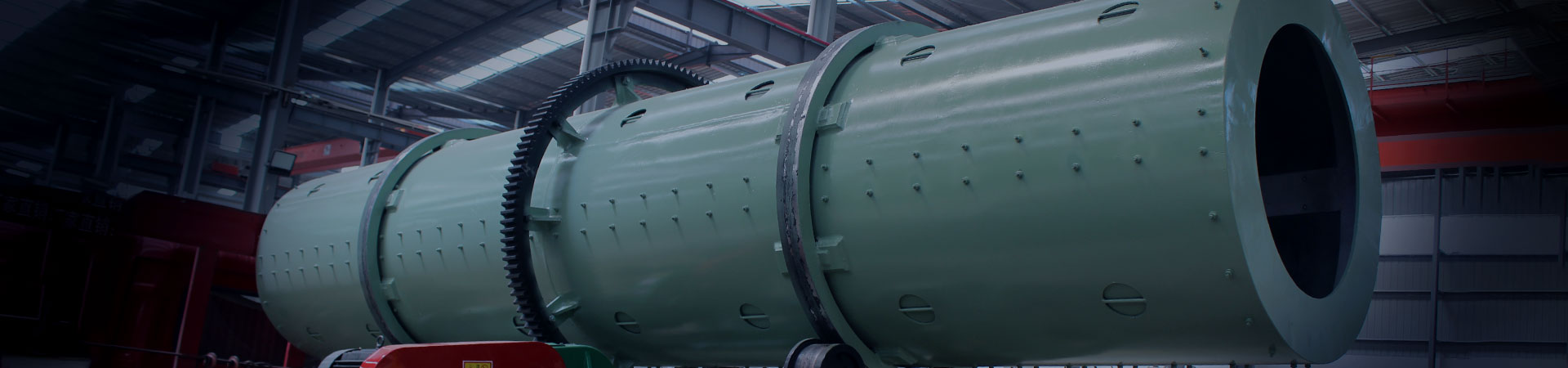
In a complete NPK compound fertilizer production line, from raw material crushing to finished product packaging, numerous pieces of equipment and many steps are involved. How to connect these diverse pieces of equipment into a highly efficient whole? The answer lies in those seemingly simple yet crucial belt conveyors. As the “flowing blood” of the production line, Huaqiang Heavy Industry’s belt conveyor series, with its wear-resistant, stable, and adjustable characteristics, seamlessly connects the entire process of crushing, batching, mixing, granulation, drying, and packaging, completely eliminating conveying breaks and helping to increase production efficiency by more than 40%.
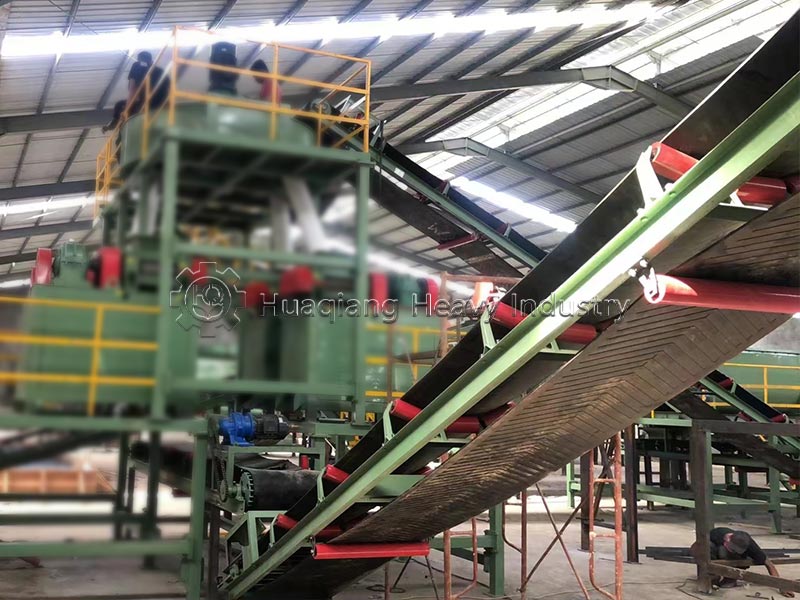
Raw Material Pre-treatment Stage: Ordinary Belt Conveyors, Stable and Fast Horizontal Conveying
The starting point of the production line is raw material crushing. After the cage crusher crushes large particles of raw materials such as urea and ammonium phosphate into fine powder of 80 mesh or higher, it needs to be immediately conveyed to the batching machine. This stage is best suited for horizontal or slightly inclined conveying using ordinary belt conveyors.
Practical Tips: Bandwidth selection must match production capacity—for production lines with an hourly output of 20 tons or more, it is recommended to use a B800 or higher wide-band conveyor to ensure sufficient conveying capacity. When conveying powdery raw materials, it is recommended to install a dust cover to prevent dust spillage and environmental pollution, and to reduce material loss. The equipment comes standard with a dustproof design and excellent sealing performance.
Post-granulation conveying stage: High-angle belt conveyor for incline feeding without slippage. The wet granules at the granulator outlet have a high moisture content and need to be sent to a dryer for dehydration. However, the dryer inlet is usually located high, making it difficult for ordinary conveyors to handle inclines. This is where a high-angle belt conveyor comes in.
Its core advantage lies in the design of corrugated sidewalls and transverse baffles—the sidewalls prevent granules from slipping from both sides, while the baffles support the material as it climbs upwards. The maximum inclination angle can reach 60°-90°, and even vertical conveying can be achieved. For high-positioned dryers and coolers, steeply angled belt conveyors can lift materials with minimal footprint, ensuring intact particles without damage during transport, thus guaranteeing the smooth operation of subsequent processes.
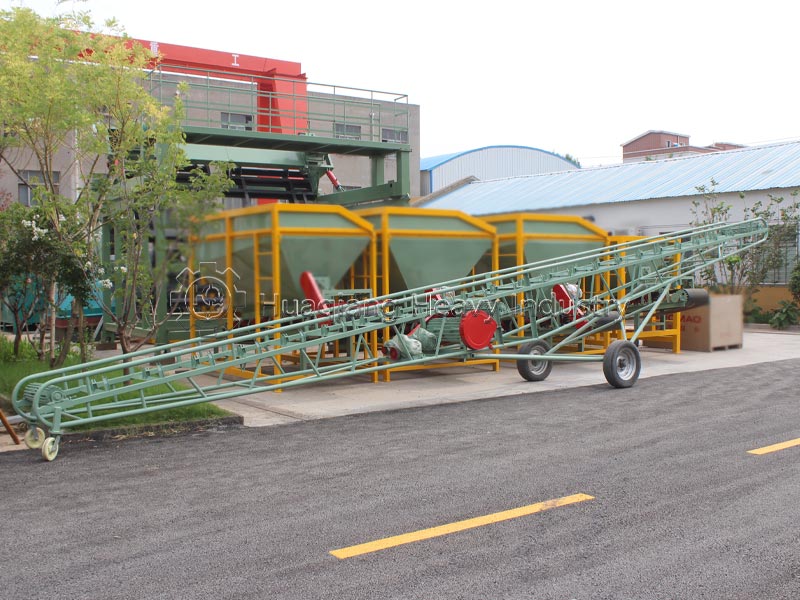
III. Finished Product Packaging: Mobile Belt Conveyors for Flexible and Convenient Palletizing Between the packaging machine outlet and the finished product warehouse, the conveyor direction often needs frequent adjustments based on the stacking position. Fixed conveyors cannot meet this flexibility requirement, while mobile belt conveyors excel.
Equipped with swivel casters and adjustable height supports, they can be moved and their angle adjusted at any time according to the stacking position. Packaged finished bags fall directly onto the conveyor belt and are automatically delivered to the designated area in the warehouse. Workers only need to stack them, eliminating the need for back-and-forth handling. After introducing mobile belt conveyors, an agricultural input factory reduced labor costs in the packaging and palletizing process by 30% and significantly improved site utilization.
Key Practical Techniques: Making Conveyor Lines More Durable and Smoother
Anti-deviation Adjustment: Belt deviation is a common fault, often caused by non-parallel rollers or material accumulation. The equipment is equipped with self-aligning idlers and belt alignment devices. Operators should regularly check and adjust these to ensure the belt always runs in the center.
High Temperature Resistance Selection: When conveying high-temperature particles at the dryer outlet, heat-resistant rubber belts must be used. Ordinary belts are prone to aging and cracking when exposed to heat. Huaqiang offers dedicated conveyor belts with a temperature resistance of 120℃ and above to meet the needs of different working conditions.
Dustproof Sealing: Dust is easily generated during the conveying of powdery materials. It is recommended to use a fully enclosed belt conveyor or install a dust cover on ordinary models. The equipment can be equipped with a “ridge-type” cover plate and PTFE packing seals to effectively suppress dust leakage.
Cleaning and Maintenance: After conveying viscous materials, the accumulated material on the rollers and idlers should be cleaned promptly to prevent belt misalignment or tripping due to accumulation. Huaqiang equipment adopts a squirrel-cage self-cleaning tail pulley design, which can significantly reduce the cleaning frequency.
Daily Maintenance: The Secret to Extending Belt Life
Daily Inspection: Observe whether the belt is misaligned or slipping; clean the accumulated material on the rollers and idlers.
Weekly maintenance: Check belt joints for looseness and wear; lubricate bearings with grease.
Monthly inspection: Check roller coating wear; adjust tensioning device to maintain proper belt tension.
From stable and reliable horizontal conveying to effortless climbing of steep inclines, and flexible and convenient mobile palletizing—Huaqiang belt conveyor series, with its comprehensive coverage capabilities, streamlines every link in the NPK compound fertilizer production line. When all aspects of your production line are seamlessly connected and materials flow smoothly, you will understand: choosing the right conveying equipment is choosing the right “passport” to efficient production.
Integrated Material Handling in NPK Production
The belt conveyor is a fundamental component of professional fertilizer conveying equipment, but a complete npk fertilizer line requires a strategic combination of different conveyor types to optimize material flow. After granulation and drying, the material often needs vertical transport. This is where a bucket elevator excels, gently lifting granules to the inlet of a rotary drum screening machine for classification. The screened, uniform product is then conveyed, often by a troughed belt conveyor, to the fertilizer drying machine for final moisture adjustment (or directly to packaging if moisture is already optimal). After cooling, the finished granules are transported, sometimes by a mobile belt conveyor, to the hopper of an automatic packing machine. This integrated network—combining the gentle incline of a belt conveyor, the precise vertical lift of a bucket elevator, and the flexibility of mobile conveyors—ensures a seamless, efficient, and damage-free flow of material from the granulator to the finished, packaged product, maximizing the throughput and reliability of the entire production line.