
In fertilizer production, not all conveying needs can be met by fixed equipment—raw material arrivals require temporary loading and unloading, finished product stacking requires frequent relocation, and production lines need temporary connections during equipment maintenance. These flexible and varied scenarios are precisely where Huaqiang Heavy Industry’s mobile belt conveyor comes in. It requires no fixed installation, can move freely, and can be started and stopped at any time. With a high-efficiency conveying capacity of 5-10 tons per hour, it becomes a versatile tool for raw material loading and unloading, finished product stacking, and temporary transfer, with an efficiency more than 10 times that of manual handling.
Core Advantages: Flexibility is the Greatest Competitive Advantage
Flexible Movement, Go Where You Want
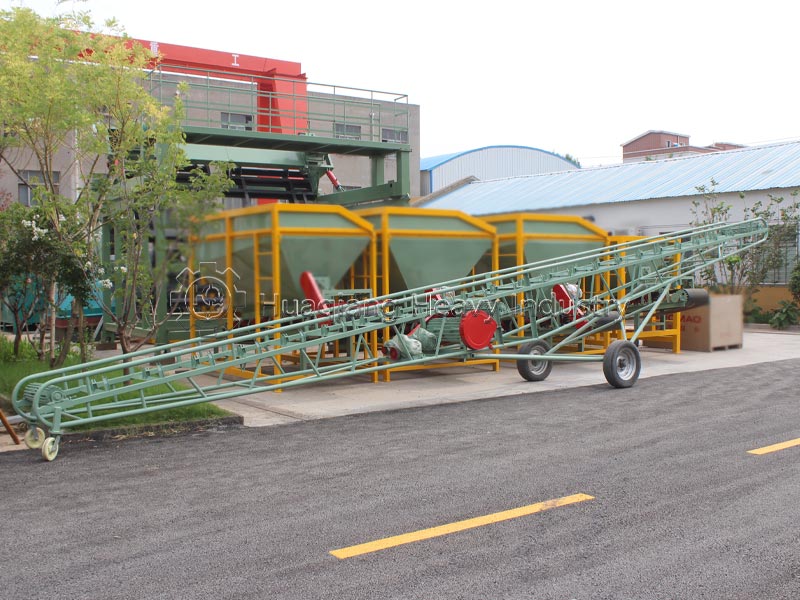
The mobile belt conveyor is equipped with swivel casters and directional wheels at the bottom, allowing for easy propulsion by a single person, enabling free movement within the factory area. From the raw material storage yard to the production workshop, from next to the packaging machine to deep inside the warehouse, wherever conveying is needed, the equipment moves there. No tracks, no overhead cranes, truly “on call.”
No need for fixing, ready to use right out of the box
Fixed conveyors require concrete foundations, installation and commissioning, and permit processing, which is time-consuming and labor-intensive. Mobile belt conveyors eliminate all of this—simply plug in the power after unpacking and they can be stored away in a corner after use, without occupying production space. This advantage is particularly prominent for temporary needs or new projects with undetermined sites.
Multi-scenario adaptability, one machine for multiple uses
By adjusting the body tilt angle (up to 30°), mobile belt conveyors can handle various tasks: horizontal conveying of raw materials, lifting particles at small angles, and loading and unloading at large angles. By changing the model with different bandwidth and length, it can cover different production capacity requirements from 1 ton to 20 tons/hour.
Core Application Scenarios: Flexible Response to Three Scenarios
Scenario 1: The “Porter” for Raw Material Loading and Unloading
When purchased urea, ammonium phosphate, and potassium chloride arrive, they are often piled up at the factory gate. Manual handling is time-consuming and labor-intensive, while forklift operations are limited by space constraints. Push the mobile belt conveyor next to the truck, insert one end into the truck bed, align the other end with the raw material silo, turn on the power, and the materials will be automatically conveyed into the warehouse. With an efficiency of 5-10 tons per hour, it’s equivalent to 10 workers handling materials simultaneously, without damage or loss.
Scenario Two: A “Good Helper” for Finished Product Palletizing
From the packaging machine’s exit to the warehouse palletizing area, the conveyor direction often needs to be frequently changed. Fixed conveyors cannot meet this flexibility, while mobile belt conveyors can be adjusted at any time—palletizing in area A today, push it to area A; loading in area B tomorrow, push it to area B. Workers only need to handle the stacking; the conveying work is entirely handled by the machine, significantly reducing labor intensity.
Scenario Three: A “Backup Player” for Production Line Maintenance
When a fixed conveyor on the production line malfunctions, the entire line may face shutdown. Mobile belt conveyors can temporarily take over, connecting the processes before and after the faulty equipment to ensure uninterrupted production. Alternatively, during equipment maintenance, a temporary detour route can be set up to allow materials to bypass the maintenance area and continue flowing. A mobile conveyor belt is like a “spare tire” for the production line.
III. Practical Operation and Matching Techniques: Making Good Use of This Flexible Equipment
Avoid Violent Collisions During Movement
When moving equipment, observe obstacles along the path and push slowly to avoid violent collisions with fixed equipment or walls. While casters offer flexibility, high-speed collisions can still damage the wheels or frame.
Adjust Height and Inclination According to Needs
Most mobile conveyor belts have adjustable height and conveying inclination angles. When conveying to higher equipment, raise the head support legs; when conveying to lower hoppers, lower the head. Inclination angle adjustments must consider material characteristics—the inclination angle should not exceed 20° for granular materials, while it can be appropriately increased to 25°-30° for powdery materials.
Improve Feeding Efficiency with Small Hoppers
Manually pouring material onto the conveyor belt is often inefficient and uneven. It is recommended to equip the feed end with a small hopper, using a loader or trolley to pour the material into the hopper in one go. The gate at the bottom of the hopper controls the flow rate, achieving continuous and uniform feeding. Huaqiang can provide mobile hoppers to match mobile belt conveyors, one machine and one hopper, a perfect match.
Convenient Power Management
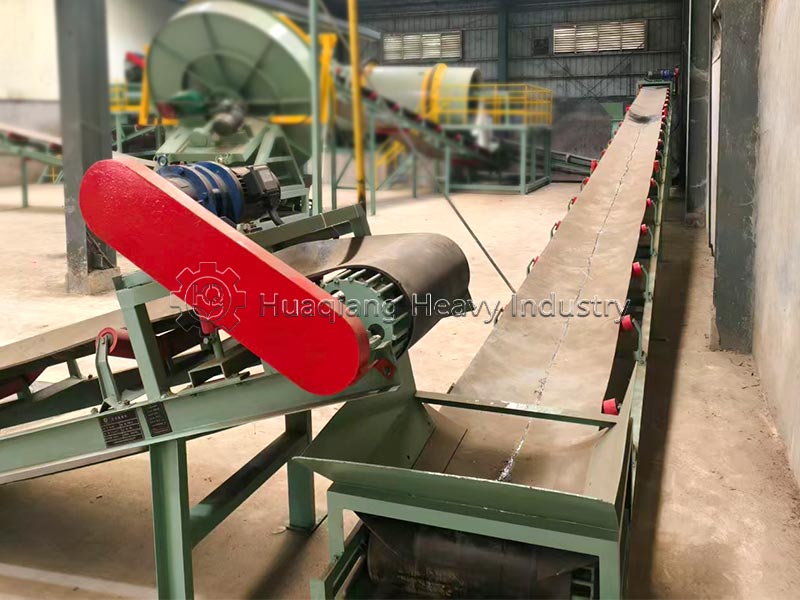
Mobile belt conveyors are typically equipped with 10-20 meter power cords for easy access to power at different locations. If there are few power outlets in the factory area, consider configuring a portable socket box or generator to ensure the equipment is always available.
Customized Services: Tailor-made Models to Your Needs
Huaqiang Heavy Industry’s mobile belt conveyors offer a variety of customization options:
Length Customization: 3m, 5m, 8m, 10m, 12m, and other specifications
Width Selection: B500, B650, B800, to match different production capacity requirements
Power Source: Electric (220V/380V) or diesel engine driven, usable in locations without electricity
Tilting Angle Adjustment: Manual or electric push rod adjustment
Tire Configuration: Standard rubber tires or pneumatic tires, adaptable to different road surfaces
From the first scoop of raw material unloading to the last bag of finished product leaving the warehouse—Huaqiang mobile belt conveyors, with their flexible and mobile core strengths, have become an indispensable “all-rounder” on fertilizer production lines. When the flow of materials within your factory no longer relies on manual labor, and when temporary conveying needs are no longer a problem, you will understand: flexibility is also a powerful form of productivity.
Mobile Conveyors in NPK Fertilizer Lines
The flexible mobile belt conveyor is an invaluable tool for loading, unloading, and temporary transfers, but a complete npk fertilizer line relies on a network of integrated, purpose-built equipment for continuous operation. After precise batching with an npk blending machine and granulation, the material requires a series of finishing steps. It first enters a fertilizer dryer machine to reach the target moisture content, then passes through a fertilizer cooler machine to prevent caking. A rotary drum screening machine classifies the granules, ensuring product uniformity. Finally, the consistent granules are precisely weighed and bagged by a fertilizer packing machine. While mobile conveyors provide essential flexibility for auxiliary tasks, the core of efficient, large-scale production lies in the seamless integration of this fixed, specialized equipment, creating a smooth and reliable workflow from raw material to finished product.