

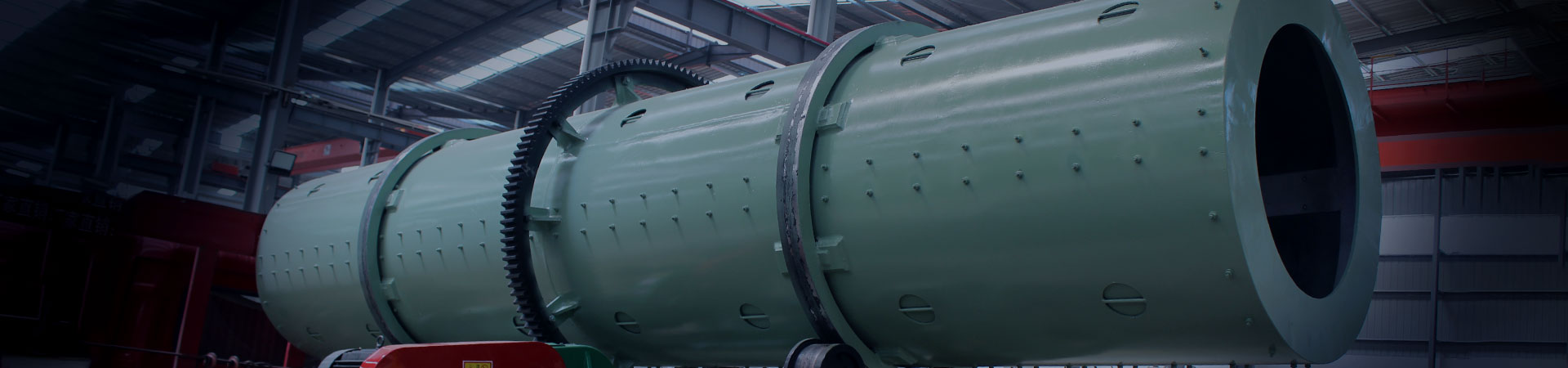
Uniform granules are a key indicator of high-quality fertilizer. Powder that is too fine is prone to scattering and inconvenient to apply; granules that are too large are difficult to mix with seeds and dissolve at inconsistent rates; and impurities can clog the seeder. The key equipment for achieving granule standardization is the rotary drum screener.
Three core functions: grading, impurity removal, and material return
The rotary drum screener appears as a tilted cylindrical screen that rotates slowly during operation (usually 10-20 rpm). Material enters from the higher end and rolls along the inner wall as the drum rotates. Particles of different sizes pass through screen sections with different apertures, thus achieving separation.
- Precise grading
A single screener can typically separate three grades simultaneously:
Fine powder (undersize): Passes through the smallest aperture screen (e.g., 1-2 mm) and is returned to the front of the production line for re-granulation.
Finished granules (intermediate material): Passing through the finished product aperture section (e.g., 2-4mm or 3.5-5.5mm, depending on product standards), they are directly sent to packaging or proceed to the next coating step.
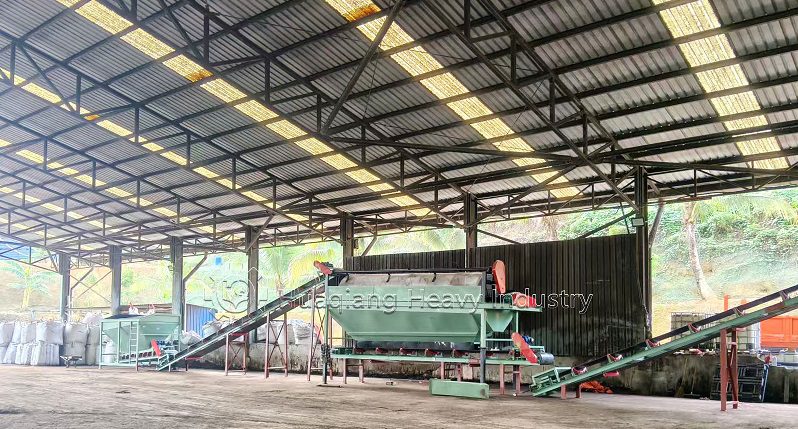
Coarse granules (oversize material): Unable to pass through the maximum aperture (usually ≥6mm), they need to be crushed by a chain plate crusher and returned to the system for regranulation.
- High-efficiency impurity removal: In organic fertilizer production lines, fermented materials may contain small amounts of impurities such as plastic flakes, stones, and metal shavings. The drum screen can intercept all of these in the oversize material, preventing them from entering the finished product. Combined with a strong magnetic separator at the feed end, it can even remove iron impurities such as screws and nails.
- Material recycling: The screened fine powder and crushed coarse material are re-entered into the granulation system, making the overall utilization rate of the entire production line close to 100%, with almost no solid waste generated.
Suitable for various granular fertilizers: The drum screen can handle all types of fertilizer granules: Compound fertilizer granules: Typically require 2-4mm or 3-5mm round granules. A rotary drum screen, used in conjunction with disc or rotary drum granulation, is a standard post-processing configuration.
Organic fertilizer granules: Cylindrical or irregular granules. It is recommended that the screen aperture be 0.5mm larger than the target size (considering the slightly rough surface of organic granules, resulting in slightly poorer throughput). For example, if a 3-5mm finished product is required, a 5.5mm screen aperture can be selected.
Organic-inorganic compound fertilizers: Combining the characteristics of both, care should be taken to ensure the material temperature is not too high (≤60°C) during screening, otherwise, it is easy for the material to stick to the screen.
Two major advantages: Clean screening and stable efficiency
- Clean screening, no screen clogging: The screen of a rotary drum screen has polygonal or circular mesh openings. As the material rolls inside the drum, the contact angle with the screen surface constantly changes, giving more opportunities to “shake” out particles stuck in the holes. Compared to vibrating screens, rotary drum screens have stronger anti-clogging capabilities for wet, sticky materials (such as organic fertilizer with a moisture content of 5%-8%). Even if local clogging occurs, it can be easily cleaned with a brush or high-pressure air after stopping the machine.
- Stable Efficiency and High Processing Capacity: The machine features a simple structure and few potential failure points. The transmission system typically uses a gear ring or chain drive, with a motor power of only 5.5-15kW. Within the rated feed rate range (e.g., 10 tons/hour), the screening efficiency can be stably maintained at 90%-95%. The equipment can operate continuously for over 300 days per year, and routine maintenance only requires checking the bearing temperature every shift and tensioning the chain every two weeks.
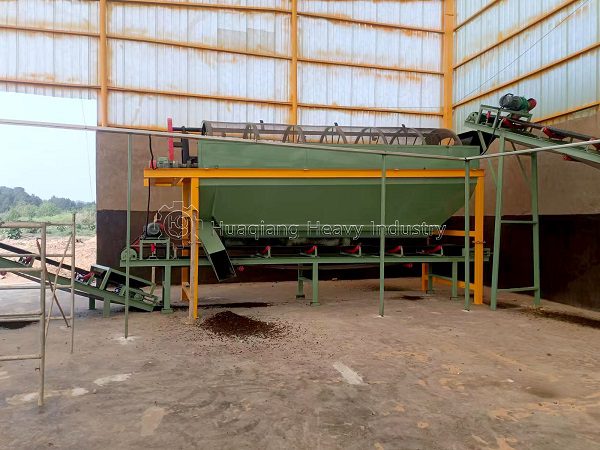
While the drum screen may seem inconspicuous, it is the “gatekeeper” ensuring the quality of the finished product. Proper configuration can ensure your fertilizer products have a consistent appearance, excellent application results, and a greater competitive edge in the market.
The rotary drum screening machine plays an indispensable role in fertilizer production lines, serving as the final gatekeeper for product quality. Its three core functions—precise grading, high-efficiency impurity removal, and material recycling—ensure that only uniform, high-quality granules proceed to the final stage. For a bio organic fertilizer production line or an npk fertilizer line, the screener is essential after the granulation and drying stages. In a roller press granulator production line (dry process), the screener separates fine powder (returned for re-extrusion) from finished granules. After screening, the product may be cooled in a fertilizer cooler machine (if a dryer was used) and then packaged by a fertilizer packing machine.
The drum screener’s design—with its rotating action and multiple screen sections—prevents clogging, even with wet, sticky materials (e.g., organic fertilizer with 5%-8% moisture). It offers stable efficiency (90%-95% screening rate), high capacity (e.g., 10 t/h), and low maintenance. By ensuring uniform granule size and removing impurities, the rotary drum screening machine directly enhances product consistency, application performance, and market competitiveness. It is a wise investment for any fertilizer producer seeking to upgrade product quality and operational efficiency. When combined with a fertilizer dryer machine and cooler, it completes a robust post-granulation quality control system.