
In organic fertilizer production, fermented and decomposed materials often exhibit two extreme states: one is that they become sticky and lumpy due to high moisture content, and the other is that they harden into large lumps after being piled up. When traditional crushing equipment processes these materials, a layer of wet material quickly adheres to the inner wall, accumulating thicker and thicker, leading to poor feeding and discharge, frequent shutdowns for cleaning, and severely restricting production efficiency. The chain crusher, through a series of targeted designs, fundamentally solves this industry pain point.
The Root Cause of Wall Sticking: Material Characteristics Determine Design Direction
Organic fertilizer lumps are characterized by high moisture content, high viscosity, and fibrous composition. The moisture content of decomposed chicken manure, cow manure, and other materials is often between 20% and 50%, and some even reach 60% to 80%. When traditional hammer mills process materials with a moisture content exceeding 40%, the phenomenon of “hammer sticking and screen clogging” easily occurs. Furthermore, the organic acids and ammonia in the material are corrosive to metals. These characteristics dictate that anti-sticking design must address three dimensions simultaneously: structure, lining, and chain.
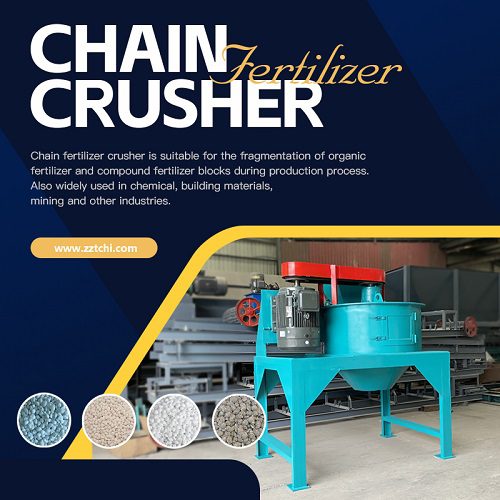
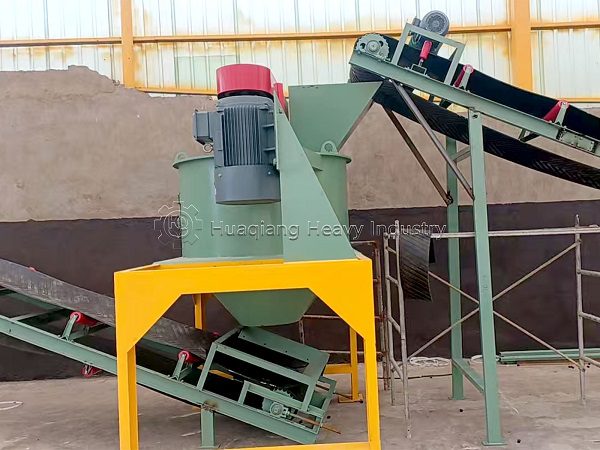
Screenless Structure: Eliminating the Source of Blockage from the outset. Traditional crushers rely on screens to control output particle size, but screens are precisely where sticky, wet materials are most prone to clogging. Chain crushers employ a screenless, top-to-bottom through-feed design, where material is crushed by the chain impact and discharged directly from the bottom. This design completely breaks the chain of failure: “material adheres to the screen → screen clogging → forced shutdown for cleaning.” Even when processing cow manure with 80% moisture content, continuous operation can be maintained, reducing downtime for cleaning by over 90%.
Lining Material Selection: Three Lines of Defense, Each with its Own Function. The inner wall of the casing is the first point of contact for materials, and its material directly determines the degree of adhesion. Currently, there are three main solutions: Polypropylene (PP) sheet lining is the most common anti-sticking solution. Polypropylene has low surface energy and a low coefficient of friction, making it difficult for materials to adhere firmly. It also possesses corrosion resistance, resisting the erosion of acidic gases produced by organic fertilizer fermentation.
Stainless steel linings are suitable for applications requiring higher hygiene and corrosion resistance. Stainless steel has a smooth surface, is rust-resistant, and has a longer service life in humid environments.
Rubber linings focus on cushioning and protection, preventing material from sticking to the walls and reducing friction and wear on the machine’s steel plates.
Some high-end models also feature a corner-free cavity design, combined with an anti-stick lining, making it difficult for material to accumulate in corners.
Chain Structure and Self-Cleaning Effect
Chain crushers use high-strength alloy steel chains as the crushing components, with chain linear speeds reaching 20-30 m/s. The centrifugal force generated by high-speed rotation not only effectively crushes the material but also throws away wet material adhering to the chain and cavity walls. This self-cleaning effect keeps the cavity unobstructed during continuous operation, eliminating the need for frequent manual cleaning.
Maintenance and Selection Recommendations
During daily use, the following should be noted: Remove hard objects such as metal and stones before feeding; regularly check the chain tension and wear; and promptly clean any residual material from the cavity after shutdown. When selecting a chain crusher, prioritize models with anti-sticking linings for processing highly moist and sticky raw materials. Semi-moist organic raw materials with a moisture content of 20%-50% can be processed directly without the need for drying or moisture control.
In summary, the anti-sticking wall design of the chain crusher provides triple protection: a screenless structure eliminates the source of blockage, the anti-sticking lining creates a physical barrier, and the high-speed chain achieves self-cleaning. This design logic enables the equipment to stably process high-moisture, high-viscosity, and high-fiber organic fertilizer agglomerates, minimizing downtime for cleaning. It is a key piece of equipment for improving the continuous operation capability of organic fertilizer production lines.
The anti‑sticking chain crusher is not an isolated machine—it is the critical first step in a well‑orchestrated production train, ensuring that sticky, high‑moisture organic lumps are transformed into a free‑flowing feed for downstream processes. As a core piece of fertilizer equipment, this chain crusher (often integrated as part of the fertilizer crusher and mixer system) eliminates the bottleneck of screen clogging and wall adhesion, enabling continuous operation even with materials at 40‑80% moisture. The consistent, uniform particle size it delivers directly benefits the fertilizer granulator machine, improving granulation efficiency and pellet quality, while reducing the load on the fertilizer dryer and cooler by minimizing moisture variability. This operational reliability translates into lower maintenance costs and less downtime—factors that favorably influence the overall industrial fertilizer machine price over the equipment lifecycle. Finally, the crushed material flows smoothly to the automatic fertilizer packing machine, ensuring consistent bag weights and dust‑free sealing. In essence, the chain crusher’s anti‑sticking design is the unsung hero of the organic fertilizer line—it transforms a troublesome feedstock into a reliable resource, protecting downstream equipment and maximizing the return on your entire production investment.