


A: The pile temperature drops to the same level as the outdoor temperature, and the moisture content is below 30%.
How to determine if fermentation is complete? The two most direct and definitive indicators of the completion of aerobic fermentation and maturity of organic fertilizer are: the pile temperature dropping to the same level as the outdoor temperature and the moisture content dropping below 30%. When the pile temperature no longer rises and stabilizes at the same level as the ambient temperature, and the material moisture content drops below 30%, fermentation can basically be considered complete. However, to ensure thorough maturity and fertilizer safety, it is necessary to combine indicators such as color, odor, structure, and germination rate for a comprehensive judgment.
Temperature: Pile temperature drops to the same level as the outdoor temperature
In the early stages of fermentation, the pile temperature will rapidly rise from room temperature to a high temperature period of 55℃–65℃ and maintain this for 5–7 days. As the organic matter is gradually decomposed, microbial activity decreases, heat production decreases, and the pile temperature begins to drop. When the pile temperature remains stable near the ambient temperature (usually not exceeding 5℃ above the outdoor temperature) for 3–5 consecutive days, and there is no significant temperature rise after turning the pile, it indicates that the decomposable organic matter has been basically exhausted, and fermentation has reached its end. This is the primary indicator of completed fermentation.
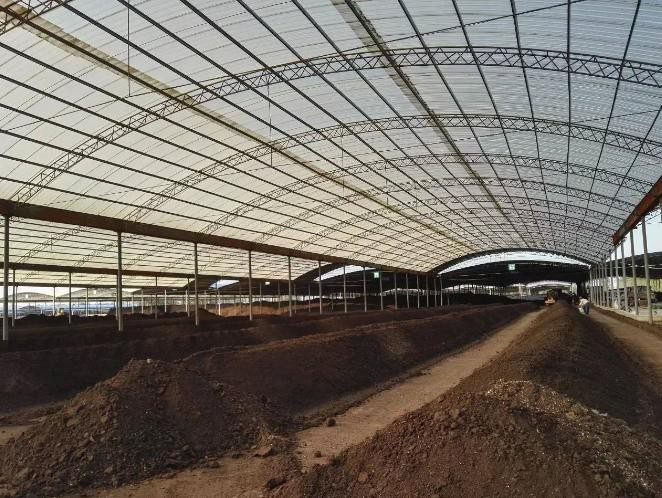
Moisture: Below 30%
During fermentation, high temperatures and turning accelerate moisture evaporation. The moisture content of fully decomposed organic fertilizer should be below 30%. This can be tested on-site with a rapid moisture meter, or judged empirically: the material should clump together when squeezed, but crumble naturally when released, without a noticeable dampness. A moisture content below 30% not only facilitates subsequent crushing, sieving, and granulation but also prevents the finished product from clumping and molding during storage.
Color and Odor: Brownish-Black and Odorless
Fully decomposed material changes color from light brown to brownish-black or dark brown, with a uniform color. The pungent ammonia and putrid odor disappears, replaced by a faint earthy fragrance. If a strong odor persists, fermentation is incomplete, and turning should continue.
Structure and Feel: Loose and Porous
Decomposed material has a loose structure, softened fibers, and is elastic to the touch, crumbling easily with gentle rubbing, and no longer feels sticky or heavy. Undecomposed material, on the other hand, clumps together tightly with hard fibers. V. Auxiliary Testing: pH and Seed Germination Rate
The pH of well-rotted compost is typically between 7.0 and 8.5. The most reliable indicator is the seed germination index (GI). Take radish or water celery seeds from the compost extract; if the germination rate is ≥85% and the root length is normal, it indicates no phytotoxicity and complete fermentation.
Summary
How to determine if fermentation is complete? The two key indicators are: the compost temperature dropping to the same level as outdoors and the moisture content falling below 30%. Combined with a dark brown color, no foul odor, loose structure, and a satisfactory germination rate, the completion date of fermentation can be accurately determined. In production, it is recommended to measure the temperature daily and the moisture content regularly, combined with the operation records of the compost turner, to create a complete fermentation management file, ensuring that every batch of organic fertilizer is thoroughly fermented, safe, and efficient.