


The answer is: a single rotary drum granulator is suitable for large-scale continuous production lines with a capacity of 10-30+ tons/hour, producing dense granules with good sphericity; while a disc granulator is more suitable for small to medium-sized production lines with a capacity of 1-10 tons/hour and for switching between multiple product formulations. The two are not mutually exclusive; the industry-standard efficient practice is to connect them in series: the disc granulator is responsible for pre-forming granules in front, while the rotary drum is responsible for shaping and strengthening them behind.
I. Capacity and Equipment Combination Comparison
The scale of production capacity directly determines the form of equipment combination. For small lines with an annual production of 10,000-30,000 tons (1-5 tons/hour), a single or double disc granulator connected in parallel is usually the main method, resulting in low investment and flexible start-up and shutdown. For medium-sized production lines with an annual output of 50,000-100,000 tons (8-15 tons per hour), if the formula is simple and the volume is large, a single rotary drum granulator is preferred. If multiple varieties need to be produced, a combination of “one rotary drum + one disc granulator” can be used, with the rotary drum handling 70%-80% of the main capacity and the disc handling small-batch custom orders. For large-scale production lines with an annual output of over 100,000 tons (20-30 tons per hour), large-scale rotary drum granulators (with a drum diameter of over 2.5 meters) must be used for continuous single-machine operation. In this case, disc granulators cannot meet the capacity requirements.
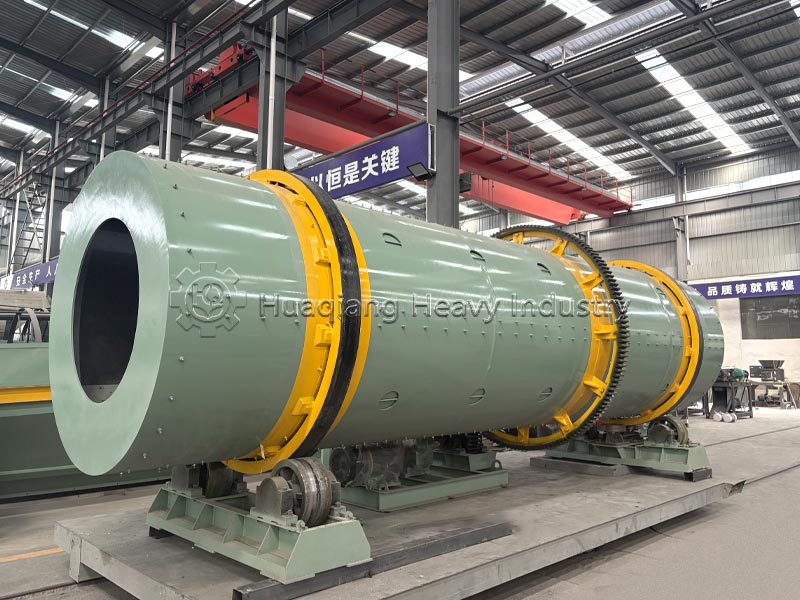
II. The Role of Lifting Plates and Baffles Inside the Rotary Drum
The core reason why rotary drum granulators can maintain dense granules at high capacity lies in their internal mechanical structure. The lifting plates inside the drum are responsible for lifting the material to a certain height before scattering it, forming a dense “material curtain.” The material collides and compresses with each other during repeated scattering and rolling, significantly increasing the density. The baffle ring at the discharge end controls the filling rate inside the drum (usually 25%-30%). It acts like a threshold, keeping the material within the drum for a sufficient time to ensure the particles have enough time to round and compact. Without the baffle ring, the material would pass through easily, resulting in loose and brittle particles.
III. Residence Time Matching in Series Connections
When discs and drums are connected in series, the core of process matching is residence time. The disc’s pelleting process is fast; the material only needs to stay in the disc for a few minutes to form preliminary masterbatches. The drum’s shaping and compaction process is slower, requiring the material to stay in the drum for 15-30 minutes. Therefore, in a series system, the disc’s discharge speed and pelleting rate must be highly stable. If the moisture content of the disc discharge fluctuates greatly or the masterbatch size is uneven, it will directly disrupt the material bed state inside the drum, causing the drum load to fluctuate wildly, and particle strength cannot be guaranteed. The bottleneck of the series system’s capacity is often not the drum’s throughput, but the stability of the feed at the disc’s front end.
IV. FAQ: Should a Disc Be Added Before the Drum?
Q: Can’t I just feed the material directly into the drum granulator? Why add a disc beforehand?
A: You can feed the material directly into the drum, but it depends on the characteristics of your raw material. If the raw material has good binding properties and is easy to pelletize, feeding it directly into the drum is perfectly feasible. However, when processing high-fiber, low-viscosity, or complex formulations, if the material is fed directly into the drum, it will tumble inside for a long time without forming pellets, resulting in a large amount of fine powder circulating inside the drum and wasting the drum’s capacity. Adding a disc at the front end for “pre-sphericification” allows the powder to be quickly rolled into small master pellets in the small disc before being fed into the drum. The drum can then focus on “growing, compacting, and polishing,” without spending time on “nucleation from scratch.” This division of labor not only greatly improves overall capacity but also enhances the sphericity and strength of the pellets.
The division of labor between drum granulation and disc granulation is essentially a synergy between “continuous high-capacity production” and “front-end pre-sphericification.” Large production lines rely on rotary drums to ensure output, while combined production lines rely on discs to ensure flexibility. By placing the equipment in the most suitable position for the process, both capacity and quality can be achieved simultaneously.