


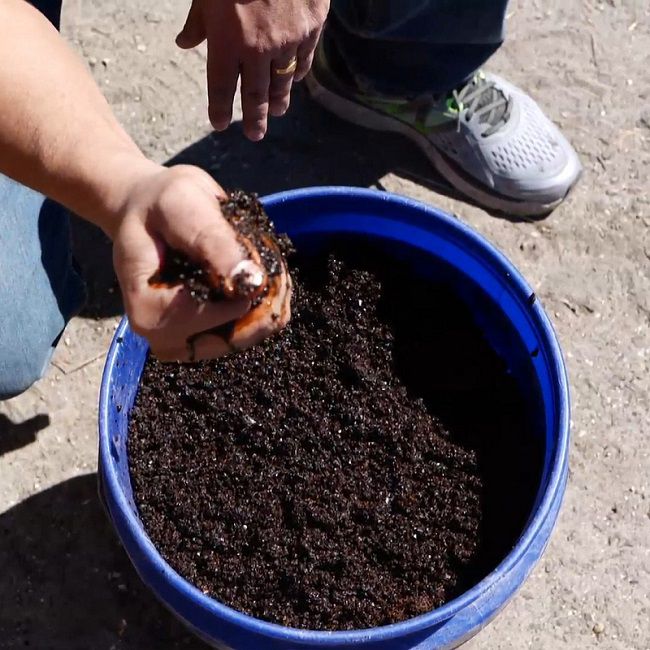
If the material clumps together when squeezed in the hand, and water seeps between the fingers but doesn’t drip, and crumbles upon contact with the ground, the moisture content is approximately 30%-40%. This is the on-site judgment window for organic fertilizer fermentation and wet granulation. The instrument method uses drying at 105℃ to constant weight as the arbitration standard (NY/T 525—2021, finished product moisture limit ≤30%), used for production line calibration and batch verification. The hand-held method solves the “speed” problem, while the drying method solves the “accuracy” problem. When the deviation between the hand-held judgment and the drying result exceeds 5 percentage points, the drying value should be used as the standard, and the on-site hand-held benchmark should be recalibrated, rather than using experience to correct the instrument.
I. The Three Actions of the Hand-held Method and Their Corresponding Moisture Ranges
The reason the hand-held method is widely used in organic fertilizer plants is not because it is “accurate,” but because it transforms the abstract moisture percentage into three repeatable action signals. By mapping the actions to specific ranges, different people can make similar judgments on the same batch of material.
Action 1: The material clumps together tightly, and when released, there is no water residue between the fingers. The material can clump together but no water can be squeezed out; the moisture content is usually below 30%, which is considered dry. Material in this range will inhibit microbial activity and slow temperature rise during fermentation; it will be difficult to form pellets in disc granulation, and the pellets will easily break apart.
Action 2: The material clumps together tightly, and water residue is visible between the fingers but does not drip; it breaks apart upon landing. This is the most commonly cited “just right” range, corresponding to a moisture content of approximately 30%-40%. The material has sufficient cohesion to maintain the clump, but it is not too wet and will stick to the hand or release water when squeezed. The suitable moisture content during fermentation usually falls within this range, and the feed window for wet disc/roller granulation also highly overlaps with this range.
Action 3: Water drips between the fingers when squeezed tightly, but the material does not break apart upon landing. The moisture content is significantly high, often exceeding 40%. Some sources use “water can be squeezed out, but the material does not break apart upon landing” as a reference for an extremely wet moisture content of over 75%. Material in this state, if directly fed into disc granulation, will create a “mud cake effect,” while entering extrusion granulation will significantly increase the risk of slippage and mold blockage.
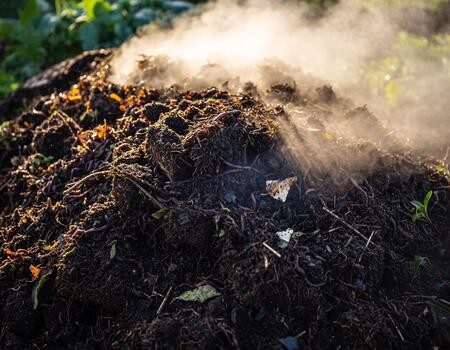
It is important to clarify that the hand-grip method provides a range classification, not a precise numerical value. Its value lies in rapid sorting—separating materials into three categories: “slightly dry,” “within the window,” and “slightly wet,” determining whether to feed directly, add auxiliary materials for adjustment, or dehydrate first. Precise numerical values must be obtained using the drying method.
II. How to Use the Instrumental Method: Calibration of Deviation Between 105℃ Drying and the Hand-grip Method
The benchmark for the instrumental method is drying loss: the percentage of mass lost from the original mass when the sample is dried to constant weight at 105℃ is the moisture content. This method eliminates empirical factors other than volatile interference and is the arbitration standard for moisture determination in organic fertilizers. NY/T 525—2021 sets the moisture limit for finished organic fertilizers at ≤30%, and testing is performed at this temperature.
However, “instrument accuracy” does not mean “instrument data can be used independently of sampling.” In practice, the discrepancies between the hand-grip method and the drying method mainly stem from three aspects, rather than the methods themselves:
Sampling representativeness: The hand-grip method involves grasping a handful of material, while the drying method involves weighing a small sample. Both methods may deviate from the average moisture content of the entire batch. A single test only reflects a localized state; in actual production, material moisture content can fluctuate by ±3%. To make the two methods comparable, samples must be taken at the same location and depth, and the number of sampling points should be increased, rather than using the drying value of a single point to negate the overall feel.
Environmental interference: Workshop humidity, material temperature, and post-sampling exposure time all alter the apparent feel. In winter, when material temperatures are low, the “wetness” of moisture is suppressed, making the feel judgment prone to being too dry; in summer, high temperatures and humidity tend to make it too wet. The drying method also faces the risk of moisture absorption during sample preparation; samples should be sealed, mixed, dried, and then cooled in a desiccator before weighing.
Calibration logic: The correct approach to handling deviations is to calibrate the feel benchmark using the drying value, rather than using the feel to question the drying value. The specific practice is as follows: When changing seasons, raw material batches, or suppliers, take 3-5 representative samples and simultaneously perform hand-feel assessment and 105℃ drying, recording the correspondence between “hand-feel setting – drying value” to form the factory’s own hand-feel benchmark. If, during daily operations, a systematic drift of more than 5 percentage points in the drying value corresponding to the same hand-feel setting is observed, the benchmark should be updated instead of continuing to rely on old experience.
Portable rapid moisture meters can serve as an intermediate layer between hand-feel and drying methods, but their readings need to be periodically compared with the drying method. Although the instrument itself has a calibration dial, readings not calibrated using a drying benchmark can only be used for trend reference and cannot be used as the basis for batch release.
III. How to Choose a Granulation Route After Moisture Deviates from the Window
The ultimate goal of moisture testing is not “knowing how much moisture is,” but rather determining which granulation route to take for this batch of material. The two main granulation routes for organic fertilizer have opposite tolerances for moisture. Once the moisture content deviates from the wet granulation window, continuing to use the disc granulator cannot be solved by simply “adjusting parameters.”
Disc/Drum Wet Granulation: Window 28%–35%; below 25% or above 38% enters the inefficient zone. The optimal moisture range for disc granulation is typically 28%–32%, while drum granulation is slightly wider, around 25%–35%. Below 25%, the material lacks sufficient capillary tension as it rolls within the disc, interrupting the process of particle growth, resulting in decreased pelleting rate and increased material return. Above 35%–38%, the material bed transitions from a “balling” state to a “cake” state, with increased adhesion between the disc surface and drum wall, significantly extending cleaning downtime.
Roller Extrusion Dry Granulation: Window 18%–22%, completely non-overlapping with wet granulation. Extrusion granulation relies on mechanical pressure rather than water film formation; therefore, the feed moisture needs to be strictly controlled within a low range. Exceeding the moisture window causes the material to slip on the roller surface, increasing the frequency of die blockage and actually decreasing particle strength. This means that a batch of conventional fermentation feed with a moisture content of 30%-40% cannot be directly switched to the extrusion line without dehydration or remixing. Conversely, a batch of material already dehydrated to around 20% will also fail to form pellets on the disc extrusion line.
The decision-making order should be “measure moisture first, then determine the route,” not “determine the route first, then try to adjust the moisture content.” If the moisture content of the fermentation output is consistently higher than 35%, continuing to add atomized water spray or adjust the tilt angle and speed on the disc extrusion line only masks the problem at the raw material end; at this point, either the dehydration/remixing capacity at the front end should be increased to bring the moisture content back to the wet process range, or the granulation route should be adjusted to a wide-range compatible extruder model. Moisture detection here serves as a route switching signal, not a basis for post-event remediation.
IV. FAQ: Moisture Detection and Frequently Asked Questions in Rainy Season Emergency Response
Q1: If the hand-holding method indicates “just right,” but the dried measurement shows only 25%, which should be considered the standard?
The dried value should be considered the standard. 25% moisture content is on the drier side, which will affect the pelleting rate of disc granulation. A “just right” feel indicates that the apparent moisture content of this batch of material matches the historical benchmark under the current plant environment, but this can be affected by material temperature, raw material fineness, and organic matter content. This deviation should be recorded, and the feel benchmark updated, rather than using 25% material as the “just right” granulation standard.
Q2: What to do first when raw material moisture content is out of control during the rainy season?
The first step is to divert and add dry additives, not to reduce the entire production line speed. For batches with moisture content significantly exceeding the granulation window, add dried rice husk powder, straw powder, or recycled material in proportion for remixing to bring the moisture content back to the 30%-35% wet processing window or the 18%-22% extrusion window; simultaneously, clear drainage from the stockpile in advance to prevent backflow of water and further increase the raw material moisture content. If the rainy season is prolonged, a dry additive silo should be reserved in the batching section, rather than waiting until the moisture content exceeds the standard before finding materials on the fly.
Q3: The drying method takes several hours to test one sample. What if production can’t wait that long?
The drying method is an arbitration and calibration tool, not a real-time control tool. Production control should rely on a “three-level detection point”: mixer outlet, granulator inlet, and dryer inlet. High-frequency screening should be performed using a rapid moisture meter or by touch, followed by a baseline verification using the drying method by batch or shift. The inherent lag in the drying method means it calibrates a “scale,” while real-time control relies on rapid judgment based on that scale. The two are not interchangeable.
V. Embedding Moisture Measurement into the Whole Organic Fertilizer Production Line
Moisture measurement should not stop at the fermentation pile or the granulator inlet; it should be embedded in the whole organic fertilizer production line. On a sheep manure organic fertilizer production line, fiber and moisture variation affect both fermentation and granulation, so hand-feel screening and 105℃ drying calibration should be used to decide whether the material goes directly to the disc granulator or needs remixing and dehydration. On a bio organic fertilizer production line, the same moisture data protect microbial activity and determine the drying load before the fertilizer packing machine. Upstream, an organic fertilizer crusher can clog or lose efficiency when moisture is too high; downstream, a fertilizer granulator machine can only hold its pelletizing window when the feed moisture is stable. Therefore, any organic fertilizer production line should link the three-level detection points—mixer outlet, granulator inlet, and dryer inlet—with the equipment settings of the crusher, granulator, and packing machine, rather than treating moisture as a single-point laboratory value.
Controlling the drying temperature of organic fertilizer essentially involves finding a balance between “dehydration efficiency” and “activity retention.” For bio-organic fertilizer, the minimum material temperature should be ≤65℃, while for conventional organic fertilizer, efficiency should be prioritized within the 80-120℃ range. Both utilize a three-stage temperature control system instead of single-point high-temperature control, and finally, sufficient cooling is used to “fix” the state of live bacteria and granules. Managing temperature, staged temperature control, and cooling separately minimizes the risks of burning seedlings and damaging bacteria.