

In the evolving landscape of sustainable agriculture, bio-organic fertilizer represents the perfect synthesis of organic matter and beneficial microbiology. A bio-organic fertilizer production line is more than just a series of machines—it’s a controlled ecosystem engineered to transform raw organic waste into a potent, living soil amendment. This sophisticated system carefully marries the processes of organic decomposition with the science of microbial inoculation, resulting in a product that not only feeds plants but actively regenerates soil health.
The Production Philosophy: A Dual Transformation
Unlike conventional organic fertilizer lines, bio-organic production involves two simultaneous transformations: physical processing of organic materials and biological activation with carefully selected microbial consortia. The line must preserve microbial viability throughout what can be a mechanically demanding process, making equipment selection and process control absolutely critical.
Stage 1: Raw Material Reception & Pre-processing
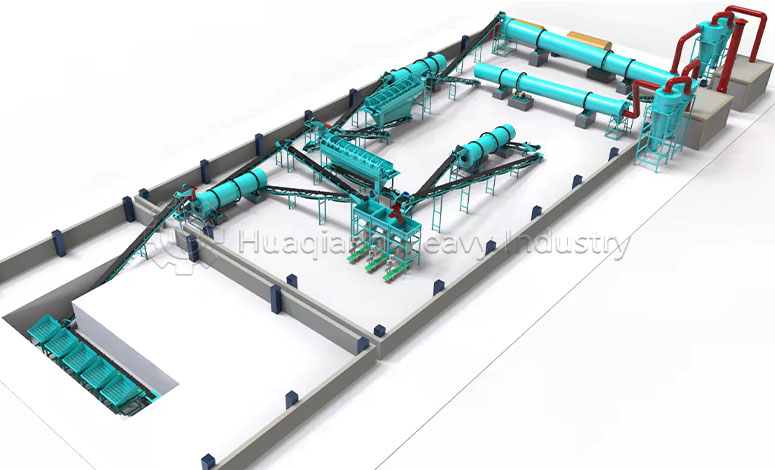
The journey begins with diverse organic inputs—animal manure, agricultural residues, food processing waste, and dedicated biomass. These materials first enter loader feeding hoppers for initial handling. A half-wet material crusher then reduces particle size, creating uniform feedstock while preserving natural moisture essential for microbial life. This material is blended with carbon-rich amendments (like rice hulls or sawdust) in a double shaft mixer to achieve the optimal carbon-to-nitrogen ratio for fermentation.
Stage 2: Controlled Fermentation & Bio-activation
This is where biology takes center stage. The blended material moves into fermentation troughs or windrows, depending on scale. Here, specialized compost turners (like the double spiral trough turner for contained systems or large wheel turners for open windrows) perform dual functions: they aerate the pile to maintain aerobic conditions while evenly distributing microbial inoculants. These inoculants—typically containing nitrogen-fixing bacteria, phosphate solubilizers, and beneficial fungi—are introduced via integrated spray systems during turning. The fermentation phase lasts 15-25 days under monitored temperature and moisture conditions, ensuring both organic matter stabilization and robust microbial colonization.
Stage 3: Refined Processing & Granulation
After fermentation, the matured compost undergoes refinement. A rotary screener machine removes oversized particles, which can be recirculated. The screened material then proceeds to granulation. For bio-organic products, the disc granulator is often preferred for its gentle action, which preserves microbial viability. During granulation, additional coating agents (like bentonite or humic acid) may be applied to protect the microbial communities. Alternatively, a new type two-in-one organic fertilizer granulator can efficiently combine crushing and forming in a single step, minimizing processing stress on microorganisms.
Stage 4: Low-Temperature Drying & Final Enhancement
Conventional high-temperature drying would destroy the living components. Therefore, specialized low-temperature dryers (<45°C) gently reduce moisture to stable levels. This is followed by cooling to ambient temperature. In some advanced lines, a final coating drum applies a protective layer of minerals or additional spore-forming bacteria to enhance shelf life. The finished granules are then screened a final time to ensure uniformity.
Stage 5: Intelligent Packaging & Quality Assurance
Packaging must protect both the physical granules and their biological activity. An automated powder and granule packing machine fills bags under controlled conditions, often with oxygen scavengers or breathable membranes to maintain microbial dormancy until use. Each batch is rigorously tested for both nutrient content and colony-forming units (CFUs) to guarantee biological efficacy.
What distinguishes a bio-organic line from a standard organic fertilizer line?
Microbial Viability Protection: Every equipment choice—from gentle mixers to low-temperature dryers—prioritizes preserving living microorganisms.
Precision Inoculation Systems: Dedicated tanks and spraying systems accurately dose microbial consortia at optimal process points.
Environmental Control: Enhanced monitoring of temperature, moisture, and aeration throughout fermentation to favor target microorganisms.
Sanitary Design: Equipment with smooth surfaces, minimal dead spots, and clean-in-place capabilities prevents cross-contamination between batches.
The Integrated Control System: The Brain of the Operation
Modern bio-organic lines are governed by sophisticated PLC/SCADA systems that monitor and control not just mechanical parameters but biological ones. Sensors track pile temperature during fermentation, while pH and moisture probes ensure optimal microbial conditions. This data-driven approach allows for precise recipe management, traceability from raw material to finished bag, and consistent product quality—the holy grail of biological manufacturing.
Economic & Environmental Value Proposition
Investing in a dedicated bio-organic production line offers compelling returns:
Premium Product Value: Bio-organic fertilizers command significantly higher market prices than conventional organic products.
Waste Valorization: Transforms low-value organic wastes into high-value agricultural inputs.
Circular Economy Contribution: Closes nutrient loops in agricultural systems.
Regenerative Impact: Products improve soil structure, water retention, and long-term fertility beyond mere nutrient supply.