

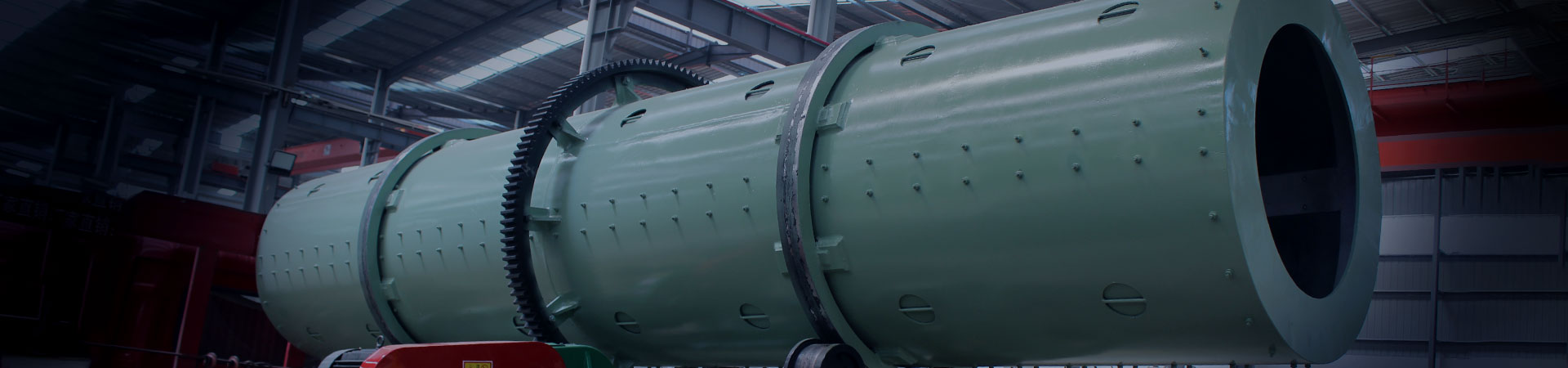
In organic fertilizer production, granulation rate directly determines production capacity and cost. Every 10% increase in granulation rate reduces return material by nearly one-third and overall energy consumption by 15%-20%. However, many manufacturers are hampered by the problem of “more powder, less granules.” In fact, improving granulation rate is not complicated; the key lies in four aspects: raw material pretreatment, binder matching, granulator control, and closed-loop screening.
Raw Material Pretreatment: Moisture Control and Fineness are the Cornerstone
After fermentation, the physicochemical properties of organic fertilizer raw materials (livestock manure, straw, lees, etc.) vary greatly, making direct granulation difficult.
Moisture Content Control: The optimal moisture content of the material before granulation is between 30% and 40%. Too high (>45%) will cause the granules to become soft and mushy, and crack after drying; too low (<25%) will prevent agglomeration. Judgment Method: The granules can be formed into a clump when squeezed in the hand, but crumble easily when lightly touched. If too wet, add dry powder or humic acid; if too dry, use a spray to replenish moisture.
Pulverization Fineness: If the material contains fibers or lumps larger than 1mm, it will damage the integrity of the particles. It is recommended to use a chain or semi-wet material pulverizer to control the fineness of over 90% of the raw materials to below 0.5mm. Fine powder has a larger specific surface area, stronger liquid bridge adhesion, and can increase the granulation rate by 20%-30%.
Binder Selection: Combination of Natural and Inorganic Materials Organic fertilizers have poor self-adhesion; adding an appropriate amount of binder is a shortcut to improving the granulation rate.
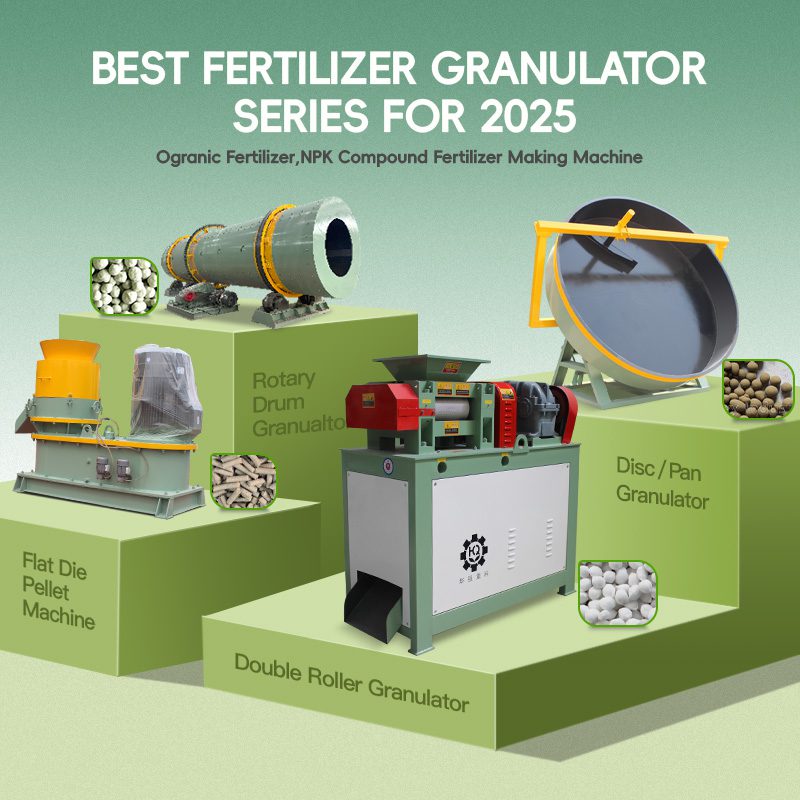
Commonly Used Binders: Bentonite (2%-5%), Sodium Humate (1%-3%), Starch or Pregelatinized Starch (1%-2%). Sodium humate combines nutrients and binding properties, and forms a colloidal film after dissolution, which is particularly effective for disc granulation.
Liquid Binder System: For extrusion granulation, a 15%-20% molasses solution or fermentation waste liquid is recommended as the spray liquid. Molasses’ viscosity increases with temperature, allowing it to firmly coat fibrous particles during granulation. Note: Excessive binder will result in overly hard granules with poor disintegration; the optimal ratio needs to be determined through small-scale testing.
III. Granulator Control: Rotation Speed, Inclination Angle, and Feed Rate
Different granulators have different parameters affecting granulation rate. Taking the most commonly used disc granulator as an example:
Disc Rotation Speed: The faster the rotation speed, the greater the centrifugal force on the material, resulting in smaller and denser particles; too slow a speed results in insufficient material tumbling. Generally, it is controlled at 12-18 rpm. For lightweight raw materials (such as mushroom residue), appropriately increasing the rotation speed (18-22 rpm) can increase the number of rolling revolutions and improve the granulation rate.
Disc Inclination Angle: An inclination angle of 40°-50° is ideal. A smaller inclination angle results in a longer material residence time, leading to larger particles; a larger inclination angle results in faster discharge and smaller particles. If the granulation rate is low and the particles are fine, the inclination angle can be reduced by 2-3°.
Feeding and Spraying Matching: Follow the principle of “continuous powder feeding, intermittent liquid spraying.” Observe the material curtain in the pan; the standard is “a small number of mother balls tumbling, not sticking to the bottom of the pan.” Feeding too quickly will crush the material layer, causing a sharp drop in granulation rate.
Screening and Return Loop: Achieving Steady-State Circulation
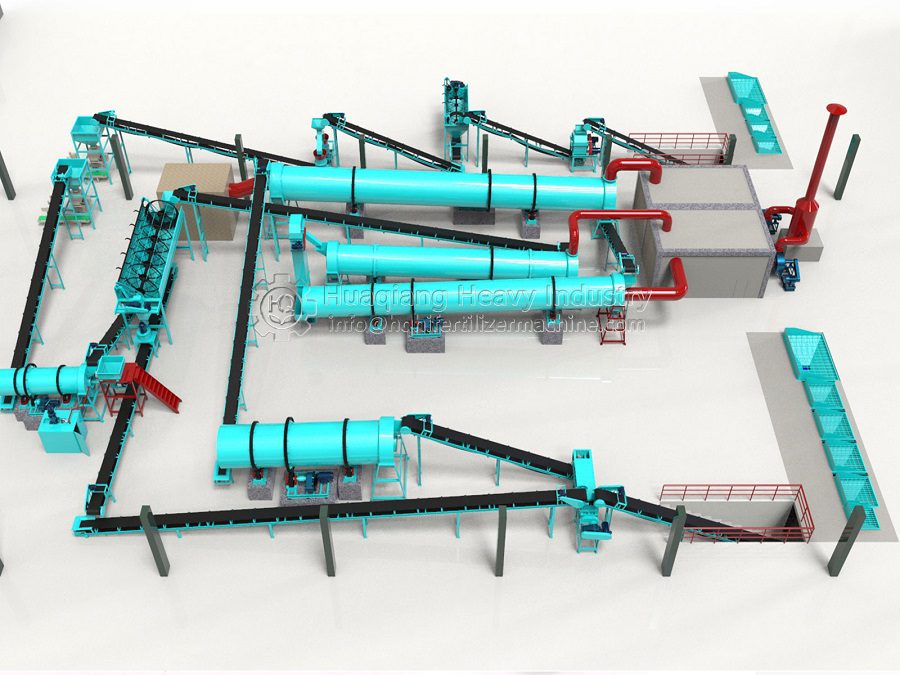
Fine powder (return material) sieved through the classifier is directly returned to the granulator. Maintaining a stable return material ratio (40%-60%) is key to ensuring granulation rate. Too little return material results in a lack of “nuclei” in the granulator; too much return material leads to overly dense granules. It is recommended to use the 1-2mm semi-finished granules from the screening as return material, as these granules have rough surfaces and easily absorb new powder to grow.
Daily Maintenance: Clean the inner wall and scraper of the granulator monthly to prevent sticking and detachment into large lumps; check the discharge particle size every two hours and adjust the spraying volume accordingly. By comprehensively applying the above four measures, the granulation rate of organic fertilizer can be increased from 60% to over 85%, significantly boosting production line efficiency.
Achieving Granulation Excellence Through Integrated Equipment Solutions
Elevating granulation rates from suboptimal levels to industry-leading benchmarks demands a holistic approach to fertilizer equipment selection and process orchestration rather than isolated parameter tweaks. At the heart of this transformation lies a precision-engineered fertilizer granulator machine—particularly an organic fertilizer disc granulator with adjustable rotational speed and inclination angle—where meticulous control over feed rate, spray timing, and return material ratio creates the ideal environment for nucleus formation and particle growth. Upstream, a high-efficiency fertilizer crusher and mixer ensures raw materials achieve the critical sub-0.5mm fineness and homogeneous moisture distribution essential for strong liquid bridge adhesion, directly impacting granulation rate by 20%-30%. Post-granulation stability is secured through an optimized fertilizer dryer and cooler sequence that prevents thermal cracking and preserves binder film integrity, while precision fertilizer screening equipment maintains the critical 40%-60% return material loop that sustains steady-state granulation dynamics. When evaluating industrial fertilizer machine price, astute investors recognize that modular, corrosion-resistant configurations yield superior long-term returns by minimizing downtime and maintenance frequency in high-humidity environments. A complete disc granulation production line seamlessly integrates these unit operations into a cohesive workflow, culminating in an automatic fertilizer packing machine that ensures consistent bag weights and sealed product integrity for market distribution. For enterprises committed to premium organic outputs, establishing a dedicated bio organic fertilizer production line with integrated fermentation monitoring and granulation intelligence represents the definitive pathway to transforming raw manure into high-value granular assets while maximizing both production efficiency and profit margins.
If you also want to quickly overcome the granulation rate bottleneck, please contact our company—we provide a complete set of equipment from raw material pretreatment to granulation and screening, along with customized binder solutions, ensuring your organic fertilizer production line truly achieves “perfect granule return” and multiplies profits!