
In the construction of fertilizer production lines, space constraints are often a major headache for companies—small factory buildings prevent long-distance horizontal conveying, complex terrain makes leveling difficult, and significant differences in equipment height make suitable connection methods difficult to find. Ordinary belt conveyors typically have a maximum inclination angle of no more than 20°, often falling short when facing steep inclines. Huaqiang Heavy Industry’s high-angle belt conveyor employs a special design with corrugated sidewalls and transverse baffles, achieving maximum vertical conveying and saving 50% of space, making it a savior for fertilizer plants with limited space.
Equipment Design Highlights: A Technological Breakthrough in Vertical Conveying
Special Belt Structure, No Slippage at High Angles
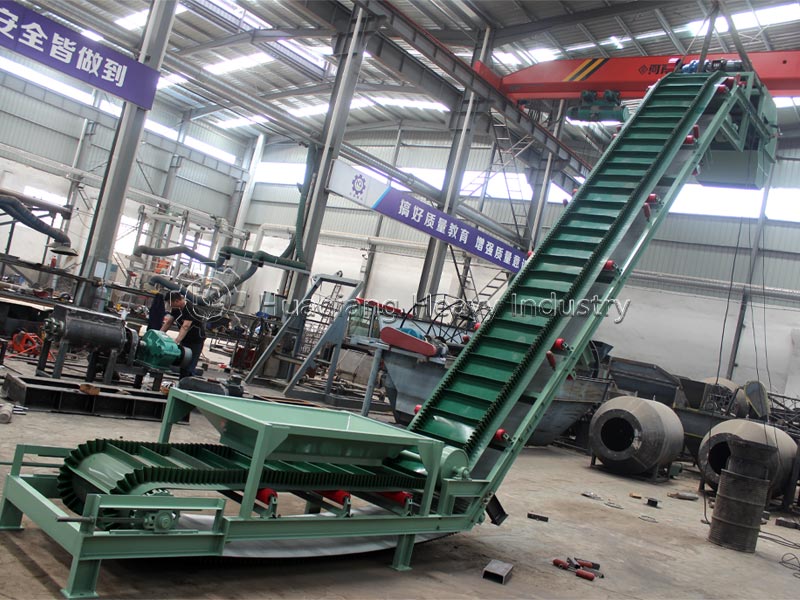
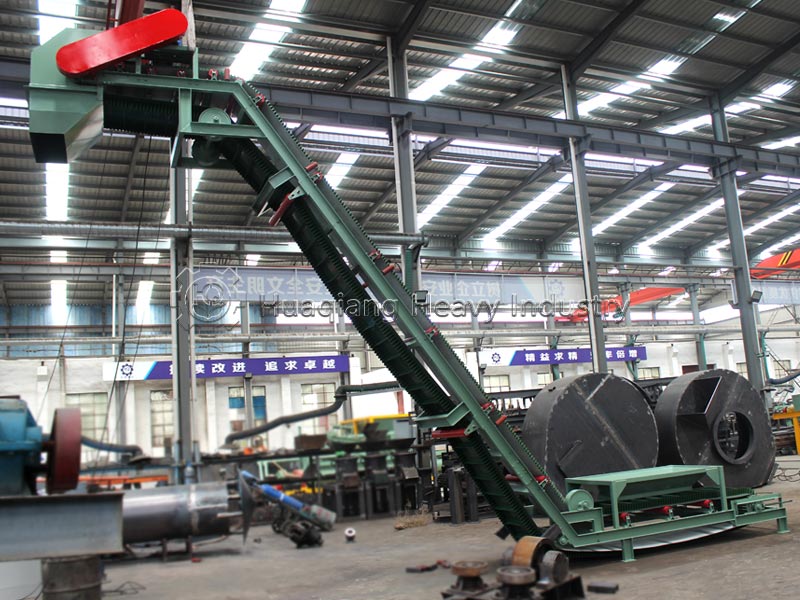
The core of the high-angle belt conveyor lies in its unique belt design. Corrugated sidewalls on both sides of the belt act like two “walls,” preventing material from slipping off the edges; transverse baffles are evenly distributed on the belt surface, dividing the material into individual small compartments, ensuring that even at a 90° vertical lift, particles will not slip. This combination of “sidewall + partition” allows for conveying angles from 30° to 90° (vertical), completely overcoming the inclination angle limitations of ordinary belts.
Powerful Drive System, Adaptable to High Loads
High-angle conveying places higher demands on the drive system. Huaqiang equipment uses high-power geared motors or hydraulic couplings, providing high starting torque and smooth operation, meeting the high-load conveying needs of over 20 tons per hour. For ultra-high lifting scenarios, dual-drive or intermediate-drive devices can be configured to ensure sufficient power.
Adjustable Conveying Angle, Flexible Response
The equipment frame adopts a modular design, allowing the conveying angle to be adjusted between 30° and 90° according to site requirements. Whether connecting a low-level granulator to a high-level dryer, or crossing roads or obstacles, the most suitable installation angle can be found.
Adaptable Scenarios: Perfect Response to Three Typical Working Conditions
Scenario 1: Production Line with Limited Space
An organic fertilizer plant has a factory width of only 12 meters, yet it needs to lift the material from the granulator outlet to the 6-meter-high dryer inlet. If a conventional horizontal belt conveyor with a lifting mechanism is used, a length of nearly 30 meters is required, which is simply not feasible in a factory building. Huaqiang’s vertical belt conveyor, with its 90° vertical lifting, solves this problem with only 3 meters of space required, saving over 50% of the required area.
Scenario Two: Factory Areas with Complex Topography
In fertilizer plants located in mountainous or hilly areas, the various workshops are distributed across terraces at different elevations, making site leveling costly. High-angle belt conveyors can directly bridge these elevation differences, organically connecting the crushing workshop, fermentation area, and granulation workshop without large-scale earthwork, significantly reducing infrastructure investment.
Scenario Three: High-Capacity High-Angle Conveying
For large-scale production lines with an hourly output of 20 tons or more, high-angle belt conveyors are equally capable. Multiple belt widths are available, including B800, B1000, and B1200, and with high-wear-resistant sidewalls and partitions, they can stably convey various granular and powdery fertilizers, meeting the needs of continuous production.
III. Practical Techniques: Key to Effective Use of Inclined Belt Conveyors
Selecting the Conveying Angle is Crucial
Although the equipment can reach a maximum angle of 90°, a larger angle is not always better. For highly fluid granular fertilizers, it is recommended to control the conveying angle within 60°; for powdery materials, the angle can be appropriately increased to 70°-80°. An excessively large angle may cause material to “levitate” between the baffles, negatively impacting conveying efficiency. Huaqiang technicians can recommend the optimal installation angle based on the material characteristics.
Regularly Inspect the Integrity of the Sidewalls and Baffles
The corrugated sidewalls and transverse baffles are core components of the equipment. Long-term operation may cause wear or cracking due to material impact. It is recommended to conduct a comprehensive inspection quarterly and replace any damaged components promptly. Damaged sidewalls can cause material to slip, while missing baffles may cause material backflow.
Proper Tension Adjustment is Essential
The tension of the conveyor belt directly affects operational stability. Too loose a belt will cause slippage, while too tight a belt will damage the bearings and belt. Huaqiang equipment is equipped with a spiral or counterweight tensioning device. Operators should adjust it regularly according to the load to ensure the conveyor belt operates under optimal tension.
Precise feeding position is crucial.
High-angle conveyors have high requirements for feeding. Material should fall near the belt centerline to avoid uneven loading and belt misalignment. It is recommended to install a guide chute at the feed inlet to ensure the material falls in at the same speed as the belt, reducing impact and spillage.
Case Study: Transformation of an Organic Fertilizer Plant in a Mountainous Area
An organic fertilizer plant in Yunnan Province was built on a hillside. The fermentation tanks were located at a lower level, while the granulation workshop was located at a higher level, with an 8-meter elevation difference and no flat ground in between. Previously, manual handling combined with a small elevator was used, resulting in low efficiency and high costs. After introducing Huaqiang’s high-angle belt conveyor, the two workshops are directly connected at a 60° angle, transporting 15 tons of granulated fertilizer per hour, increasing efficiency by 5 times and reducing labor costs by 70%. The factory manager stated, “One belt conveyor solved our major problem; now the production line is finally running smoothly.”
Daily Maintenance: Key Points to Extend Equipment Lifespan
Per-shift Inspection: Observe whether the conveyor belt is misaligned, whether the sidewalls are damaged, and whether the idler rollers rotate freely.
Weekly Maintenance: Clean accumulated material from the return belt to prevent material from getting caught in the rollers and causing damage.
Monthly Overhaul: Check the temperature of each roller bearing and add grease; test the tensioning device for its flexibility and effectiveness.
Quarterly Major Overhaul: Thoroughly inspect the sidewalls and partitions for wear, replace them if necessary; correct belt misalignment.
From vertical conveying that saves 50% of space, to crossing complex terrain, and to stable operation with high capacity—Huaqiang’s steep-angle belt conveyor, with its groundbreaking design, has opened up a completely new conveying solution for fertilizer plants with limited space. When your production line is no longer constrained by limited space, and when materials flow smoothly between various devices, you will understand: choosing the right conveying equipment is choosing the optimal solution for space utilization.
The high-angle belt conveyor is a crucial piece of professional fertilizer manufacturing equipment, solving complex material transfer challenges, but it is just one component within a complete production system. In any efficient npk fertilizer line, the material, after granulation, must undergo a series of standardized finishing processes. The granules are first transported, often by a high-angle conveyor, to a fertilizer dryer machine to reduce moisture to safe levels. They then pass through a fertilizer cooler machine to bring them to ambient temperature, preventing subsequent caking. Next, a rotary drum screening machine classifies the granules, ensuring only uniformly sized product moves forward. Finally, the consistent, high-quality granules are precisely weighed and sealed into bags by a fertilizer packing machine. Each piece of professional fertilizer manufacturing equipment, from the innovative high-angle conveyor to the robust dryer and precise packer, plays an indispensable role in transforming raw materials into a stable, market-ready product. The seamless integration of these machines, enabled by reliable conveying like the high-angle belt, is the hallmark of a modern, high-efficiency fertilizer plant.