

Walk onto the installation site of an NPK blending fertilizer production line, and you will see something that resembles a giant puzzle being assembled piece by piece. Steel frames rise from concrete foundations, conveyors stretch across the floor like metallic arteries, and technicians move between machines with wiring diagrams in hand, checking alignments, tightening bolts, and calibrating sensors. This is where precision engineering meets practical execution, and when the final connections are made, what emerges is a production line capable of delivering perfectly balanced fertilizer blends with unwavering consistency.
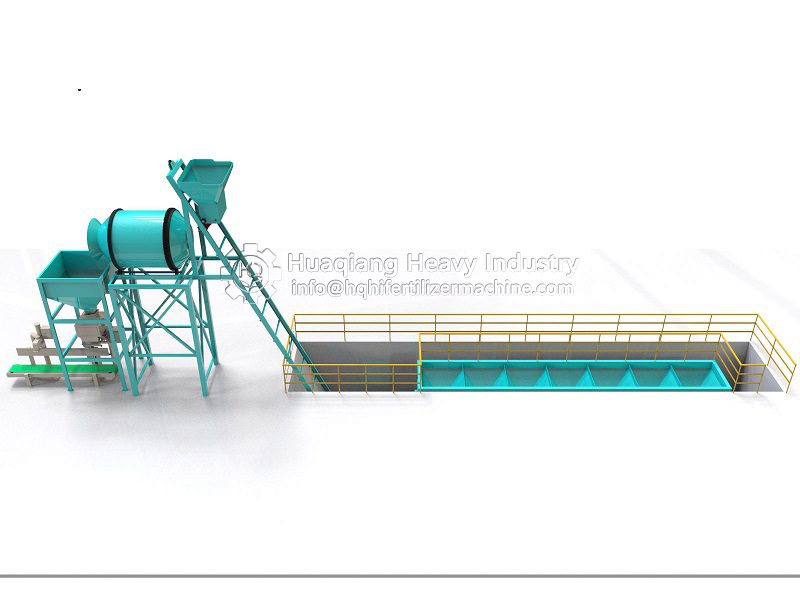
The installation begins at the raw material section. Bulk bags and storage hoppers are positioned first, forming the intake point of the entire operation. These hoppers are mounted on load cells—precision weighing devices that will later measure each ingredient down to the kilogram. The installation crew levels each hopper carefully; even a slight tilt would throw off the accuracy of the entire batching system. Above them, a mobile belt conveyor system is assembled, designed to shuttle raw materials from storage to the weighing stage without cross-contamination.
Adjacent to the hoppers, the main batching scale is being erected. This is the brain of the blending line. A large stainless steel bin suspended on high-accuracy sensors, it receives ingredients one by one from the hoppers below. The technicians calibrate the load cells, running test weights through the system to ensure that every reading is precise. Nearby, the control panel is being wired—a network of cables that will soon allow a single operator to oversee the entire blending process from a touchscreen.
Behind the batching scale, the horizontal mixer takes shape. Its twin shafts, fitted with paddles and ribbons, are carefully aligned within the mixing chamber. The installation team checks the clearance between the paddles and the chamber walls repeatedly; too much gap and the mix would be uneven, too little and the machine would bind. The motor and gearbox are mounted, and the drive chain is tensioned to specifications. This machine will later tumble granules of urea, potash, phosphate, and filler into a uniform blend, ensuring that every bag contains the exact ratio of nutrients printed on the label.
Running alongside the mixer, a bucket elevator is being assembled section by section. Its steel casing is bolted together, and the belt with attached buckets is threaded through, then tensioned to prevent slipping. This elevator will lift the blended material from the mixer up to the screening and coating stages, moving it vertically to save floor space. The crew checks the alignment of the head and tail pulleys with laser levels; any misalignment would cause belt tracking issues later.
Nearby, the rotary screener machine is set into its foundation. Its cylindrical drum, perforated with precisely sized holes, is mounted on rubber-lined trunnion wheels. The installation team rotates the drum by hand to check for wobble, adjusting the support wheels until it spins true. This machine will later separate the finished blend into uniform particle sizes, ensuring that oversized or undersized material does not reach the final product.
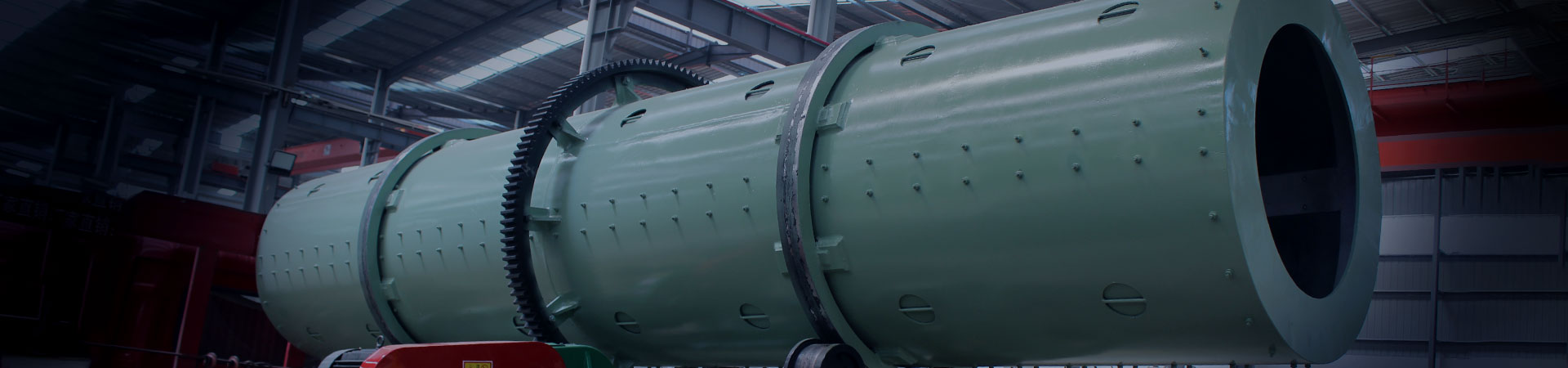
For producers who require enhanced functionality, a coating drum is also being installed. This machine, a gently sloping cylinder, will apply a thin layer of oil or anti-caking agent to the finished blend, improving flowability and preventing clumping during storage. The crew positions it with a slight downward angle, allowing gravity to assist the flow of material from inlet to outlet.
At the end of the line, the automatic packaging system is taking shape. A bagging scale, a sealer, and a conveyor are aligned in sequence. The technicians mount the bag clamp and fill spout, then connect the pneumatic lines that will control the bagging cycle. A palletizer is being assembled at the very end, ready to stack filled bags onto pallets for forklift transport.
Throughout the installation site, electricians pull cables through conduits, connecting motors, sensors, and control panels. Programmable logic controllers are being programmed with the blending recipes that will later run day after day. Air compressors are mounted and piped to provide the pneumatic power for valves, clamps, and actuators. Every machine must be aligned, leveled, and connected before the first test run.