

Dust emissions during fertilizer production not only lead to material loss but also pose a significant challenge to environmental compliance. By implementing closed-loop material handling, graded dust collection systems, and granulation modification processes, plants can reduce dust emissions by over 40% while significantly improving resource recycling rates.
Core Process Logic of Dust Control
In the NPK fertilizer production chain, dust generation primarily stems from wear and tear on rotating equipment, airflow carryover during the drying process, and dust drop during conveying. To reduce dust at its source, both process layout and mechanical precision must be addressed.
- Sealed and Automated Conveying
Open belt conveyors are major sources of dust spillage. Closed-loop tubular chain conveyor systems should be prioritized, with micro-negative pressure control implemented in the crushing, screening, and granulation areas. If using a high-efficiency high-pressure roller press granulator specification, ensure reliable flexible connections and sealing devices at the connection between the extrusion chamber and the rear shaping section. This reduces the fugitive emissions of fine powder generated during extrusion within the workshop. 2. Stratified Dust Removal Strategy
A single dust collector cannot address the dust characteristics at each stage. A two-stage filtration system of “cyclone dust collector + bag filter” is recommended. The cyclone dust collector captures larger dust particles and returns them to the hopper, while the bag filter filters finer dust particles. In the drying exhaust gas treatment, the corrosion resistance of the filter bag material should be checked regularly to prevent bag clogging due to condensation.
- Additive-Enhanced Granulation
The root cause of excessive dust emissions is often insufficient granulation strength, leading to repeated friction and breakage of materials during transportation. Introducing bio-based binders can effectively increase the wear resistance of the particle surface, thereby reducing the probability of dust generation at the source.
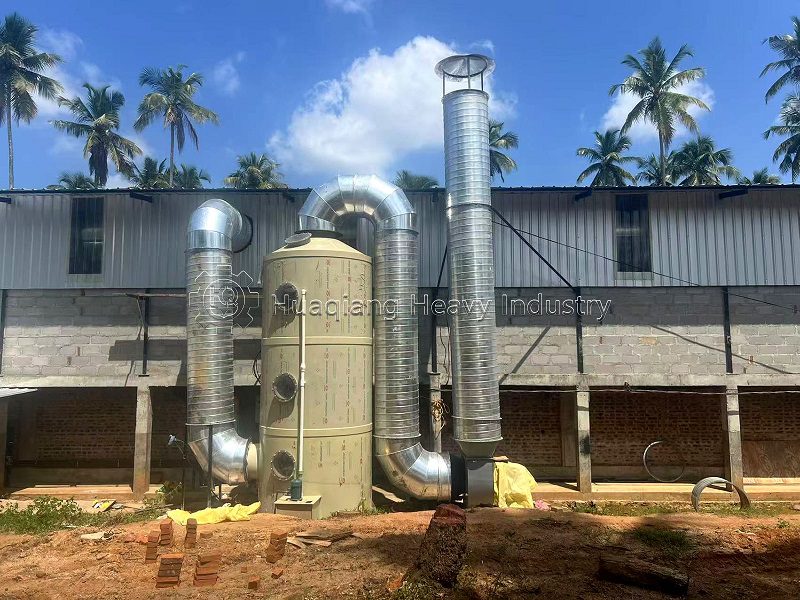
Key Emission Reduction Technical Parameters List
Dust Collection Airflow Ratio: It is recommended that the airflow setting of the dust collection system be 1.2-1.5 times the process exhaust gas volume to ensure that the dust collection hood always maintains an effective collection velocity.
Negative Pressure Stability Range: The core operating area of the workshop should maintain a slight negative pressure of -50Pa to -100Pa to prevent dust from spreading to the surrounding area.
Filter Bag Cleaning Cycle: Automatic pulse cleaning based on differential pressure sensing should be set, automatically starting when the differential pressure reaches 1200Pa to extend filter bag life.
Material Drop Height: In chute design, the material drop height should be controlled within 0.5 meters, or baffles should be installed to reduce dust generation.
Technical Risk Management Recommendations: The operation of dust collection systems often involves the risk of flammable and explosive dust. Therefore, explosion relief discs must be installed at the dust collector outlet, and all dust collection pipelines must be reliably grounded. Furthermore, the collected dust should be recycled through a re-granulation process; direct discharge or disposal is strictly prohibited. This is not only an environmental compliance requirement but also a key means of controlling production costs.
Dust Suppression as a System-Wide Value Protector
The 40% dust reduction achieved through sealed conveying, stratified filtration, and binder-enhanced granulation is not merely an environmental compliance milestone—it is a direct economic safeguard across every stage of the production workflow. In a modern npk fertilizer line, dust control must be architected as an integrated discipline: the fertilizer dryer machine exhaust feeds a cyclone-baghouse cascade with corrosion-resistant filter media; the fertilizer cooler machine discharge connects to micro-negative-pressure hoods preventing fugitive emissions at the thermal shock point; and the rotary drum screening machine operates within a sealed enclosure with differential-pressure pulse cleaning to capture near-size fines for immediate recycle. For roller press granulator production line operations, flexible sealed connections at the extrusion chamber eliminate the powder leakage endemic to high-pressure compaction, while recovered dust is re-fed to the mixer rather than lost. In bio organic fertilizer production line configurations, where microbial dust poses unique respiratory hazards, hermetic tubular conveying from fermentation through fertilizer packing machine sealing stations ensures that organic particulates never enter the plant atmosphere. Ultimately, treating dust not as a peripheral nuisance but as a recoverable product stream—captured, recycled, and re-granulated—transforms environmental protection from a cost center into a material-efficiency engine, delivering compliance, safety, and margin protection simultaneously.

Frequently Asked Questions (FAQ) Why does the dust collector efficiency decrease while the system load increases?
This is usually because of severe condensation and clogging of the filter bags or failure of pulse cleaning, leading to a sharp increase in ventilation resistance. It is recommended to check the heating and heat tracing system to ensure that the exhaust gas temperature is always above the dew point.
How to determine the required exhaust volume for each section of the production line?
This should be calculated based on the equipment volume, opening area, and material settling velocity. In principle, the control velocity at the dust collection hood should not be lower than 0.5 m/s.