

You know that feeling when you turn a compost pile by hand—the satisfying heat rising from the core, the earthy smell, the sense that you’ve just given a living thing exactly what it needs. Now imagine scaling that feeling up. Not a shovel, not a pitchfork, but a machine that straddles rows of organic waste as long as a football field, turning them with the precision of a baker folding dough. That’s the windrow composting machine.
At its heart, this machine is a lung for the compost pile. Organic matter—manure, crop residue, food scraps—needs oxygen to decompose properly. Without it, the pile goes anaerobic, turning sour and releasing methane instead of the rich, earthy goodness soil craves. The windrow compost turner fixes that. It rolls along the length of a windrow, its rotating drum or paddle wheel lifting material from the core and tossing it outward, letting oxygen flood every pocket. In one pass, it aerates, mixes, and homogenizes, turning a lifeless heap into a thriving microbial metropolis.
But like any great performer, the windrow turner never works alone. It’s the star of a supporting cast that begins long before the first pass.
First comes the pre processing crew. A heavy duty shredder chews through bulky stalks, woody prunings, and straw bales, reducing them to manageable pieces. Without this step, the windrow turner would struggle to create the uniform texture microbes need to colonize efficiently. Then a horizontal mixer might join the scene, blending green nitrogen rich materials with brown carbon sources, along with a dash of water or inoculants, ensuring the pile starts with perfect balance.
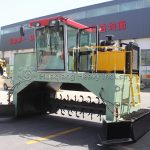
Once the windrows are formed—long, symmetrical rows lined up like soldiers—the windrow composting machine takes center stage. It moves slowly but relentlessly, often powered by a diesel engine or a tractor’s PTO. Some models ride on tracks or wheels, straddling the row and lifting material with flails or augers. The best ones can handle piles six feet high and fourteen feet wide, turning thousands of cubic yards per hour. As the machine advances, it leaves behind a re aerated, fluffed up windrow, steaming gently as thermophilic bacteria celebrate their new oxygen supply.
Over the following weeks, the windrow turner returns again and again. With each pass, temperatures spike, pathogens die, weed seeds are neutralized, and the pile transforms. The machine’s consistency—timed turns, even mixing—compresses what might take a year of manual labor into mere months.
But the supporting cast reappears at the finish line. A vibration screener machine separates finished compost from any remaining oversized particles, which get sent back for another round. Sometimes a windrow turner’s work is followed by a refining mixer or a bagging line, turning bulk compost into a marketable product.
And let’s not forget the quieter members of the team: the turning pad itself—often a concrete or asphalt strip that keeps the machine’s wheels clean and prevents groundwater contamination—and the monitoring systems that track temperature, oxygen, and moisture, feeding data back to operators so they know exactly when to turn.
So why does all this matter? Because composting is no longer just a backyard chore. It’s a scalable solution to organic waste, a way to rebuild depleted soils, and a tool for carbon farming. The windrow composting machine takes what was once considered waste and turns it into a resource—reliably, efficiently, and at a scale that can serve communities, farms, and entire regions.