

Walk into the installation site of an organic fertilizer disc granulator, and the first thing you’ll notice is that large, tilted steel disc – it leans back slightly, like a giant deep in thought. Workers climb all over it, the clang of wrenches and the sizzle of welding mingling in the air. This isn’t a game of building blocks. It’s paving a “road to pellets” for stinky waste.
The disc granulator is the heart of the whole production line. Its tilted steel pan must be locked at around 45° – too steep, and the powder rolls away before it can form balls; too flat, and the granules stick into flat pancakes. Two fitters are bent over the rim, measuring the angle with a protractor. The old hand shouts, “Lift it another two millimeters! Good lock it!” The young apprentice tightens the bolts, each turn like tightening a brace on a giant’s teeth.
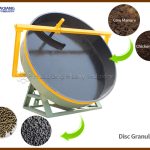
At the bottom of the disc, scrapers are being adjusted. Those sharp steel blades hug the pan bottom and inner wall like razor blades, scraping off sticky wet material. Without them, the material would quickly form a hard crust, turning the disc into a pan full of burnt rice. Beside them, the spray nozzle bracket is freshly welded – three nozzles pointing downward. Soon they’ll spray a fine mist, helping the powder tumble and slowly stick into little balls.
The disc doesn’t work alone. Upstream, a vertical crusher is already in place. Its sharp hammers spin like a windmill, turning clumped fermented material into flying powder. Next to the crusher, a horizontal mixer is being wired up. Two shafts with paddles spin empty – a whooshing sound like a giant snoring. Above the mixer’s inlet, a belt conveyor has been laid out, its black rubber belt stretching from the raw material bin right into the mixer’s mouth.
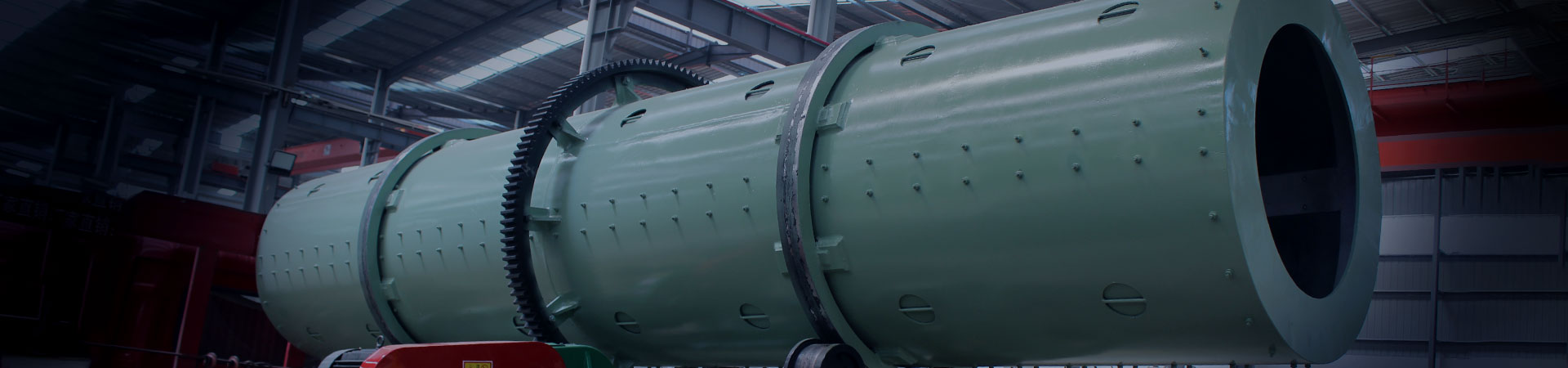
Downstream of the disc comes a drum fertilizer dryer. This huge cylinder tilts on support rollers, and workers are adjusting its angle and speed. At the dryer’s tail, the hot air stove’s flue has just been connected. A welder squats by the gap, touching up the seam with flickering arcs. Further along sits the cooler – it looks much like the dryer, but inside there’s no hot air, only cool air to bring the pellets’ temperature down. Below the cooler’s outlet, a vibration screener machine is having its mesh installed. The two layers of screen cloth must be stretched tight
The busiest spot on site is the final station – the automatic packaging scale. Several workers are mounting load cells under the scale hopper. Every cell must bear the same load, otherwise the weight will jump up and down. Below the scale, a bag sealer hangs ready, its sewing needle glinting cold in the sunlight.
As evening falls, it’s time for the test run. The disc slowly starts turning – at first just a low hum from the motor. After a few minutes of no load running, a worker shovels some wet powder into the pan. The nozzles spray a fine mist. The powder tumbles, agglomerates, and compacts. In less than two minutes, the edge of the disc begins “spitting” round little pellets, clattering into a collection bin. Workers grab a handful and spread it on their palms – uniform, smooth, solid. Grins spread across their faces.
Tomorrow, this line will start swallowing tons of chicken manure and straw, spitting out shiny black organic fertilizer pellets. Isn’t that turning waste into magic? The disc tilts, waste turns into pellets – sometimes, the circle of nature is driven by nothing more than a tilted piece of steel.