

Among the various pathways for transforming powdered organic fertilizer into commercial granules, the disc granulator plays the role of a focused and elegant “spherical artist” with its unique working principle. It does not rely on powerful mechanical pressure but utilizes ingenious rotation and gravity to allow fine powder to naturally grow into uniform, rounded granules through a gentle “snowballing” process. This nearly biomimetic forming method grants it a unique niche in organic fertilizer production, especially where granule integrity and biological activity are of high importance.
Core Advantage: “Growth-Type” Granulation Dancing with Gravity and Centrifugal Force
The excellence of the disc granulator lies in its profound understanding of the essence of granulation—agglomeration, not compaction.
Perfect Sphericity & Uniformity: The inclined, rotating disc provides a continuous tumbling bed for the material. With the addition of an appropriate liquid binder (water or slurry), fine powders gradually grow through mutual coalescence and layering, forming granules with excellent sphericity, smooth surfaces, and uniform particle size. Such granules have good flowability and high commercial appeal.
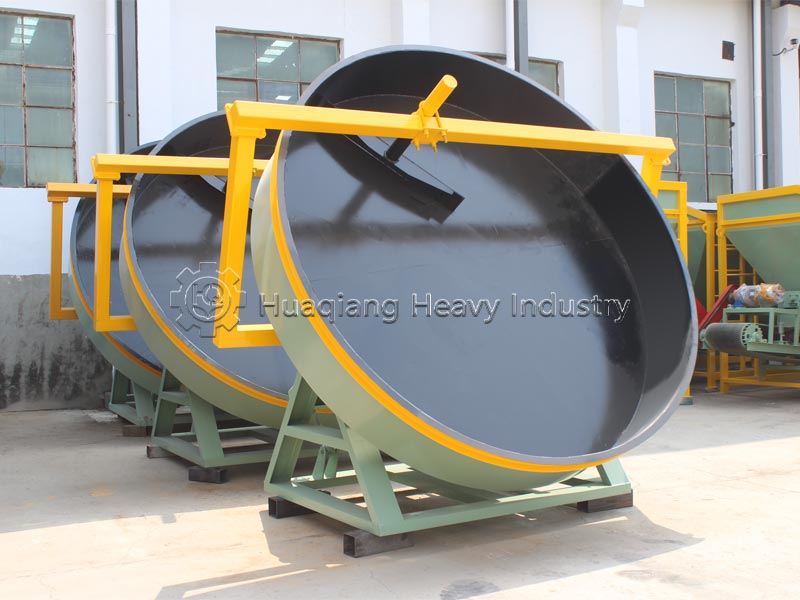
Unparalleled Flexibility: Granule size can be steplessly and real-time adjusted by changing the disc inclination angle, rotation speed, and retention time, without the need to replace molds. This flexibility is highly valuable for producing multiple product specifications or adapting to raw material fluctuations.
Gentle Process Preservation: As a typical wet granulation method, the entire process generates almost no high temperature or pressure, maximizing the protection of heat-sensitive active ingredients in the raw materials, such as beneficial microbial agents and enzymes. This is crucial for producing high-end bio-organic fertilizers.
Low Energy Consumption & Easy Maintenance: The structure is relatively simple, with power consumption mainly for driving the disc rotation, significantly lower than that of high-pressure extrusion granulators. The wear-resistant disc liner is easy to replace, resulting in low maintenance costs.
Comparative Positioning: The Elegant Pole in the Granulation Technology Spectrum
To clarify the value of the disc granulator, it must be compared with mainstream granulation technologies:
| Feature | Disc Granulator | Flat Die Pellet Machine | Double Roller Press Granulator |
| Core Principle | Tumbling Agglomeration (Growth-type) | Mold Extrusion (Compaction-type) | Roller Compaction (Compaction-type) |
| Granule Shape | Standard Spherical | Cylindrical (with edges) | Irregular Flakes/Lumps |
| Granule Strength | Moderate (Surface Dense) | High (Internally Dense) | High |
| Active Ingredient Protection | Excellent (Low Temp) | Poor (High Pressure/Heat) | Poor (High Pressure/Heat) |
| Suitable Raw Materials | Powder, requires some binding property | High-fiber, Low-viscosity Materials | Dry Powders or Crystals |
| Capacity Flexibility | High (Easy Adjustment) | Medium (Mold Change is Cumbersome) | Low to Medium |
Key Conclusion: The disc granulator is the model for pursuing granule sphericity, process gentleness, and production flexibility. It is not the strongest granulation equipment for all scenarios but is an irreplaceable choice in fields such as producing high-end garden fertilizers, seedling substrates, and microbial fertilizer granules. It forms a perfect functional complement to the Flat Die Pellet Mill (excels at processing coarse fibers) and the Double Roller Extruder (excels at dry powder high-pressure forming).
Conclusion: Bestowing Perfect Form upon Quality
As the organic fertilizer industry moves towards refinement and differentiation, the physical form of the product has become an important value dimension. With its gentle, flexible, and precise characteristics, the disc granulator shapes fertilizer powder into uniform, rounded “seeds.” This not only enhances the product’s commercial appearance but also optimizes its application performance. Choosing a disc granulator means opting for a refined production process that respects raw material properties and emphasizes product form aesthetics and functionality, granting your organic fertilizer product unique recognition and competitiveness in the market.