


In NPK compound fertilizer production, screening and return material circulation are the “quality gate” connecting granulation and finished product. An excessively high return material ratio significantly increases overall line energy consumption and equipment wear. This article analyzes practical methods for optimizing the return material circulation from three dimensions: screening efficiency, granulation control, and process design.
What is the Return Material Ratio and its Optimization Goal?
The return material ratio refers to the ratio of the amount of material returned to the system for regranulation (undersize fine powder + oversize large particles) to the amount of qualified finished product, usually expressed as R:1 (return material tons: finished product tons). Industry benchmark values: The return material ratio for rotary drum granulation processes is generally 0.8:1 to 1.2:1; the return material ratio for roller extrusion processes is generally 0.3:1 to 0.5:1.
Optimization Goal: Reducing the return material ratio by 20%-30% directly results in lower overall line power consumption, increased production capacity, and extended lifespan of wear parts. According to equipment parameters, for every 0.1 reduction in the return material ratio, the overall energy consumption of the production line can decrease by approximately 5%-8%.
Method 1: Improving Screening Efficiency
2.1 Selecting Suitable Screening Equipment
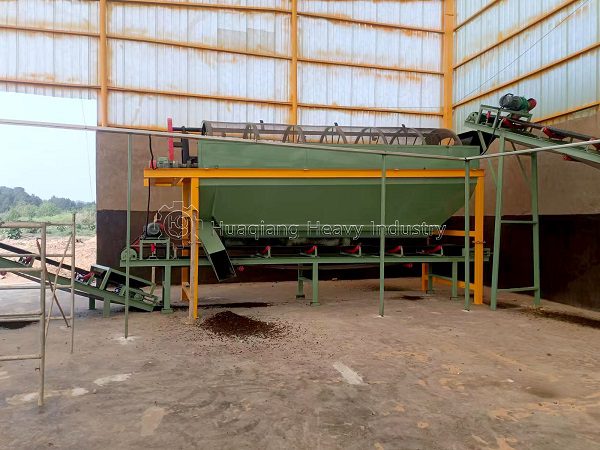
Drum screens are currently the mainstream choice in the fertilizer industry. Their core advantage lies in their superior anti-clogging ability compared to vibrating screens for wet, sticky materials (moisture content 3%-8%). As the material rolls inside the drum, the contact angle with the screen surface constantly changes, giving more opportunities to “shake” out particles stuck in the mesh.

Selection Parameters:
The processing capacity should match the granulator’s output capacity; select a model with 1.1 times the granulation capacity.
Number of screen grading sections: Two sections (finished product, return material) are sufficient; three sections (fine powder, finished product, coarse particles) provide finer results.
When processing organic fertilizer or urea-based formulations, it is recommended to choose a model with a self-cleaning device (external hammer or brush roller).
2.2 Controlling Screen Mesh Diameter and Material Moisture
The screen mesh diameter directly determines the particle size range of the finished product. NPK compound fertilizer commonly uses finished product mesh sizes of 2-4mm or 3.5-5.5mm. If the finished product section contains too much fine powder, the mesh size should be reduced or an upper pre-screening layer should be added.
Material moisture content significantly affects screening efficiency: when the particle moisture content is >5%, the screening efficiency will plummet from 95% to below 70%. The moisture content of particles entering the screening machine should be controlled below 3%, which can be achieved by optimizing the dryer outlet temperature.
2.3 Regular Screen Maintenance
Screen clogging or damage is a common cause of increased return material ratio. Maintenance points:
Check the screen weekly for damage or loosening (especially at joints).
Run the screen idle for 1-2 minutes after each shift to remove adhering wet material.
When handling sticky materials, polyurethane screens can be used instead of stainless steel screens, increasing anti-clogging ability by 50%.
III. Method Two: Optimize the granulation process to reduce return material at the source
Return material is essentially material that fails to be formed in one granulation stage. Improving the one-time granulation rate is the fundamental way to reduce the return material ratio.
3.1 Adjusting Granulator Parameters
Control the material filling rate inside the drum to 10%-15%.
Maintain stable steam pressure at 0.3-0.5 MPa, avoiding excessive moisture or dryness.
Adjust the drum inclination angle and rotation speed to maintain the material residence time inside the drum at 3-5 minutes.
Actual results: First-pass granulation rate increased from 65% to 80%, and the return material ratio decreased from 1.2:1 to 0.7:1, a reduction of over 40%.
3.2 Controlling Mixture Quality
The mixture entering the granulator should meet the following requirements:
Moisture content: 3%-5% (rotary drum steam granulation)
Fineness: 90% passing through a 40-mesh sieve
Temperature: 40℃-60℃ (preheating required in winter)
Fluctuations in mixture quality are a major external factor contributing to unstable granulation; therefore, process control during batching and mixing should be strengthened.
Method 3: Designing a Reasonable Return Material Circulation Process
4.1 Return Material Path Optimization
Return material (undersize fine powder + crushed coarse particles) should return to the granulator or mixer via the shortest path. The ideal design is: Screening machine → Return material elevator → Return material hopper → (after metering) Mixer or granulator. The entire process uses a closed conveyor to reduce dust spillage and material loss.
4.2 Setting up a Return Material Buffer Hopper
A return material buffer hopper (with a volume of 20%-30% of the granulator’s hourly processing capacity) should be set up above the granulator to smooth fluctuations in the return material flow and ensure continuous and stable feeding to the granulator. A variable frequency screw conveyor should be installed at the buffer hopper outlet to achieve precise feeding of the return material.
4.3 Separation of Fine Powder and Coarse Particles
Undersize fine powder (<1mm): can be directly returned to the mixer or granulator without pretreatment. Oversize coarse particles (>6mm): need to be crushed to 2-4mm by a chain plate crusher before returning to the system. Coarse particles may contain hard lumps, and chain plate crushers are more durable than ordinary hammer crushers. According to the equipment parameters provided by Huaqiang Heavy Industry, an NPK production line equipped with a high-efficiency drum screen, chain plate crusher and return buffer silo can stably control the return ratio between 0.6:1 and 0.8:1, and the power consumption of the whole line is 15%-20% lower than the industry average.
Optimizing the return material ratio is not merely a granulation-side fix but a system-wide discipline that synchronizes thermal, mechanical, and material-handling subsystems. A precisely calibrated fertilizer dryer machine ensures moisture exits the granules below 3% before they reach the rotary drum fertilizer screening machine, where anti-clogging drum action and correctly sized mesh separate qualified product from recycle streams with minimal energy penalty. Downstream, a staged fertilizer cooler machine stabilizes pellet temperature to prevent thermal shock cracks that would otherwise generate additional fines during handling. For producers seeking even lower recycle rates, integrating a npk bulk blending machine provides agile formulation switching for specialty grades without the thermal footprint of granulation-drying-cooling trains. When these unit operations are orchestrated within a unified control loop, the finished product flows seamlessly to the fertilizer packing machine with moisture, size, and temperature specifications locked within target bands. The result is a 15%–20% reduction in overall power draw and a payback period that typically falls well within two years.