

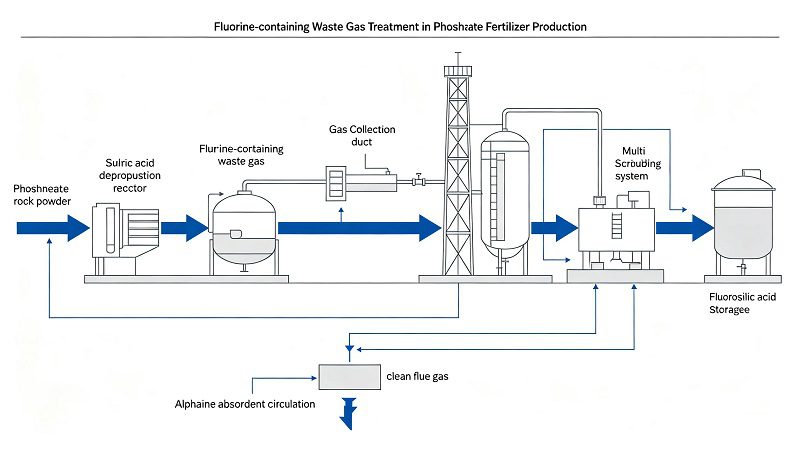
During phosphate fertilizer production, phosphate rock powder releases a large amount of fluorine-containing waste gas under the decomposition of sulfuric acid, with hydrogen fluoride (HF) being the main pollutant. HF is highly corrosive and toxic; if emitted directly without effective treatment, it not only corrodes equipment and pollutes the atmosphere but also causes serious harm to the human respiratory system and bones. Therefore, constructing an efficient and stable hydrogen fluoride waste gas purification and resource utilization system is not only essential for phosphate fertilizer companies to meet environmental compliance requirements but also a crucial pathway to recovering the value of fluorine resources.
Core Technology: Multi-Stage Scrubbing and Purification Tower System
Currently, the mainstream industrial technology for treating fluorine-containing waste gas is a combined process of “wet absorption + deep purification.” Wet absorption uses spray scrubbing towers and packed towers as core equipment. Utilizing the high water solubility of hydrogen fluoride, a neutralization reaction is carried out using an alkaline absorbent (commonly sodium hydroxide solution), transferring the hydrogen fluoride from the gas phase to the liquid phase.
A typical purification tower system usually employs a two-stage or multi-stage spray tower configuration in series. Fluorine-containing waste gas first enters the primary scrubbing tower through a gas collection pipe, where it comes into countercurrent contact with circulating alkaline solution. The waste gas enters from the bottom of the tower and flows upwards, while the alkaline solution is sprayed downwards from the top, achieving sufficient gas-liquid mass transfer and reaction on the packing surface. The primary tower typically uses a high-concentration alkaline solution (such as 5% NaOH solution) to remove high concentrations of hydrogen fluoride; the secondary tower uses clean water or a low-concentration alkaline solution for further deep purification. A demister is installed at the top of the tower to remove liquid droplets entrained in the waste gas, ensuring clean emissions. Some high-standard processes also add an activated carbon adsorption tower or catalytic oxidation device after wet absorption as a final guarantee for deep purification.
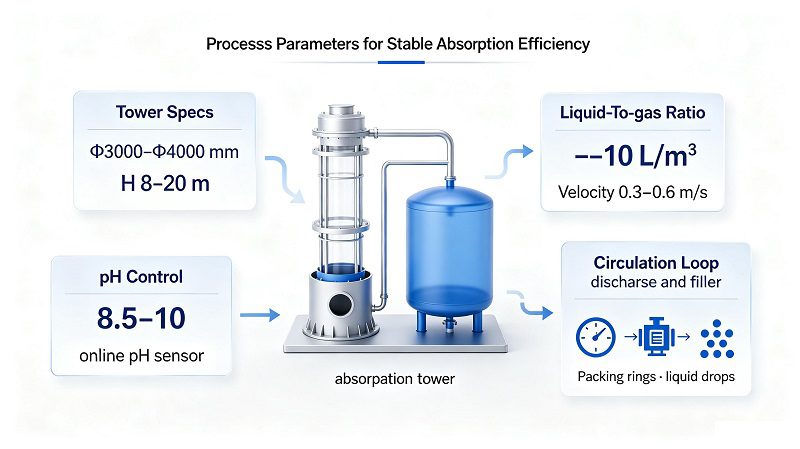
Key Process Parameters of the Purification Tower The absorption efficiency of the purification tower directly depends on the precise control of process parameters. Core parameters include: Regarding tower specifications, commonly used absorption towers have a diameter of Φ3000 mm to Φ4000 mm and a height of 8 to 20 m. Corrosion-resistant polypropylene Pall rings are recommended for the packing to increase the gas-liquid contact area.
Regarding the gas-liquid ratio and flow rate, a liquid-to-gas ratio controlled within the range of 5-10 L/m³ is considered reasonable; the empty tower gas velocity is generally controlled between 0.3 and 0.6 m/s. A reasonable liquid-to-gas ratio and empty tower gas velocity ensure sufficient contact reaction while avoiding excessive system pressure drop and liquid entrainment.
Regarding the pH value of the absorbent, the amount of alkali added needs to be automatically controlled using an online pH meter to maintain the absorbent pH between 8.5 and 10. Too low a pH will affect absorption efficiency, while too high a pH may exacerbate equipment corrosion.
Regarding the circulation system, the flow rate design of the liquid circulation pump must meet the system’s circulation load requirements. Once the fluoride ion concentration in the circulating liquid reaches a certain threshold, part of the absorbent liquid needs to be discharged and fresh alkali solution added to maintain stable absorption capacity.
III. Resource Utilization: A Value Leap from “Waste Gas” to “Product” The higher level of fluoride-containing waste gas treatment in phosphate fertilizers lies in the recovery and utilization of fluoride resources, achieving “treatment through waste.” In the wet absorption process, fluorine-containing waste gas reacts with water or dilute acid to produce fluorosilicic acid (H₂SiF₆), a chemical raw material with industrial value. By precisely controlling the circulation and concentration of the absorbent liquid, when the fluorosilicic acid concentration reaches a certain level, it can be discharged into a fluorosilicic acid storage tank for the production of downstream products such as sodium fluorosilicate, hydrogen fluoride, and silica.
Industrialization practice has fully validated the economic value of this approach. By optimizing the absorption process by adding a scrubbing tower between the reaction tank and the scrubbing tower, the fluorine concentration in the tail gas can be reduced to below 9 mg/m³, and the yield of fluorosilicic acid per ton of P₂O₅ can be increased by 9.8 kg. More systematic technological upgrades can increase the yield of fluorosilicic acid per ton of P₂O₅ from 45 kg to 62 kg. The phosphorus content in the fluorosilicic acid product can be stably reduced to below 250 mg/kg, with the concentration increased to 12% to 18%, and the continuous operation cycle of the tail gas scrubbing system extended from 7 days to over 50 days. This has fundamentally transformed fluorosilicic acid from a “byproduct waste acid” into a “chemical raw material.”
Conclusion: The treatment of hydrogen fluoride waste gas in phosphate fertilizer production is a systematic project integrating environmental compliance, process optimization, and resource recovery. Using a multi-stage scrubbing and purification tower as the core equipment, and through precise control of key process parameters such as tower specifications, liquid-to-gas ratio, and pH value, a defluorination efficiency of over 98% can be achieved. Furthermore, converting the recovered fluorosilicic acid into high-value-added chemical products opens up new profit growth points for enterprises. For phosphate fertilizer companies, this is not only about meeting the “passing grade” of environmental regulations, but also a strategic choice for practicing green manufacturing and achieving sustainable development.
The purified fluorosilicic acid recovered from the scrubbing system is not merely an environmental by‑product — it can be directly utilised as a valuable raw material in downstream fertiliser production. For instance, fluorosilicic acid can serve as a source of silicon and fluorine in the formulation of specific compound fertilisers, or be converted into sodium fluorosilicate for use as an additive in bio organic fertilizer production line to enhance crop resistance. Moreover, the high‑purity fluorosilicic acid can be integrated into the npk fertilizer line as a micronutrient carrier, while the granulation stage — whether using a roller press granulator production line or an organic fertilizer disc granulator — benefits from consistent particle characteristics ensured by advanced fertilizer screening equipment. Thus, treating fluorine‑containing waste gas is no longer a cost burden but a strategic link that connects environmental compliance with nutrient‑enhanced product development, turning a pollution source into a resource that enriches both the soil and the bottom line.