


The choice of urea granulation route is locked in by three hard constraints: New large-scale plants, pursuing single-line scale and product consistency → Fluidized bed, with a maximum single-unit scale of 800 kt/a, a crushing strength of approximately 4.1 kg for 3 mm particles, and product moisture control at the 0.2% level; Existing plants facing capacity expansion, investment constraints, and sensitivity to biuret → Rotary drum fluidized bed, with a maximum single-unit scale of approximately 200 kt/a. A 200,000-ton/year plant would have a total investment of approximately 14.5 million yuan, while a comparable fluidized bed route would cost approximately 28 million yuan, and it does not produce biuret during granulation. Disc granulation is no longer a mainstream option for new urea plants. The first question in route decision-making is not “which particle size looks better,” but rather “what range does your scale fall into, and what is the upper limit of your biuret tolerance?”
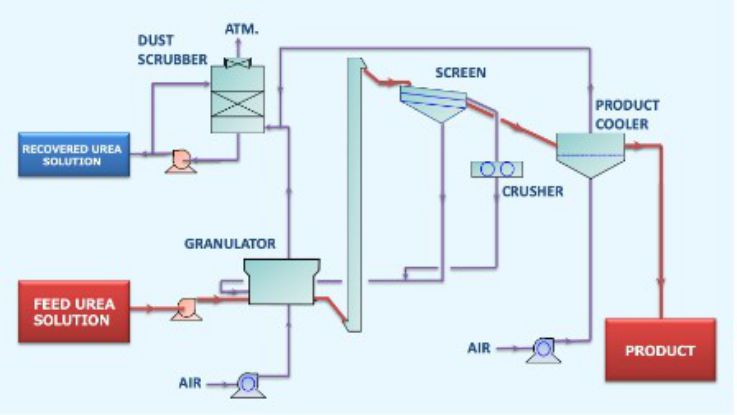
I. Parameter Comparison of Three Routes: Scale, Investment, Intensity, and Biuret
Placing the mainstream urea granulation routes in the same table reveals the trade-offs made in the “selection” process.
| Comparison Dimension | Fluidized Bed Granulation | Rotary Drum Fluidized Bed Granulation | Disc Granulation |
|---|---|---|---|
| Max Capacity per Unit | 800 kt/a (Under construction can reach 6,000 mt/d per line) | Approx. 200 kt/a | Suitable for small to medium scale; rare in new urea projects |
| Reference Investment for 200,000 t/a | Approx. 28 million RMB | Approx. 14.5 million RMB | — |
| Granule Strength | 3 mm: 4.1 kg; 7 mm: 10.0 kg | 3 mm compressive strength ≥27 N (approx. 2.75 kgf) | Strength is usually lower than fluidized bed / rotary drum routes |
| Biuret Control | Typical 0.7—0.8 wt%, requires temperature management | No biuret generated during granulation (Tsinghua University Rotary Drum Fluidized Bed Technology) | Depends on melting temperature and residence time |
| Product Moisture | Standard particle size 0.2 wt%, large particle size 0.3 wt% | Rotary drum route w(H₂O) ≤0.3% | Usually higher, requires supporting drying |
| Applicable Scenarios | New large-scale plants, single-line scale-up | Capacity expansion of old plants, priority on investment payback period | Small scale, multi-variety switching |
Key Conclusions: The “high cost” of fluidized bed granulation corresponds to the scale of a single production line and product consistency; the “economical cost” of rotary drum fluidized bed granulation corresponds to the investment threshold and compatibility with established plants. The difference in particle strength (4.1 kg vs ≥27 N, different unit diameter, but both meet storage and transportation requirements) is not a rejection factor. The real dividing line is whether the scale is suitable and whether biuret needs to be eliminated from the process route.
II. Temperature Window and Biuret: The First Quality Constraint in Urea Granulation
The biggest difference between urea granulation and organic fertilizer/compound fertilizer granulation is that the biuret formation rate increases non-linearly with temperature. Temperature management is not an “efficiency issue” but a “compliance issue.”
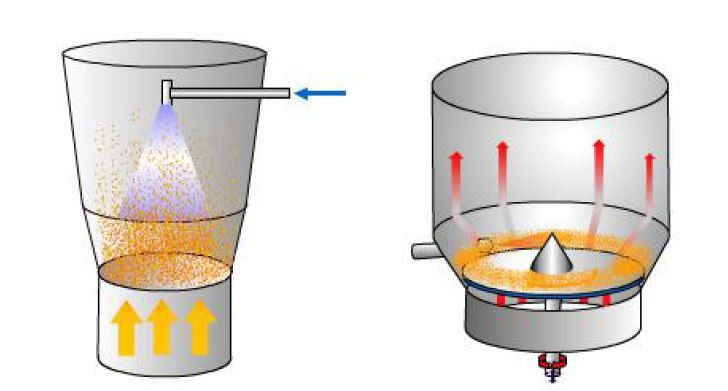
Biuret is generated by the thermal condensation and deammoniation of two molecules of urea. When urea is heated to its melting point and above, decomposition accelerates. Biuret formation is rapid at conventional melt granulation temperatures (approximately 140°C), but the formation rate decreases significantly in lower-temperature hot solutions. In fluidized bed granulation, the bed temperature is typically maintained at 110-120°C, and the melt feed temperature can be as low as around 135°C, precisely to strike a balance between sufficient atomization/coating and biuret suppression. Some data indicate that controlling the operating temperature below 100°C can further reduce the biuret formation rate; however, this temperature range places higher demands on the fluidity of the molten urea system, and not all granulation methods can operate stably at low temperatures.
The structural advantage of the rotary drum fluidized bed granulation method lies here: the rotary drum fluidized bed granulation technology developed by Tsinghua University does not produce biuret during the granulation process. Its mechanism involves the gradual solidification of micro-droplets on the surface of dynamic particles, cooling from the inside out, thus avoiding prolonged residence of molten urea in high-temperature zones. For biuret-sensitive applications (such as specific crops, automotive urea feedstock, etc.), this route provides process-level “avoidance” rather than end-point “control.”
Operational Implications: If you choose the fluidized bed route, biuret control should focus on reducing melting temperature, shortening high-temperature residence time, and controlling feed concentration, rather than relying on subsequent screening or coating to “eliminate” it. Particle strength can be adjusted by process parameters, but once biuret is generated in the granulation stage, subsequent processes cannot reverse it.
III. Moisture and Particle Strength: The 0.2%–0.3% moisture window is not “the drier the better.”
There is a directional window relationship between the moisture content and particle strength of urea particles, rather than simply “the lower the moisture, the stronger.”
Typical product moisture content for industrial fluidized bed: 0.2 wt% for standard particle size, 0.3 wt% for large particle size. The specifications for the drum route also require w(H₂O) ≤ 0.3%. The significance of this window lies in the fact that excessive moisture content makes granules prone to clumping and reduced strength during storage and transportation; however, pursuing extremely low moisture content (e.g., below 0.1%) often requires higher drying intensity or longer residence time, which is detrimental to energy consumption and biuret control.
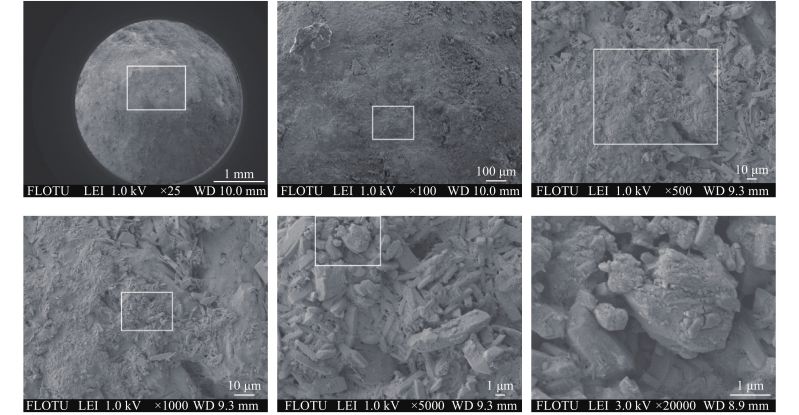
The industrial acceptance criteria for granule strength also need to be standardized: fluidized bed granules are reported in kg/granule (4.1 kg for 3 mm granules, 10.0 kg for 7 mm granules), while drum granules are reported in N/granule (≥27 N, approximately 2.75 kgf). These values cannot be directly converted and compared, but both point to the same fact: the strength of urea granules mainly comes from the dense structure formed by “accretion,” rather than from bridging by binders. This also explains why fluidized bed and drum fluidized bed products are superior to traditional granulation tower sprayed granules in terms of breakage and abrasion resistance—the latter typically have significantly lower strength.
IV. FAQ: Frequently Asked Questions Regarding Urea Granulation Route Selection
Q1: Existing plant granulation tower capacity is limited; fluidized bed or rotary drum?
Prioritize rotary drum fluidized bed. The maximum capacity of a single rotary drum line is approximately 200 kt/a, with an investment of about 52% of a comparable fluidized bed. It can utilize existing granulation tower particles as seed crystals, making it suitable for capacity expansion and retrofitting of older plants. For newly built large-scale plants aiming for single-line capacities of 800,000 tons or more, the economies of scale of fluidized beds become a decisive advantage.
Q2: Biuret exceeds limits; how to adjust from the granulation stage?
First, reduce the melting temperature and high-temperature residence time, then consider route switching. The biuret formation rate increases with temperature. Fluidized bed temperatures are typically controlled at 110-120℃, while the melt feed temperature can be as low as around 135℃. If the existing route still cannot meet the biuret limit after temperature optimization, the “no biuret generation during granulation” characteristic of the rotary drum fluidized bed is the structural solution.
Q3: How to standardize the particle strength specifications for fluidized bed and rotary drum fluidized bed systems?
Do not directly convert them. Acceptance should be based on their respective product standards. Fluidized bed reports report kg/particle (3 mm 4.1 kg), while rotary drum reports report N/particle (3 mm ≥27 N). The testing methods and particle size benchmarks differ between the two. When selecting a system, the acceptance standards of the target market or downstream customers should be the primary considerations, rather than comparing two different specifications.