
In the operation of fertilizer production enterprises, energy consumption and efficiency are the two core factors determining profit margins. Many managers are accustomed to “improving only after problems arise,” neglecting the enormous optimization potential inherent in existing production lines—through simple equipment adjustments and process reengineering, without additional investment, production efficiency can be increased by 30% and energy consumption reduced by over 20%.
Equipment Interconnection Optimization: Letting Materials “Walk By Themselves”
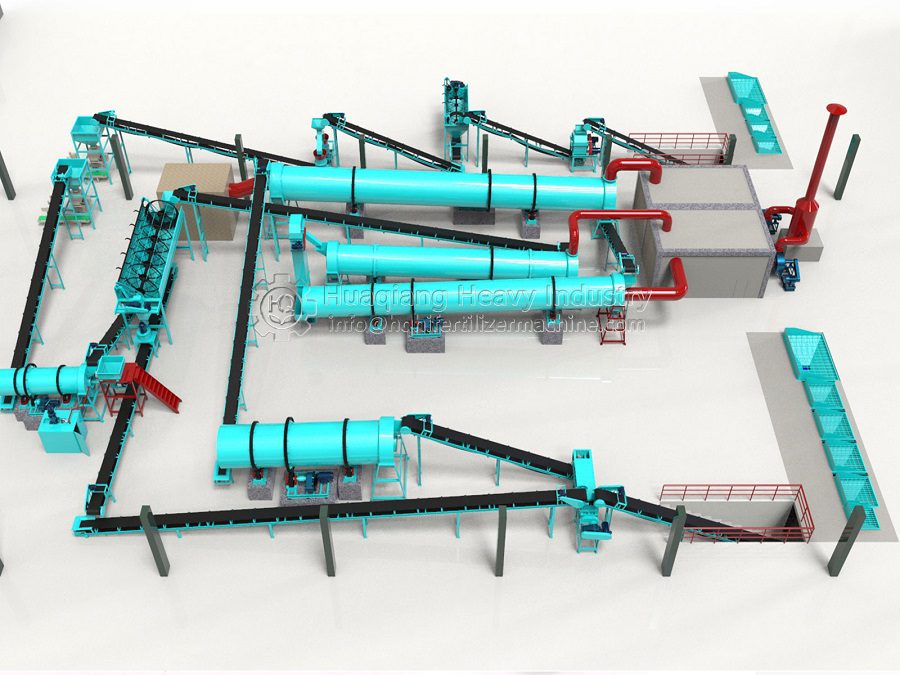
Many outdated production lines still rely on manual handling—crushed materials need to be transported by forklifts, and fermented materials need to be pushed by workers. This not only consumes manpower but also disrupts the production cycle. The optimization method is to seamlessly connect equipment at each stage through belt conveyors and bucket elevators to form a continuous production line.
From raw material input to finished product packaging, materials never touch the ground or wait. Taking a 10-ton/hour production line as an example, interconnection optimization can reduce at least 2-3 handling workers and increase production efficiency by over 15%. Simultaneously, continuous operation avoids frequent equipment start-ups and shutdowns, reducing motor energy consumption by approximately 10%.
Energy Consumption Control Optimization: Giving Waste Heat a “Second Life”
The drying process is a major energy consumer in fertilizer production, typically accounting for over 60% of total energy consumption. Optimizing the drying process is key to cost reduction.
Waste Heat Recovery and Utilization: The flue gas temperature discharged from the rotary dryer is still 80-100℃. Direct emission not only wastes heat energy but also increases the burden on dust removal. A heat exchanger can be installed in the flue to preheat the cold air entering the dryer with waste heat, raising the hot air temperature by 10-15℃ and reducing fuel consumption of the hot air furnace by 8%-12%.
Dry Process Replacement: For materials suitable for dry granulation (such as some compound fertilizers and blended fertilizers), the wet process can be replaced with double-roller extrusion granulation. Dry granulation does not require water, thus eliminating the need for subsequent drying and cooling stages, reducing the overall energy consumption of the line by more than 40%. Although equipment investment increases slightly, the operating cost advantage will become apparent within 1-2 years.
III. Simplified and Optimized Processes: Eliminate Every Required Step
Air Drying Instead of Oven Drying: For small and medium-sized pure organic fertilizer production enterprises, under sunny weather and with sufficient space, the drying process can be replaced with air drying. Spreading out wet granules to dry for 1-2 days will reduce the moisture content to a safe storage standard. Although air drying requires space and time, the investment in drying equipment and the thousands of yuan in fuel costs per day saved are extremely worthwhile for enterprises with small annual output.
Binder-Free Granulation: When granulating pure organic fertilizer, use a disc granulator or a stirring tooth granulator. Utilize the material’s own viscosity to form granules, eliminating the need for adding bentonite, starch, or other chemical binders. This not only saves on raw material costs (50-80 yuan per ton) but also maintains the pure quality of the organic matter, enhancing the product’s selling points.
Optimized Fermentation Process: Combining Crushing and Turning
In traditional fermentation processes, turning and crushing are two separate steps—a turning machine is used to supply oxygen, and after fermentation, a crusher is used to break up clumps. Now, some advanced equipment combines the two processes.
Using a hydraulic turner or double-spiral turner with crushing function, the compacted material is broken up simultaneously during turning. The fermentation cycle can be shortened by 5-7 days, and the fermented material is already largely loose when it leaves the pile, allowing it to directly enter the granulation stage, eliminating one crushing step. For a production line processing 20 tons of raw materials per day, this can save approximately 30,000 yuan in crushing electricity costs annually.
Optimized Batching Process: Multiple Batching Steps in One Go
Old production lines often use a “one-material-one-batching” method—batching one raw material, mixing it, then adding another, mixing it again, repeating this process multiple times, which is time-consuming and prone to errors. The optimization method is to upgrade to a multi-compartment precision batching machine.
One batching machine can simultaneously control the feeding of 4-8 raw materials, completing the metering and feeding of all raw materials in one go according to the set formula. Batching time is reduced from 20-30 minutes to 3-5 minutes, and the dynamic batching error is controlled within ±0.5%, avoiding quality fluctuations caused by multiple mixing steps. Based on 20 batches of raw materials per day, this alone can save 2-3 hours of operating time daily.
Optimized Screening Process: Multi-stage Finished Product Screening in One Step
Traditional screening processes use single-layer screens, which can only separate “qualified” and “unqualified” products. Unqualified products need to be returned to the previous stage for reprocessing. This not only increases rework but also occupies equipment capacity.
Upgrading to a multi-layer vibrating screen (usually three layers) allows for the removal of oversized particles in the upper layer (returned for crushing), the collection of qualified finished products in the middle layer, and the removal of fine powder in the lower layer (returned for granulation). Three-stage separation can be completed in one screening step. Qualified products are directly packaged, and returned materials are accurately returned to the corresponding stage. The finished product qualification rate can be increased by 5-8 percentage points, rework volume reduced by more than 30%, and screening efficiency increased by 40%.

VII. Case Study: Significantly Increased Efficiency Without Adding Equipment
A certain organic fertilizer plant in Shandong had an existing production line built in 2018, using a traditional segmented process, which involved a lot of manual handling, high energy consumption, and low efficiency. Under the guidance of the Huaqiang Heavy Industry technical team, the factory underwent a two-week process optimization:
Connecting each stage with conveyor belts to achieve continuous material flow;
Adding a waste heat recovery device to the dryer, reducing hot air furnace fuel consumption by 12%;
Replacing the ordinary turning machine with a hydraulic turning machine with crushing function, eliminating a crushing step;
Upgrading the batching system to a multi-bin batching machine, shortening batching time by 70%;
Replacing the single-layer screen with a three-layer vibrating screen, reducing rework by 35%.
After optimization, the production line increased production efficiency by 35% and reduced energy consumption per ton of product by 25% without adding any major equipment, resulting in a decrease in operating costs of over 800,000 yuan that year. The factory manager remarked, “I always thought about buying new equipment before, but I never imagined that adjusting the old equipment could bring so much benefit.” The process optimization of the fertilizer production line is essentially about improving efficiency through management and increasing profits through attention to detail. From the smoothness of equipment linkage to every degree of waste heat recovery, and every minute of screening accuracy—every seemingly small improvement ultimately converges into a considerable increase in efficiency. Huaqiang Heavy Industry not only provides high-quality equipment, but also offers free process diagnostics and optimization suggestions for your existing production lines, helping you go further on the road to cost reduction and efficiency improvement.
Holistic Optimization of Fertilizer Production Lines
The principles of optimization extend across the entire npk fertilizer line and are integral to a successful fertilizer production line optimization process. For example, the heat recovery system described earlier is directly applied to the fertilizer drying machine, preheating inlet air and significantly reducing fuel consumption. Improved material flow, achieved through the strategic use of bucket elevator systems, ensures consistent feed to the rotary drum screening machine, maximizing its efficiency in separating product grades. This, in turn, provides a consistent, high-quality granule stream to the automatic packing machine. Furthermore, an often-overlooked optimization is the integration of a cyclone dust collector at key transfer points and on the dryer exhaust. This not only captures valuable fine material for recycling but also protects downstream equipment and ensures environmental compliance. By systematically applying these optimizations—from waste heat recovery on the fertilizer drying machine to dust control with a cyclone dust collector—a production line achieves seamless, energy-efficient operation from raw material input to final packaged product.