

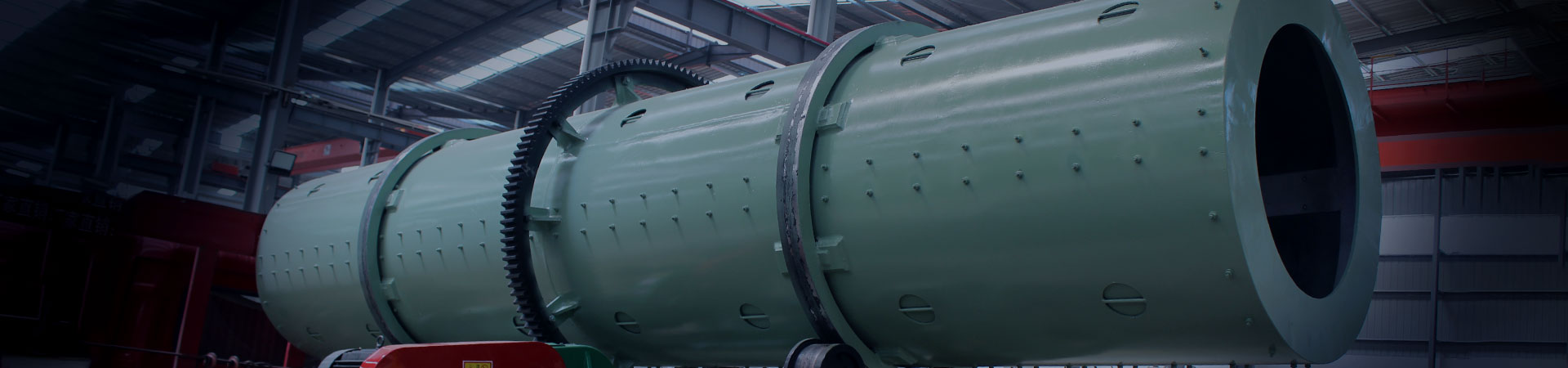
Core Structure: A Precision Mechanical Assembly
A complete drum fertilizer dryer system consists of the following key components:
Drum Body: The core component, made of rolled and welded quality steel plates, lined internally with wear-resistant plates and insulated externally to reduce heat loss.
Support Rolls & Thrust Rolls: Support the drum body and allow its free rotation, bearing the entire weight of the equipment.
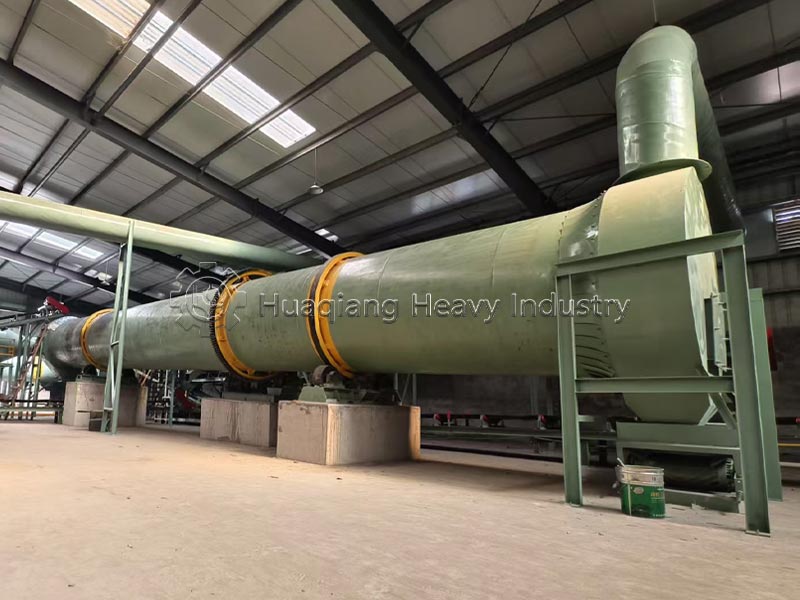
Transmission System: Includes the main motor, reducer, and girth gear/pinion, providing smooth and reliable rotational power.
Lifting Flight Assembly: Various types of flights (e.g., lifting, sector-shaped, honeycomb) installed on the inner wall of the drum. Their design directly affects material showering efficiency and drying uniformity.
Sealing Assembly: Sealing rings installed at the drum’s feed and discharge ends prevent cold air leakage and dust spillage, ensuring thermal efficiency and a clean working environment.
Hot Air System: Includes the combustion chamber (coal, gas hot air stove, oil, or biomass), blower, and hot air ducts, providing a stable and controllable heat source.
Dust Removal System: Connected to the exhaust end, it includes cyclone dust collector separators, bag filters, or wet scrubbers to collect dust, purify exhaust gas, and meet environmental requirements.
Performance Advantages: Why is it So Popular?
High Processing Capacity: Capable of 24/7 continuous operation with a wide single-unit capacity range (1-50 tons/hour), suitable for large-scale industrial production.
Excellent Drying Uniformity: The rotation and lifting flight structure ensures every fertilizer granule is repeatedly showered and fully heated, resulting in consistent product moisture content.
Strong Adaptability: Can dry various fertilizers with different particle sizes and initial moisture contents by adjusting rotation speed, inclination angle, hot air temperature, and flow rate.
Stable & Reliable Operation: Mature mechanical structure with low failure rates, relatively simple maintenance, and long service life.
High Fuel Flexibility: Can be adapted to multiple heat sources, offering particular advantages in utilizing renewable energy like biogas or biomass.
Operation & Maintenance Essentials
Guidelines for Safe & Efficient Operation:
Start-up Sequence: Start the dust removal and conveying systems first, then start the drum rotation, and finally introduce hot air while gradually increasing the temperature.
Temperature Control: Strictly control the inlet air temperature according to material properties to avoid nutrient loss or particle melting caused by excessive heat.
Load Monitoring: Maintain uniform feeding to prevent overfilling (affecting drying efficiency) or underfilling (wasting thermal energy) inside the drum.
Shutdown Procedure: After stopping the feed, continue rotating the drum and purge with low-temperature hot air for a period. Allow the drum body temperature to decrease before complete shutdown to prevent drum deformation.
Routine Maintenance:
Regular Inspection: Daily check for wear and lubrication of support and thrust rolls; listen for gear meshing sounds.
Cleaning & Tightening: Periodically clean any minor scaling inside the drum; check and tighten all bolts.
Seal Inspection: Ensure the sealing assemblies at the feed and discharge ends are intact to prevent air leakage.
Bearing Lubrication: Lubricate main and transmission bearings regularly as per the maintenance manual.
Flight Inspection: Periodically enter the drum to inspect flight wear and repair or replace as needed.
Technological Development Trends
Intelligent Control: Integrated PLC and sensors for real-time monitoring and automatic adjustment of temperature, air volume, and rotation speed to achieve the optimal drying curve.
High Efficiency & Energy Saving: Adoption of heat pump technology or multi-stage waste heat recovery systems (e.g., preheating inlet air, using dryer exhaust to preheat raw materials) to significantly reduce energy consumption.
Low-NOx & Environmental Protection: Use of low nitrogen oxide combustion technology combined with high-efficiency bag filters and exhaust gas scrubbing to meet increasingly stringent emission standards.
Modular Design: Equipment manufactured in sections for easier transportation, on-site installation, and shorter construction periods.