

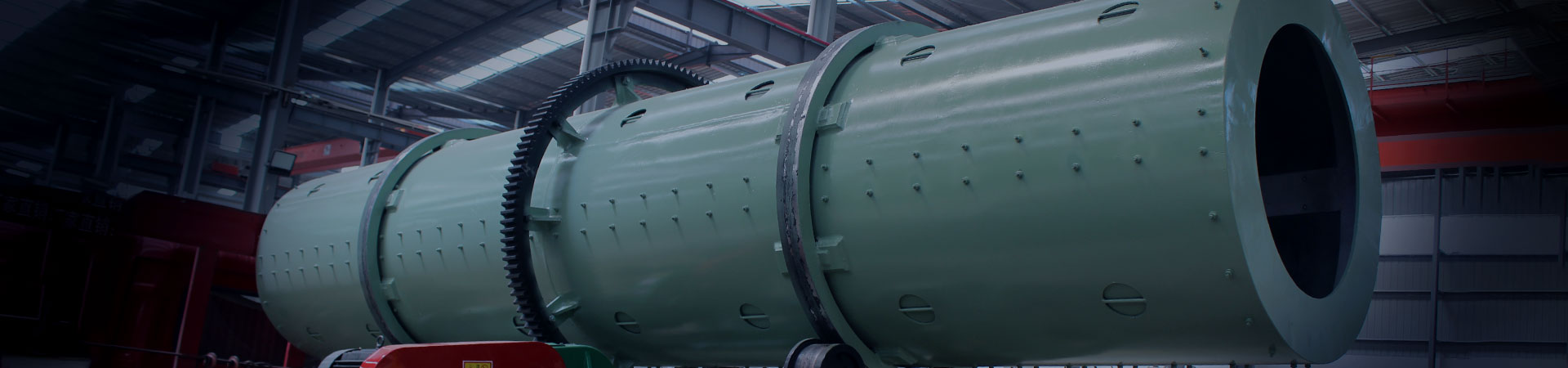
The core value of the disc granulator in laboratory research and development lies in its ability to simulate the granulation process of industrial production with extremely small feed volumes through the coordinated adjustment of three independent variables. Unlike industrial machines that often require tens of kilograms of material, laboratory-grade disc granulators can feed as little as tens of grams at a time, and their rotation speed, angle, and water spray volume are all infinitely adjustable. This flexibility makes them an ideal tool for formula screening and process parameter optimization.
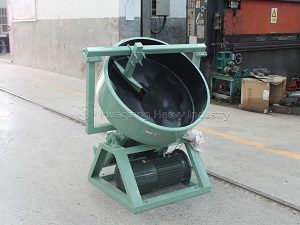
Inclination Angle: Controlling the “Residence Time” of Particles
The disc inclination angle determines the rolling time of the material within the disc—the smaller the inclination angle, the longer the material rolls, and the larger the particles become. The inclination angle adjustment range for laboratory disc granulators is typically 30° to 90°, while the effective range commonly used in actual production is concentrated between 40° and 55°.
Target Particle Size 2-4mm: Set the inclination angle to approximately 50° to achieve a suitable number of rolling revolutions within the disc.
Target particle size 4-6mm: Set the tilt angle to approximately 45° to extend particle growth time.
Overall particle size too large: Increase the tilt angle by 1°-2° to accelerate discharge using gravity.
Generally small particle size: Decrease the tilt angle by 1°-2° to extend the growth cycle.
When adjusting, it is recommended to change the angle by 1°-2° each time, observe for 10-15 minutes, and then make the next fine-tuning.
Rotation Speed: Controlling the “Tumbling Force” of Particles
Rotation speed affects the centrifugal force and tumbling frequency of the material on the disc surface. Higher rotation speed results in more compacted particles; lower rotation speed results in more uniform particle growth.
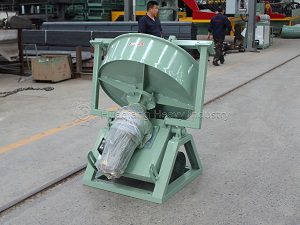
The rotation speed adjustment range of a laboratory disc granulator is typically 0-90 rpm. Using a disc with a diameter of 2-3 meters as a reference, 8-12 rpm is a commonly used range: For processing fine powder raw materials (particle size ≤1mm): Use a higher rotation speed of 10-12 rpm to promote particle agglomeration through high-frequency collisions.
For coarse-grained raw materials (2-3mm in diameter): Use a lower rotation speed of 8-10 rpm to avoid excessive friction between particles.
For flat, non-round particles: Too high a rotation speed causes the material to be thrown too violently; reduce the speed by 10%-15%.
For loose particles and low granulation rate: Too slow a rotation speed results in weak tumbling; increase the speed by 10%-15%.
Water Spray and Scraper: Precise Coordination of Auxiliary Variables
Atomized water spray is a key auxiliary factor in particle formation. Laboratory equipment is usually equipped with atomizing nozzles, where water evenly covers the material in a “drifting” manner, rather than directly rinsing it. Granulation moisture content is generally maintained at 15%-20%—too high a moisture content easily leads to large clumps adhering, while too low a moisture content makes agglomeration difficult.
The scraper position also affects particle uniformity. The normal gap between the scraper and the disc surface is 5-10mm. Too large a gap will not effectively break up oversized particles; too small a gap will result in excessive scraping and an increase in small particles.
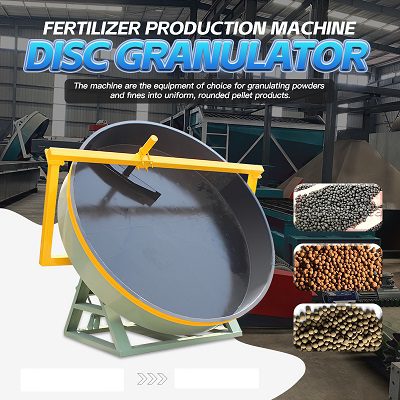
Experimental Operation Procedure
Raw Material Pretreatment: Sieve the powder through a 60-80 mesh sieve to ensure uniform particle size.
Single Variable Adjustment: Use the single variable method, adjusting only one parameter at a time to avoid interference from multiple factors.
Stable Operation and Sampling: After adjustment, run stably for 30 minutes, then sample and sieve (2mm, 4mm, 6mm). The qualified standard is that the proportion of 2-5mm particles reaches more than 75%.
Data Recording: Record the particle size distribution, particle strength, and particle size distribution of each batch to provide a basis for scale-up production.
Precautions: When the inclination angle increases by 5°, the rotation speed should be increased by 1-2 rpm to maintain the dynamic balance of the material in the pan. After each adjustment, observe the complete cycle of particle “formation-growth-rolling”.
The laboratory disc granulator is not merely a scaled‑down version of its industrial counterpart—it is a precision tool that enables researchers to decode the complex interplay of rotation speed, inclination angle, and water spray, revealing the optimal process window for each formulation. These small‑batch trials provide the critical data needed to confidently scale up to full production, where the same principles govern the performance of commercial fertilizer equipment. The insights gained from the lab disc granulator machine directly inform the settings of industrial fertilizer granulator machine lines, ensuring that the granulation behavior observed at gram‑scale translates reliably to tons‑per‑hour operation. Moreover, the laboratory work often includes evaluating raw material pretreatment—using a fertilizer crusher and mixer to achieve the right particle size distribution and homogeneity—and assessing the post‑granulation stability, which later requires a fertilizer dryer and cooler to lock in moisture and strength. By systematically documenting each variable adjustment and correlating it with particle size distribution and strength, the lab serves as the intelligence hub for the entire production chain. Ultimately, a well‑executed laboratory study not only accelerates process development but also reduces the risk of costly scale‑up failures, ensuring that the transition from bench to plant is smooth, efficient, and data‑driven—a cornerstone of modern fertilizer manufacturing.