
In small fertilizer plants or production workshops with limited space, the conveying process is often the most troublesome issue—open belt conveyors generate dust, which is both environmentally unfriendly and wasteful of materials; large conveying equipment occupies a large area and simply cannot fit in confined spaces. Huaqiang Heavy Industry’s screw conveyor adopts a sealed spiral structure, with its core advantages of small size, dust-free operation, and stable operation, making it the ideal choice for small-scale fertilizer production, batching, and short-distance conveying.
Core Advantages: Small Size, Big Impact
Sealed Conveying, Dust Removal Rate Over 95%
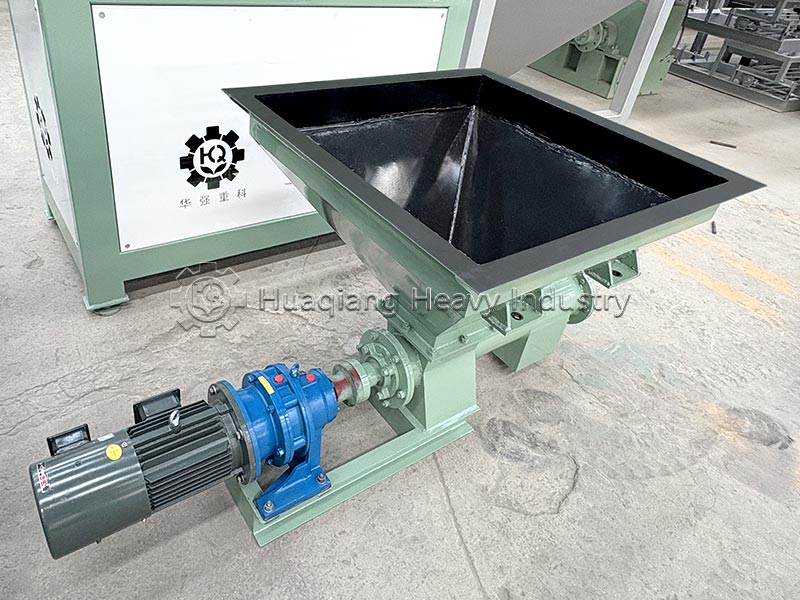
The biggest highlight of the screw conveyor is its fully enclosed structure. Materials are propelled forward by rotating spiral blades within a U-shaped or cylindrical shell, completely isolated from the outside environment. Whether conveying ultrafine powders or easily dusty particles, there is no dust spillage, significantly improving the cleanliness of the workshop environment. Actual test data shows that compared to open conveyors, the screw conveyor achieves a dust removal rate of over 95%, easily meeting environmental compliance requirements.
Compact Size, Minimal Footprint
Screw conveyors are linearly arranged, requiring minimal installation space. Lengths range from 1 meter to over 10 meters and can be customized to meet specific needs, while widths are typically only 300-500 millimeters. They can be flexibly installed between equipment, in corners, or even suspended from the ceiling. For renovation projects with limited space or compact production lines, screw conveyors are irreplaceable “space utilization masters.”
Stable Operation, No Material Segregation
The helical blades slowly agitate the material during conveying, ensuring uniform mixing of powders or small particles and preventing material stratification caused by vibration. This characteristic is particularly crucial in the batching process—ensuring consistent raw material ratios entering the mixer.
Simple Structure, Easy Maintenance
Screw conveyors have no idlers, belts, or hoppers; the core components are only a single helical shaft and drive unit. Routine maintenance only requires checking the wear of the helical blades and the lubrication of the bearings, which can be performed by ordinary workers, resulting in extremely low maintenance costs.
Suitable Application Scenarios: The Precision Choice for Small-Batch Conveying
Scenario 1: Precision Small-Batch Conveying in the Batching Stage
In small-scale compound fertilizer production lines, raw materials such as nitrogen, phosphorus, and potassium, after being metered by the batching machine, need to be fed into the mixer. This stage is best suited for a screw conveyor—the conveying volume can be precisely controlled by adjusting the speed, forming a closed-loop linkage with the batching machine to achieve continuous and uniform feeding. For additives such as trace elements used in extremely small quantities, the screw conveyor is an irreplaceable precision conveying tool.
Scenario 2: Close-Range Connection Between Crusher and Granulator
When the crusher and granulator are arranged compactly, large belt conveyors are difficult to implement. A screw conveyor only 2-3 meters long can perfectly connect them: the crushed material falls from the discharge port into the screw conveyor inlet and is pushed at a uniform speed to the granulator hopper, with no material touching the ground and no dust generated throughout the process.
Scenario 3: Conveying Finished Products to the Packaging Machine
In the packaging stage of small-scale finished fertilizers, long-distance conveying is often difficult to arrange due to the limited space of the packaging machine. Screw conveyors can be installed at an incline (maximum angle 30°) to lift finished granules from a warehouse or hopper to the packaging machine’s hopper, ensuring the granules remain intact and undamaged during transport.
III. Practical Precautions: Key to Effective Screw Conveyor Use
Inspect Screw Blades Before Startup
The screw blades are the core working component. Long-term transport of highly abrasive materials (such as ammonium phosphate and potassium salts) will cause the blade edges to wear and thin. Before starting, check the blade wear. When the gap between the blade’s outer diameter and the casing exceeds 10 mm, the conveying efficiency will significantly decrease, requiring timely replacement or welding repair.
Control Feed Speed to Avoid Blockages
The biggest problem with screw conveyors is “excessive feeding”—material accumulates inside the casing, preventing the screw blades from pushing it out in time, leading to blockages and shutdowns. The correct approach is to maintain continuous and uniform feeding, controlling the feed rate to 80%-90% of the equipment’s rated conveying capacity. For materials with poor flowability, a vibrator can be installed at the feed inlet to assist the material in falling into the screw.
Clean promptly after conveying damp materials
When conveying damp materials such as organic fertilizer and fermented materials, some material may adhere to the screw blades and casing. After each shift, run the machine idle for a few minutes to remove residual material. If necessary, open the cleaning port for manual cleaning. Cleaning becomes much more difficult once the material dries and hardens, and may even damage the blades.
Regularly lubricate bearings
The head, tail, and intermediate suspension bearings of the screw conveyor require regular grease application. Typically, lubricate once every 100 hours of operation; in dusty environments, the lubrication interval should be shortened.
Customized Services: Designed to Your Needs, Precisely Matched
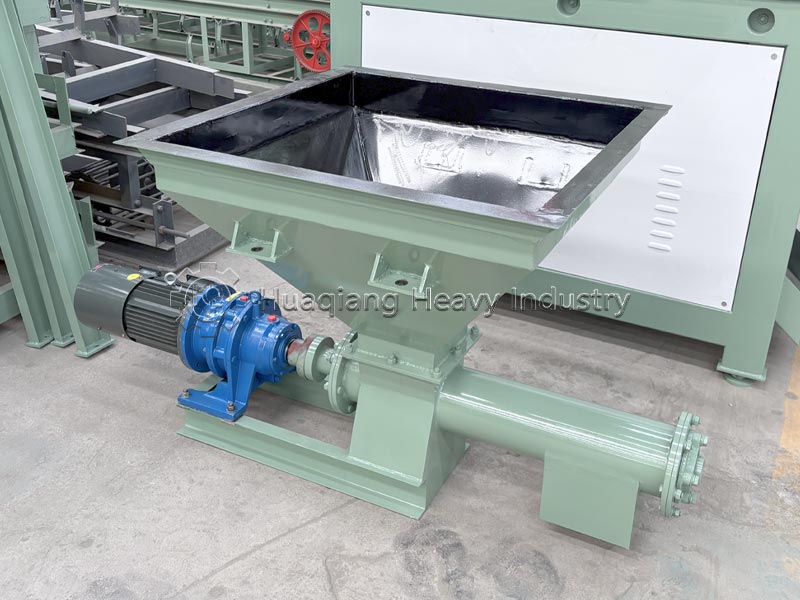
Huaqiang Heavy Industry’s screw conveyors offer a variety of customization options:
Length Customization: Any length within the range of 1-15 meters
Inclination Angle Customization: Horizontal or inclined (≤30°)
Material Selection: Carbon steel (standard type) or 304 stainless steel (food/pharmaceutical grade)
Blade Type: Full-face type (conveying granules) or belt type (conveying viscous materials)
Explosion-proof Design: Explosion-proof motor optional to meet the needs of the chemical industry
From precise metering in the batching process to the compact connection of crushing and granulation, and then to the clean conveying of finished product packaging—Huaqiang screw conveyors, with their unique advantages of being enclosed, compact, and stable, have become the ideal choice for small-scale fertilizer production. When your workshop is free from dust, and when smooth flow can be achieved even in confined spaces, you will understand: choosing the right conveying equipment means choosing a win-win situation of environmental protection and efficiency.
The screw conveyor is an excellent example of a specialized material handling solution, but a complete fertilizer line requires a network of different conveyors to move material efficiently. In a standard npk fertilizer line, after granulation, the material must be transported through several key stages. A bucket elevator is often used for vertical lifts, gently moving granules up to a rotary drum screening machine for classification. The screened, uniform product is then fed into a fertilizer drying machine to achieve the final moisture content. The dried granules, after cooling, are then conveyed, often by another sealed screw conveyor, to the hopper of an automatic packing machine. This integrated network—from the precise, enclosed transfer of a screw conveyor for fragile or dusty materials, to the high-capacity vertical lift of a bucket elevator—ensures a smooth, efficient, and dust-controlled flow of material from the granulator to the finished, packaged product, maximizing both throughput and plant cleanliness.