

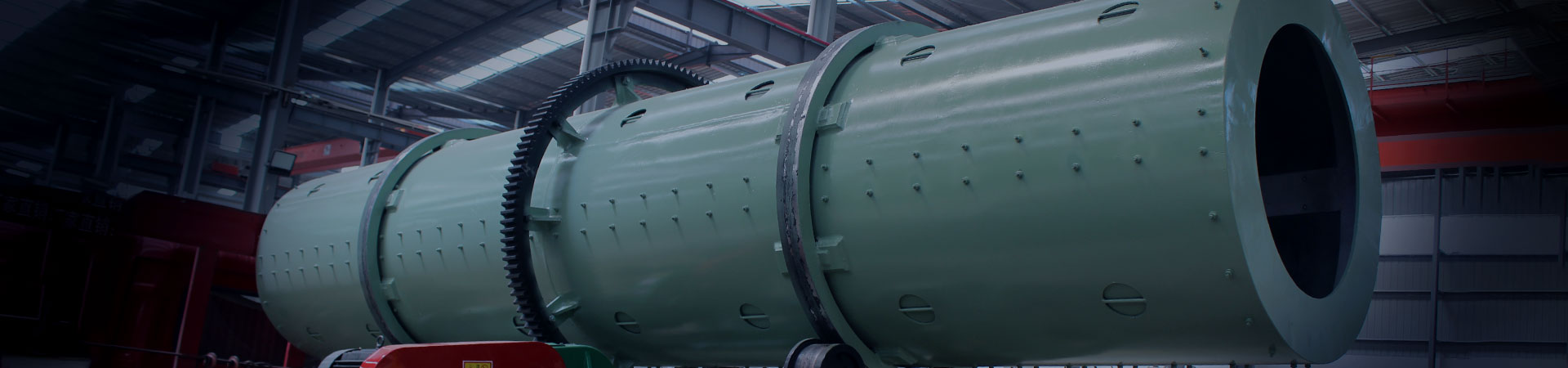
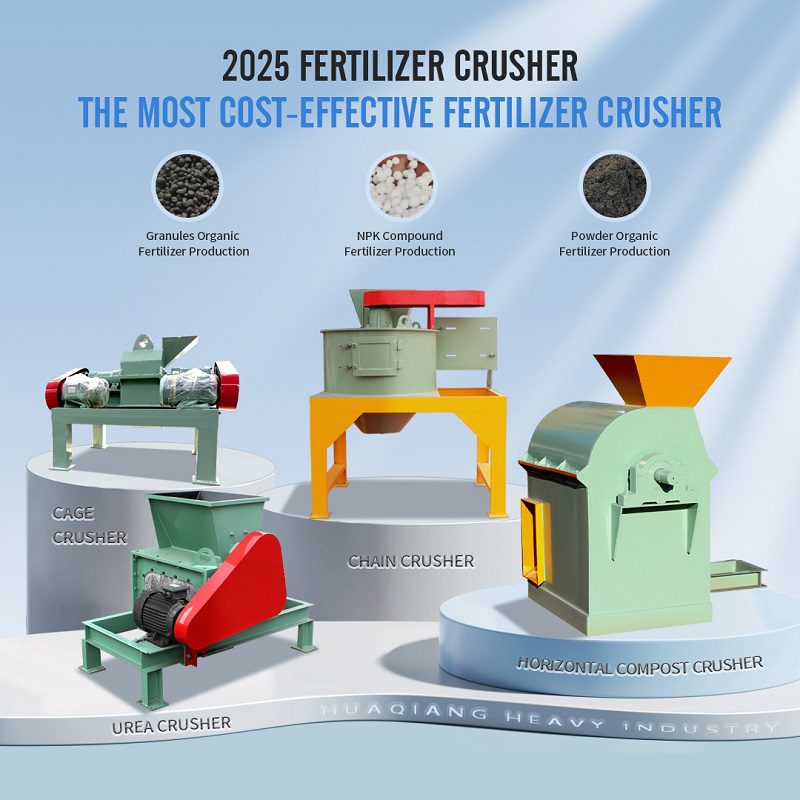
In organic fertilizer production lines, the crusher is often referred to as the “core of the first process”—its proper selection directly determines the subsequent fermentation effect, granulation rate, and even the fertilizer efficacy of the final product. Faced with raw materials of varying forms (wet, sticky chicken manure, compacted cow manure, long, thick straw), no single “all-purpose” crusher can handle everything. Huaqiang Heavy Industry’s five types of crushing equipment covering all scenarios in organic fertilizer production are designed to help users accurately match the most suitable model based on the characteristics of their raw materials. This article will break down how to choose the right “key player” from three dimensions: raw material characteristics, production capacity requirements, and process requirements.
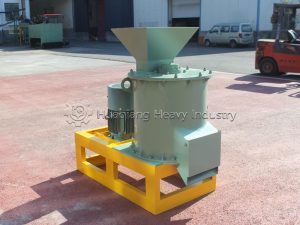
Half-Wet Material Crusher: The Nemesis of High-Moisture Raw Materials
This is the most widely used and favored model in the organic fertilizer industry, and can be considered Huaqiang Heavy Industry’s core best-selling product. It is specifically designed for materials that retain high moisture content after fermentation, applicable to a moisture content range of 25%-55%, and can be directly crushed without drying.
Suitable Scenarios: Suitable for fully decomposed chicken manure, cow manure, pig manure, mushroom residue, etc. These materials have high moisture content, making ordinary crushers prone to clogging. However, the semi-wet material crusher uses a dual-stage rotor structure and a screenless design. The material is torn into fine particles through high-speed collision and friction within the machine, preventing clogging and ensuring uniform output fineness. For newly established organic fertilizer plants, equipping them with a semi-wet material crusher can skip the drying process, significantly reducing energy costs.

Chain Crusher: The “Iron Teeth and Copper Teeth” of Hard Organic Fertilizer
When materials have formed large amounts of hard lumps after decomposition, or when the raw materials contain small amounts of hard impurities, the chain crusher demonstrates its unique advantages. It uses a high-speed rotating chain to violently impact the material, breaking up the hard lumps through impact force.
Suitable Scenarios: Suitable for fully decomposed cow manure, sheep manure, and organic raw materials that have dried out over a long period of time. Chain mills offer high output and adjustable fineness (achieved by changing different screen sizes), with a single machine capable of producing 5-15 tons per hour, making them suitable for large-scale production. However, they are less adaptable to high-moisture materials (moisture content > 20%) and are better suited for processing relatively dry raw materials.
III. Cage Mills: The “Artists” of Fine Grinding
When you need to produce high-value-added products (such as bio-organic fertilizers and microbial fertilizers), or require extremely fine finished products, cage mills are the ideal choice. They consist of two opposing rotating cages, where the material repeatedly impacts and rubs against the cage teeth, ultimately achieving fine grinding.
Applicable Scenarios: Secondary grinding of powdered organic fertilizers, pre-grinding of additives in formulated fertilizers. Cage mills can grind materials to ultrafine powders of 80 mesh or higher, resulting in more uniform nutrient distribution and more stable fertilizer release. However, they have stringent requirements for raw material moisture content (usually < 10%) and relatively high energy consumption, making them suitable for specialized fertilizer plants with extremely high fineness requirements.
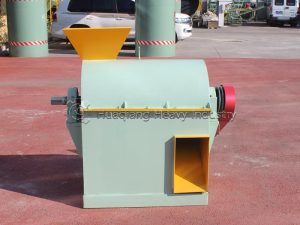
Horizontal Crusher: A Versatile Tool for Mixed Raw Materials
In production, we often need to process multiple raw materials simultaneously—manure, straw, rice husks, oilseed cake, etc. The horizontal crusher, with its unique structural design, achieves true “multi-purpose functionality.”
Applicable Scenarios: Pre-crushing of mixed raw materials at the front end of organic fertilizer production lines, especially suitable for situations requiring the mixing of straw and manure in a specific ratio. The horizontal crusher is equipped with multiple hammers and blades, capable of crushing fibrous materials and breaking up lumps. The fineness of the output can be flexibly controlled by adjusting the screen aperture size. Another advantage is its small footprint and easy installation, making it suitable for space-constrained renovation projects.
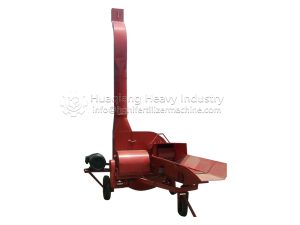
Straw Crusher: Specialized Scissors for Coarse Fiber Raw Materials
Adjusting the carbon-to-nitrogen ratio is crucial for organic fertilizer fermentation, and straw is the most commonly used high-carbon raw material. However, corn stalks, wheat stalks, cotton stalks, etc., are long and tough, making them difficult to process with ordinary crushers. The straw crusher was developed precisely for this purpose.
Applicable Scenarios: Specifically designed for processing various types of crop straw, chopping it to an ideal length of 1-5 cm. It employs a blade-type cutting structure, combined with a forced feeding device, for efficient processing of bundled or loose straw. Mixing the chopped straw with manure not only optimizes the carbon-to-nitrogen ratio but also increases the permeability of the compost pile, significantly improving fermentation efficiency.
Precise Selection in Three Steps
Faced with five types of equipment, how do you make the choice? We suggest you consider three dimensions:
Based on Raw Material Type: High-moisture compost → Semi-wet material crusher; Dry, hard lumps → Chain crusher; Ultra-fine powder requirements → Cage crusher; Mixed materials (including straw) → Horizontal crusher; Pure straw → Straw crusher.
Based on Production Capacity Targets: Small farms (less than 1 ton per hour) can choose a small semi-wet material crusher or chain crusher; medium-sized fertilizer plants (3-5 tons per hour) are recommended to use standard equipment; large production lines (more than 10 tons per hour) require heavy-duty reinforced models.
Pre- and Post-Processing: If granulation is performed directly afterward, the fineness of the pulverized material must be guaranteed (at least 60 mesh). If drying is required afterward, the fineness requirement can be relaxed to reduce energy consumption.
Huaqiang Heavy Industry: More Than Just Equipment, More Than Solutions
Every organic fertilizer plant has different raw material characteristics, site conditions, and budget. Huaqiang Heavy Industry’s five types of pulverizers covering all scenarios are designed to provide users with the possibility of “precise matching.” More importantly, we offer one-on-one customized services—whether it’s adjusting the spindle speed to adapt to special materials, adding iron removers to protect equipment safety, or optimizing the inlet and outlet interfaces according to the production line layout, everything can be tailored to your specific needs.
Choosing the right pulverizer is half the battle won for your organic fertilizer business.
The specialized crushing equipment for organic raw materials is a critical subset of the broader category of fertilizer raw material processing machinery and equipment. Once these materials are properly prepared—whether it’s high-moisture manure processed by a half-wet crusher or fibrous straw handled by a dedicated straw crusher—they are ready for the next stages of a complete fertilizer line. In a typical npk fertilizer line, after granulation, the material must undergo a series of finishing steps. The moist granules are fed into a fertilizer dryer machine to reduce moisture content to safe levels. They then pass through a fertilizer cooler machine to bring them to ambient temperature, preventing caking. Next, a rotary drum screening machine classifies the granules, ensuring only uniformly sized product moves forward. Finally, the consistent, high-quality granules are precisely weighed and sealed into bags by a fertilizer packing machine. The seamless integration of specialized front-end fertilizer raw material processing machinery and equipment with these robust downstream processors is the hallmark of a modern, efficient, and high-quality fertilizer manufacturing plant.